Which wine grape is currently most fashionable? The Pinot Noir of Burgundy? I would respectfully suggest it’s a little too widely planted nowadays for it to seem cutting edge. The Cabernet Sauvignon of Bordeaux? You must be joking. Syrah is showing some form; its Australian version Shiraz definitely not.
Let me posit the Nebbiolo of Barolo and Barbaresco. It is famously as finicky as Pinot Noir and needs a particularly propitious site to ripen. Furthermore, like Pinot Noir, Nebbiolo is good at expressing the nuances of different terroirs. But, although Australians in particular, and some Californians, are doing their damnedest to coax fair copies of Barolo out of their vineyards, Nebbiolo is very much a rarity there, as it is worldwide. And for fashionistas, rarity is an asset.
The world’s greatest concentration of Nebbiolo vines by far is in the Langhe hills south of Turin in Piemonte where Barolo and Barbaresco are grown. And the total area is increasing here because Nebbiolo wine is in such demand that many a Langhe slope traditionally devoted to easier-to-ripen grapes such as Barbera and Dolcetto is being planted with Nebbiolo.
Due north is the historic wine region of Alto Piemonte, which used to be a much more important source of Nebbiolo than Barolo but today its wines, called things such as Gattinara, Ghemme and Lessona, however sought-after thanks to Nebbiolo’s fame, are distinctly niche.
Even further north, almost in Switzerland to the north-east of Milan in the far north of Lombardia, is Valtellina – so far off the path beaten by most wine lovers that it receives scant attention but deserves much more. Not least because the style of Valtellina wines is so in tune with what many twenty-first-century wine drinkers seek: fresh, pure, expressive and mineral. The wines also tend usefully to mature rather earlier than Barolo. Oh, and they are cheaper.
Like Alto Piemonte, Valtellina was once extremely significant as a wine producer. Thanks to its position as an important subalpine trading post, it supplied vast quantities of wine to the thirsty Swiss. But once the St Gotthard tunnel and other transalpine routes were developed, it lost its special status, though not its extraordinary topography.
We almost lost our Italian specialist Walter Speller when he finally made it there, so vertiginous are the slopes on a 50-km (30-mile) stretch along the right bank of the Adda Valley, to which 2,500 km of vine terraces cling. They are often destroyed by heavy rains. Some can be reached only by funicular. The locals are hoping for UNESCO heritage status.
These are vineyards that are incredibly difficult and expensive to work. Yields are much lower than average. Whereas in the Langhe, one person can look after about 10 ha (25 acres) of vines, it’s more like 1 ha in Valtellina.
And to make life even more difficult, the average size of a vine holding is tiny. Fewer than 10 of Valtellina’s 900 vine growers own more than 3 ha (7.5 acres) of vineyard; more than half of them own less than half an acre. More than two-thirds of them are part-time vignerons, tending a little patch of vines that have been in their family for generations. Like their counterparts in Galicia, north-west Spain, farmers here like to hang on to what they’ve got. Negotiating a purchase can take decades.
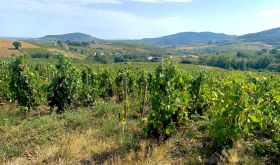
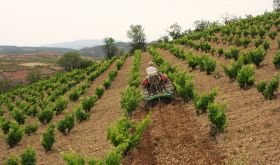
The vast majority of growers sell their grapes to one of the few wine producers of any size. Nino Negri, an ex co-op, is the biggest, now owned by the ubiquitous (in Italy) Gruppo Italiano Vini. The best-established independent producer is ARPEPE, pronounced ‘are-pay-pay’ and called after fourth-generation Arturo Pelizzatti Perego, who founded it in 1984, having thought better of having sold the old family company to GIV. Our picture above from their website shows some ARPEPE vineyards teetering above the winery.
Today ARPEPE is run by his sons Emanuele and Guido and his daughter Isabella, who told me ruefully on a visit to London a few years ago that in the 1980s and 1990s, Valtellina was virtually ignored by the powerful annual Italian wine guides, then obsessed by alcohol and oak. ‘My father was seen as ridiculously old-fashioned', she remembered, adding that they prefer old chestnut casks that have no tasteable effect on the delicate fruit of the Nebbiolo vine, traditionally called Chiavennasca here after the town of Chiavenna en route to the all-important Swiss market. Nowadays the fashionable 'Nebbiolo' is much more widely used.
Valtellina’s alpine wines are not naturally hefty. Some vineyards are as high as 800 m (2,625 ft) elevation and, although virtually all of them face due south and, angled towards the sun, can soak up sunshine during the day, temperatures often plummet at night. Until recently, therefore, the higher vines have had to really struggle for full ripeness so the tradition has been to dry some of the grapes to produce a stronger wine called Sforzato – the same technique as that responsible for Amarone from the Valpolicella zone but with fresher, lighter results.
I had a chance to taste 30 of Valtellina’s better current wines at our Valtellina Night in December, which we organised in order to try to bring these delicate wines to the attention of British wine lovers. The 100 or tasters were delighted with them, as was I. I found myself giving a score of at least 17 out of 20 to 13 of them: an unusually high strike rate. Those listed below are merely those both with a high score and imported into the UK. The only problem with these elegant Nebbiolos is that they can be difficult to find.
But one good, and perhaps somewhat unexpected, augury for a wine region that is so difficult to work is that a new generation of producers is emerging, some of them from scratch. Barbacàn, Boffalora, Cà Bianche, Dirupi, Maria Luisa Marchetti, Alfio Mozzi and Pizzo Coca are all names worth looking out for. (See also Walter's profiles of several of these in part 2 of his Valtellina report).
Valtellina encompasses a zone called Valtellina Superiore, whose wines are a little riper than regular Valtellina. And within this Superiore zone are the subzones of Sassella, Grumello, Inferno, Valgella and Maroggia, strung out along the valley like jewels in a necklace. I was particularly excited about the quality of the two wines in our tasting from the delightfully named Inferno but neither of these wines, from Aldo Rainoldi and Rupi del Nebbiolo, have UK importers, alas.
Looking at my tasting notes, I see words like ‘pungent’, ‘stony’, ‘like licking tarmacadam’, ‘rocky’ and even ‘hot rocks’. All very much in line with the popular quality of minerality, about which I wrote last week.
Recommended Valtellina wines
With UK importers and approximate retail prices.
ARPEPE, Rocca de Piro 2015 Valtellina Superiore 13%
£27 Tutto Wines
Boffalora, Pietrisco 2015 Valtellina Superiore 13.5%
£28 FortyFive10
Barbacàn, Pizamej 2016 Valtellina Superiore, Valgella 13.5%
£34.50 Raeburn Fine Wines
Sandro Fay, Carterìa Rizerva 2015 Valtellina Superiore, Valgella 13.5%
£36 Passione Vino
Sandro Fay, Ronco del Picchio 2014 Sforzato di Valtellina 15%
£50 Passione Vino
Dirupi, Vino Sbagliato 2016 Sforzato di Valtellina 15%
£60 Passione Vino
See Walter's tasting notes on a wide range of Valtellinas as well as his report on current goings on there. International stockists can be found on Wine-Searcher.com.