
30 September 2019 Samantha Cole-Johnson reports from the thick of an underripe harvest, and indulges in a little rant.
I am out of clean clothes. Every piece of work clothing I own is stiff with juice and stained. I think my trousers may actually be able to stand up without me in them. In the last four days I’ve worked 53 hours and there was no time for laundry in there. My next day off will be spent hibernating, and it might be coming up soon. Processing fruit (sorting, destemming, pressing, dumping or pumping it into tanks) will end on Wednesday. Everything will have been picked by then - and then, instead of having some interns outside running the sorting line (forklifting Chardonnay into the press, forklifting waste bins into the compost, sulfuring must, dumping destemmed Pinot into open-top fermenters, and adjusting every piece of equipment every five minutes so that it continues to hum along), we will all be inside sharing the massive amount of fermentation work.
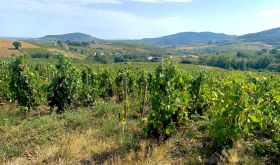
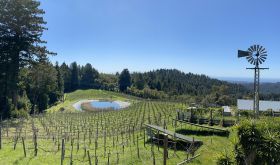
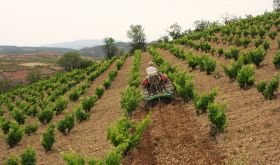
This week the vineyard struggled. Or rather, it went to bed, and our vineyard team struggled to pick as many tons as they could. As you can see in the photo top right, leaves are changing and vines are starting to go dormant for the winter. This means that nothing is getting any riper and dehydration, magnesium and nitrogen deficiency, and rot can all be a problem. Our fruit may be healthy but the biggest issues have been ripeness (relatively low sugar levels) and YANs (yeast-assimilable nitrogen levels).
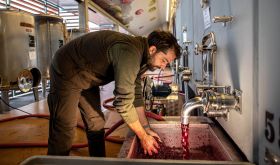
The lack of sugar is a result of the vintage and everyone will likely have that problem. What they do about it is their decision. But the local cash and carry store is out of 22kg bags of sugar, so I’m going to assume that most people are doing the same thing we are. I asked our assistant winemaker, why not just make lower alcohol wine? Her answer was that it’s not all about alcohol; the wine will feel thinner, weaker and less textured without chaptalisation. So we’re adding sugar to our ferments, as you can see below.
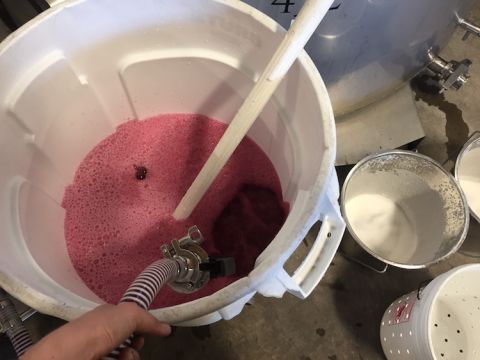
YANs are a different issue. We have a young, organic, no-till vineyard, which means it struggles to meet its nutrient requirements. And then yeast struggle because they don’t have enough nitrogen from the grapes to nourish them. So to the fermentations of some of our vineyard blocks (not all of them are deficient) we add Optiflore, an organic nitrogen supplement. It smells like the nutritional yeast you might put on salad but that smell goes away as soon as the yeast start processing it.
To do an addition, you wait until a must is fermenting. Then you either siphon must out of a barrel (because we ferment our Chardonnay in barrel) and mix it with what needs to be added and pour it back in, or for Pinot Noirs which are fermented in open-top fermenters, you attach a hose to a valve at the bottom of the tank, pump wine out into a bucket containing your addition, mix it, and then pump it back over the top of the tank.

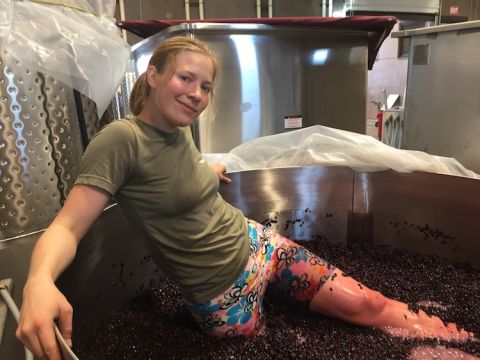
This can then lead to a pumpover, attaching a hose to the bottom valve and pumping wine over the top of the tank to homogenise the wine’s sugar, yeast and temperature. Pumpovers, without additions, are done as a regular part of cap management (cap being the floating grape skins). It helps encourage fermentation along. Another cap management technique we use is pigeage. It involves jumping into a tank full of fermenting red wine and mixing it up with your legs, feeling for hotspots and making sure that the wine’s temperature is uniform throughout. It might not seem like it, but treading wine, trying to keep your head above dangerous CO2, is quite a workout. Don’t mind me smiling in the picture. I was in a two-ton tank. I hadn’t yet progressed to the seven-ton tank.
The rest of the week was spent topping up barrels of Chardonnay whose fermentations had slowed down (to protect them from harmful oxygen), sampling the last few blocks in the vineyards, and running analysis on all the must and fermenting wines. All this while, the sorting line (below) and press hummed along, putting ever more must into our tanks.

Who does what?
Two Fridays ago, 20 September, I went sampling at contract and client vineyards, which is what inspired the lengthy rant below.
There’s something the Champenois talk about that nobody else seems to: the matter of who owns the vineyard and grows the fruit, who uses the fruit to make the wine, and who sells the wine and under what label. The Champenois have a system for making this clear on wine labels. The letters NM denote a big house that buys grapes (usually in addition to the grapes from their own vineyard holdings) and makes wine. RM is a grower making wine from only their own vineyard’s fruit. CM is a co-operative winery where many people blend their fruit and make wine and so one (you can read more about this in Jancis’s Cracking Champagne codes). But this type of arrangement is by no means unique to Champagne. Yet for some reason, no other region talks about it and so you can’t be quite sure who makes what from where unless you work in production for them or call up the producer.
Our winery has an estate vineyard. Most of our Pinot Noir comes from that vineyard; some of our Chardonnay comes from that vineyard. But we also buy fruit (mostly Chardonnay) from a lot of other vineyards scattered around the Willamette Valley. And we sell some of our estate Pinot Noir to other wineries (some of which aren’t even in Oregon!). Some producers who buy grapes from certain vineyards ferment them separately, keep them separate, and put the name of the vineyard on the label with a Burgundian-style focus on terroir. So you can tell, if they don’t own that vineyard, they bought that fruit. For us, while we ferment separately, at the end of the day some vineyards may be lacking something that another has in spades, so we blend, and forfeit single-vineyard labelling. These are pretty standard practices.
Where it gets really interesting is that we also function as a custom crush facility, and we are not the only ones who do this in the valley. Our winery is large, the idea being, when it was built, that production would grow into it. Meanwhile we have over half a dozen clients. Some of them own no vineyards. They buy all their fruit, and they do all the work for their label. They have what’s called an alternating proprietorship (AP), which declares them a bonded winery within our winery. They own their own tanks and equipment but essentially their wine label is them making wine from someone else’s vineyard in someone else’s winery.
Other clients have vineyards but no winery and no winemaking experience. They drop off their fruit, tell us what they want, let us do all the work on it, and check in once in a while to make sure that they like the results.
Some clients don’t have vineyards, winemaking experience, or a winery. They buy fruit and have us make their wine. One label doesn’t even buy fruit. Its owners come in six months after vintage, select their favourite barrels from our wines, buy them, and have them bottled. This results in a dozen different labels coming out of one winery. And during harvest everyone is trying to pick at the same time and use all the equipment at the same time. There’s a constantly changing schedule of who’s bringing in what on which day and our winemaker has a permanent headache from juggling everyone else’s needs in addition to making our own brand!