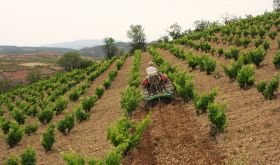
A shorter version of this article is published by the Financial Times. George Rose took this photograph this week close to the intersection of Highway 128 and Chalk Hill Road in Sonoma's Alexander Valley.
The wildfires that have cost so many lives and desecrated the northern California wine counties of Napa and Sonoma (see reports from Alder and Elaine) and their counterparts around Dão in northern Portugal and Rías Baixas in Galicia are just the most recent examples of a phenomenon that is affecting world wine production with increasing frequency. Hotter, drier summers leave vineyards and the land around them horribly easy prey to a dropped match, lightning strikes or the sort of spontaneous combustion that can arise when metal hits stone. And when the wine those vineyards produce is some of the most expensive in the world, as it is in northern California, the consequences will be widely felt, both in terms of production and tourism. Early estimates put losses in multiple billions of dollars.
Earlier this year in June wildfires reached California’s most extensive vineyard, Bien Nacido in Santa Maria Valley north of Santa Barbara. At the end of January smallholders’ vineyards throughout Maule and Itata in southern Chile were wiped out by fires started in the pine forests surrounding them that had been planted with little thought for firebreaks or emergency water supplies.
Southern French forests may be better planned, but fires have become an annual occurrence there, often threatening vines. South African winelands have become used to devastating fires every year. Two years ago one of the finest sites in the Catalan wine region of Priorat was wiped out by fire. These are only a few examples of how the legacy of serious fires is affecting wine production worldwide.
When Mark Krstic of the Australian Wine Research Institute started out in wine academe in 1996, he never expected to become an expert in how fire damages wine. Today it is his speciality, and a topic, unfortunately, of increasing interest worldwide.
Bushfires have long ravaged Australia. I was just outside Melbourne on Black Saturday in February 2009 when fire claimed nearly 200 lives and wiped out many of the Yarra Valley’s finest vineyards and wineries as well as local homes. After a period of record high temperatures, an insistent hot wind developed terrible intensity, with the desert-dry undergrowth acting as a tinderbox. The flames travelled far faster than any vehicle could.
Flying over the Yarra Valley the next day was a sobering experience. Vineyards that, in these last few weeks before harvest, should have been bright green, were dark grey. That famous Australian can-do spirit was tested to the limit among the vine growers I saw in the immediate aftermath, all of them exhausted from physically trying to stave off the flames.
Unusually hot, dry weather and exceptionally high winds was also the combination responsible for the recent northern California conflagration that blew up so rapidly that people who went to bed peacefully on the night of Sunday 8 October were woken by the smell of smoke at 3 am.
The worst concentrations of fire were initially around the popular tourist destination and wine centre Santa Rosa – reduced to a bleak ashen desert in just a few hours – and in the much less populated Atlas Peak district in the eastern hills above Napa Valley but the flames soon spread downhill to Stags Leap district, closing the Silverado Trail, the eastern artery of the valley.
According to current estimates, at least 16 wineries have been destroyed with many more suffering incineration of some buildings, but for some producers smoke rather than fire has been the enemy.
There’s never a good time for a fire to rampage through your home or workplace but fires tend to hit wine regions at the worst possible time: high summer when temperatures are peak and grapes approaching harvest. The work of Mark Krstic and other specialist researchers has shown that grapes are most affected by the effects of smoke in the atmosphere after they turn colour as midsummer kicks in and they approach harvest.
According to Krstic, grapevines are the single crop most vulnerable to fire damage, and in particular smoke tainting the resulting wine. This is because grapes are particularly prone to absorb volatile phenols in smoke that can combine with grape sugar to form compounds that, during fermentation, may release unpleasant smoky or ashy odours in the resultant wine, often intensifying, or appearing, as the wine matures in bottle.
Because the phenol compounds tend to form just under the grape skin, winemakers can try to minimise the ill effects of smoke taint by keeping the embryonic wine in contact with the skins for as short a time as possible (more difficult to do with red wines than white) and slowing reactions by doing everything at lower temperatures than usual.
Most Napa and Sonoma grapes, particularly those destined for white wine and the early ripening Pinot Noir, had already been picked before the fires but some growers and vintners still have a preference for extended hang time, particularly for the late-ripening Cabernet Sauvignon, the signature grape of the Napa Valley, so as to make super-ripe wines.
Cathy Corison of St Helena, for instance, heroine of those of us who like our Napa Cabernet to have a little freshness, structure and lift, had finished her harvest more than two weeks before the fires struck, but growers in cooler areas such as Coombsville just east of the city of Napa had not yet picked their Cabernet because the grapes were stubbornly refusing to ripen. That said, different varieties seem to vary in their susceptibility to smoke taint, with the Sangiovese of central Italy, for instance, particularly vulnerable.
Fermented grape juice, wine, is apparently less susceptible to smoke taint than grapes out in the vineyard.
As for burnt vines, of which there is no shortage in northern California at the moment, they too vary in how irrevocably damaged they are by fire. I asked Steve Webber of De Bortoli who had been my host when I visited Yarra Valley the day after Black Saturday in 2009 how well his vines had recovered from their incineration, hoping that their extensive root system had saved them. ‘We didn't have a lot of success with burnt vines', he reports with resignation. ‘Some bounced back, others not so good.’
Krstic points out that some vines are also killed by radiation. If the temperature of trees or bushes burning close to them exceeds 1000 ºC, for instance, that side of the vine will be fatally affected. Old vines, and the increasing proportion suffering from trunk diseases, are particularly vulnerable.
Sorry not to have better news.
SOME NORTHERN CALIFORNIA FAVOURITES
Sonoma resident and wine writer Elaine Chukan Brown, who was evacuated from her home, urges us to buy northern California wines to help support the beleaguered wine industry there. These are her current favourite producers of Sonoma Cabernet, which tends to be relatively good value. Tasting notes and more background in Elaine’s favourite Sonoma Cabernets .
Calluna
DuMOL (wines made by a Scot)
Enfield, Waterhorse Ridge
Laurel Glen
Scherrer