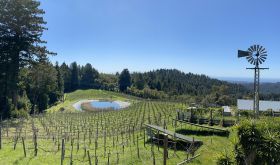
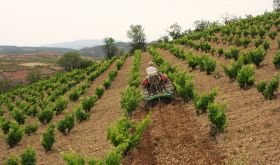
We had met initially at wine trade fairs in various locations in Asia. Until I met him I had no knowledge whatsoever of the Tannat variety and only a faint awareness of Madiran. But Alain’s robust commitment to get AOC regulations changed to permit 100% Tannat wines under the Madiran appellation got me very interested and I sought him out at any wine trade fair I was attending around that time. Of course, the quality of his wines was a powerful draw for me too.
I set out then to see if there was anyone in the Australian wine industry who might have known about Tannat or might even have given it a try in a vineyard at some stage. I wasn’t able to find anyone then – though I do know now that Symphonia Fine Wines, a small family winery in Victoria’s cool-climate region King Valley, was moving in that direction at the time and was probably the first Australian winery to release a Tannat wine. So I then started talking about the possibility of Tannat with some of my respected friends in the industry and came up with a few who were interested to hear more and would give it careful thought.
Then I asked Alain whether he thought the variety would be suitable for any particular area in this vast continent but he was not familiar with the options and he said he would come and address that question directly. So, in December 2000, we began a tour of the south-east of the continent. We began with a warmer-climate option, the Hunter Valley in New South Wales, and ended up with a cooler option, the Eden Valley in South Australia. There were various other options in between that we also investigated.
In the Hunter Valley we took the proposition to John Davis, a contact with a big portfolio in the industry including Pepper Tree, Briar Ridge and Tallavera Grove in the Hunter and vineyards in cool-climate Orange in Central NSW as well as in Coonawarra and Wrattonbully in South Australia. John was very interested and decided he would give it a try and got the project going very quickly. Not long after that, John hosted Alain’s son Clément for a vintage in the Hunter. But after several vintages and a release under the Pepper Tree label, John concluded Tannat wasn’t going to deliver the outcomes he expected and it stopped there. John says a couple of vines still survive, unlike Pepper Tree Tannat.
In the Eden Valley we took the proposition to Jim Irvine, the master of achievement with Merlot. I had thought that a splash of Tannat would add a firm note to Merlot and Jim did give that a try, but not as a varietal wine. There are still Tannat vines in the Irvine vineyard, although it is now in other hands.
Tannat does now have a place in the Australian wine spectrum as more growers in various locations – and about 35 wineries – have given it a try. It is not yet extensively grown, but it has become a regular feature in both single-variety wines and blends for a growing number of producers. In blends it is mostly combined with Merlot, Cabernet Sauvignon, Shiraz or Grenache, but I’ve also seen it blended with Sangiovese and even Tempranillo. A good indication of both the success of producers with Tannat and the geographical distribution can be seen in James Halliday’s Australian Wine Companion.
In recent years the Companion has reviewed wines featuring Tannat from 25 wineries. Almost half of them are in South Australia – five in the Adelaide Hills, three in McLaren Vale and one each in Barossa Valley, Langhorne Creek and Clare Valley. Seven of these producers are in New South Wales and I would suspect that Alain would be pleased to learn that three of these are in the Hunter Valley. The others are in the New England region, in the north of the state, and the South Coast. Victoria and Queensland each have three producers and there is one in Margaret River, Western Australia.
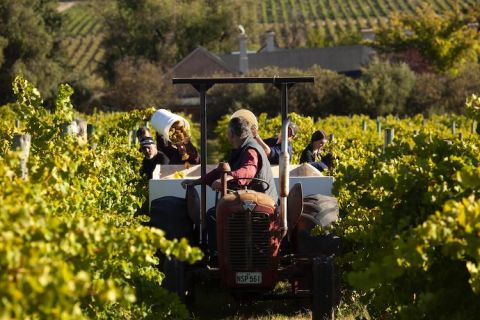
The variety is performing well, with most of the wines reviewed in the Companion scoring at least 90 points (out of 100). It is very interesting to me that the consistently highest-scoring examples are from just two producers, Boireann and Just Red, both in the warm Granite Belt in southern Queensland. Another strong performer, Toppers Mountain, is not so far away, in the New England region of northern New South Wales.
While in Australia Alain also conducted tastings for wine critics and importers or distributors. But selling Tannat wines, when it was totally unknown there, was a hard call. Now, however, the uptake of locally produced Tannat wines has directed wine drinkers’ interests to the source of the variety, and Madiran wines are beginning to win a place in the Australian market.
The fact that Tannat has been adopted by Australian producers in such a short time frame underlines the openness of Australia’s regulatory system to change as well as the productive creativity of grape growers and winemakers. There is no official regulation of the use of specific varieties in specific locations and this permits a huge range of options to deal with challenges such as climate change. A long time ago I decided to keep a record of the number of grape varieties that I have found in commercially available Australian wines, whether as varietal wines or in blends. The total on my list stands at 244 – so far!
Experimentation with different varieties to better match the changing climate conditions has also been greatly encouraged by the Australian Alternative Varieties Wine Show (AAVWS)* which has now been running for 20 years.
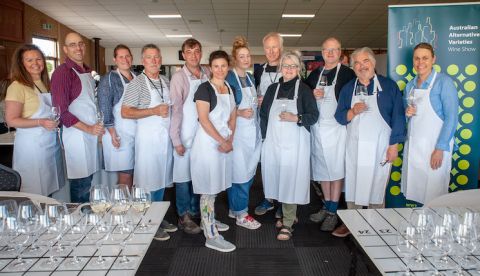
Another variety that is still not particularly well known in the local market but through its performance in the AAVWS very recently is emerging as another strong contender is the white grape Savagnin, most commonly associated with Jura and originally misidentified in Australia. Coolangatta Estate’s 2010 Savagnin won three of the 18 Best in Category trophies awarded at the 2019 AAVWS including, most impressively, the award for Best White Wine.
There are many other quirky exotic variety stories in Australia but perhaps the most colourful glimpse of varietal diversity has to be the David Franz Red Rosé. The winemaker is Dave Lehmann, son of Barossa Legend, Peter Lehmann. His wines are all released under the David Franz label – David is his first given name and Franz his second. He opted not to use the Lehmann name on his brand so nobody could claim he was cashing-in on his dad’s reputation.
The Red Rosé is a delightful wine, made in tiny quantities, now around 200 dozen per vintage, but it was a mere 25 dozen when I first encountered it, accidentally, a couple of decades ago. He actually started out making wine using the fruit on a clutch of unusual vines in the family’s nursery vineyard. These vines were never picked for the Peter Lehmann wines because the focus was totally on the better-known varieties in the main vineyard. When David came back to Australia from a long tour of Europe after graduating from university (not in oenology, by the way) he asked his father if he could get into winemaking and was ordered by Peter to start out working solely in the vineyards. Peter’s view was that if you don’t understand what goes on in the vineyard, you’ll never make good wine as it all starts there.
The David Franz Red Rosé is a very serious wine. I opened a bottle of the 2008 Red Rosé recently with some friends who know their wine and they were amazed at how expressive and bright it still is. Few expect a rosé to age, of course.
The key feature of this wine is that it is made from 108 different grape varieties, both red and white. The base is still always the Lehmann family nursery vineyard but over the years other families in Barossa have donated the fruit from their exotic vines, sometimes only a couple of bunches, to add both volume and more diversity.
It seems like a long time ago that Australian vineyards were dominated by a handful of international grape varieties.
*In his 2010 book The Future Makers our correspondent Max Allen wrote:
‘The show was conceived by vine nurseryman Bruce Chalmers, vine specialist the late Dr Rod Bonfiglioli (then working for Chalmers) and celebrity chef Stefano di Pieri, whose restaurant in the cellar of the Mildura Grand Hotel was then – and is still – one of Australia’s great dining experiences.
‘Bruce had been encouraged to import dozens of non-mainstream grape varieties a few years before by Phil Reedman, the wine buyer for UK supermarket, Tesco. "You’re a boring mob," Reedman had railed at Australian grape growers in general. "Why don’t you plant more interesting varieties than Chardonnay and Shiraz?"’
Further reading: Australia's ongoing infatuation with Italy by Walter Speller