Our cellar is relatively small. There is room for about 2,500 bottles in double-depth racks round three sides of a windowless chamber maintained at a steady 13 °C. I’d love not to be using energy to keep our beloved bottles in good condition, and envy those living in European cities where subterranean storage is a given. But we live on the top floor of a London building that’s less than 10 years old. No chance of a proper cellar that stays cool naturally.
The floor space in front of the racks in our wine-storage space – as perhaps it should be called – is just 1.65 m2, a small area that tends to be heavily stacked, with all sorts of boxes and carriers of wine and various foodstuffs as this room doubles usefully as a larder. (The Cotswold cellar of my FT predecessor Edmund Penning-Rowsell also doubled as a larder but his ran to two spacious rooms, both truly underground and effortlessly chilly.)
All of this preamble is a rather pathetic attempt to explain why I managed to overlook a carton with two extremely exciting wines in it for five months. It had been delivered by Pierre Lurton, the president of two of Bordeaux’s most famous wines, Chx d’Yquem and Cheval Blanc, and his wife, the wine writer Alexandra Forbes, pictured below at Ch Marjosse. On arrival last May, it was promptly covered by many other boxes.
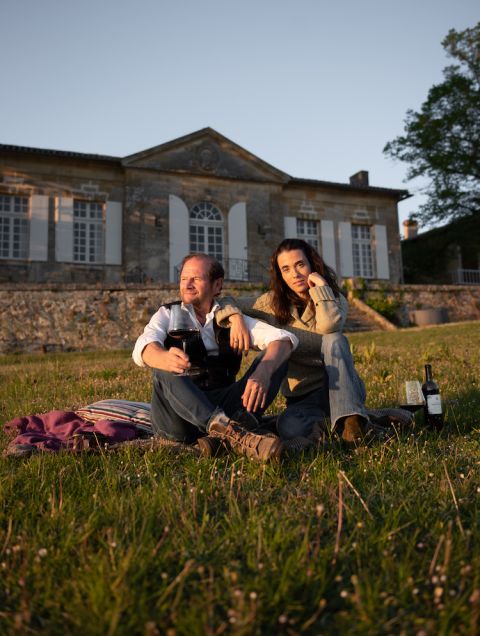
What I can say is that the wines were worth the wait. They are made at Ch Marjosse, Lurton’s personal wine farm near Grézillac in the far north of the Entre-Deux-Mers region south-west of St-Émilion, about 12 km (7.5 miles) as the crow flies south of Ch Cheval Blanc. Lurton started out with just 11 ha (27 acres) of vineyards in the early 1990s but has been gradually extending his vine holdings so that they now comprise a total of 41 ha (101 acres), including some particularly old vines.
Until recently, serviceable but not outstanding red AOC Bordeaux and white Entre-Deux-Mers blends were all that Ch Marjosse produced but since 2017, the team, led by recently hired technical director Jean-Marc Domme, has been experimenting with much smaller lots of wines based on the best combinations of vine variety and individual plot. It was two of these that I finally tasted recently and I was bowled over by them.
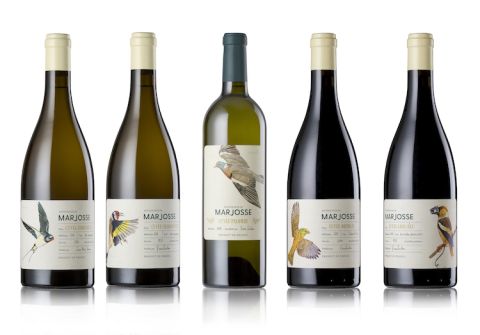
They’re branded Anthologie de Marjosse and most of the eight in the range are named after a bird pictured on the recently redesigned label. The first I tasted was Cuvée Palombe, a startlingly rich white based on 45- to 70-year-old vines named after a pigeon. The blend is a third each of Sémillon, Sauvignon Blanc and the more perfumed Sauvignon Gris but seems to me to be dominated by the lovely beeswax and lanolin flavours of fully ripe Sémillon, a grape variety more often encountered in sweet white bordeaux. (Though admittedly, because selling Sauternes is such a struggle nowadays, more and more Sémillon is being made into dry wine in that sweet white wine region.)
I originally tasted the wine at room temperature when it seemed almost fat, until a nice cooling breeze of Sauvignon Blanc blew across my palate on the finish. The wine benefited from being restored to the cellar before I tasted it a second time, when it was, again, such a welcome and characterful contrast to the technically perfect Sauvignon-dominated style that has become typical of Bordeaux Blanc.
Cuvée Palombe comes in a tall, straight-sided bordeaux bottle and carries the Bordeaux appellation so its origins are pretty clear. But if you were to come across the other wine in my carton on a shelf, you would be hard-pressed to work out where it came from. Cuvée Ortolan 2019 is labelled Vin de France and comes in a (too heavy) sloping-shouldered burgundy bottle. It’s based on 25-year-old Cabernet Franc vines grown on what must be a particularly propitious plot of clay-limestone, the typical soil-type of Bordeaux’s right bank.
Cabernet Franc, parent of Cabernet Sauvignon and in Bordeaux frequently regarded as inferior to it, is associated with a powerful perfume that I tend to describe as ‘pencil shavings’ and the wines are not usually especially full bodied. This offering in the Anthologie de Marjosse range is not the most typical Cabernet Franc, having been aged half in demi-muids and half in concrete, but is almost irresistible in its winning combination of freshness and ripeness, admittedly made in a pretty warm vintage in Bordeaux. It has great intensity and roundness so that it’s already a delight to drink, the tannins exhibiting the ‘cashmere’ quality that I remember Pierre Lurton touting at Ch Cheval Blanc as long ago as 2005. This Cuvée Ortolan is named after the rare, tiny birds that are regarded as an (illegal) delicacy and apparently nest in the forests around Ch Marjosse. I was subsequently able to taste the 2018 vintage of Cuvée Ortolan and can vouch for its outstanding quality too.
No one could enjoy the finest, classic wines of Bordeaux at their mature apogee more than me, but I can’t tell you how delighted I am to see increasing evidence of new sorts of wines coming out the Gironde department. The Anthologie range, which includes wines based on other traditional Bordeaux grape varieties, Malbec, Muscadelle and three Merlots from adjacent plots, also includes an incomer from Burgundy, Chardonnay, a sop to Forbes who is no great fan of stereotypical dry white bordeaux. They’re priced at over £30 a bottle by their UK importer Jascots but that seems fair enough to me. Thirty pounds doesn’t go very far in the bordeaux fine-wine market and these wines are arguably much more distinctive than most bordeaux selling at this price level.
But Marjosse is not the only source of such innovation. By coincidence, at the same time as discovering the hidden duo from Marjosse I was sent a very similar range of new wines based on superior plots of single grape varieties by négociants Dourthe. Funnily enough Dourthe’s collection of three new bottlings, devised by their R&D ‘Lab’ and named Les Parcellaires, also includes one based on Sémillon and one on Cabernet Franc. Sémillon 54 2020 is so-named because the vines were planted at Ch Rahoul in Graves way back in 1954. This all-Sémillon wine is a little livelier (and of course younger) than the Cuvée Palombe 2019, perhaps partly because a third of the wine was aged in fashionable amphorae, as all clay vessels whatever their shape are called by wine people now, to the disgust of classicists. (See this thread on our Members' forum.)
A whole two-thirds of Les Parcellaires La Gravière Cabernet Sauvignon 2020, another wine from Ch Rahoul in Graves, was aged in amphorae, resulting in an energetic version of this varietal. Less impressive to my mind is the rather skinny Peykem Cabernet Franc 2020, named after a plot in Ch Reysson in the Haut-Médoc. But the trio is not overpriced: €132 from Dourthe’s own website for a case of six bottles of any one of them seems reasonable for a spotlight on individuality in Bordeaux. Only 2,500 bottles of each have been produced.
Bordeaux was long known as a region famous for blended wine, the idea being that growing Cabernet Sauvignon, Merlot, Cabernet Franc as well as perhaps a little Malbec and Petit Verdot offered vintners some insurance in a variable climate that often prejudiced flowering or ripening of a single variety. Now that summers are much warmer, single-variety wines are presumably easier to produce than they once were. Not that Petrus and Le Pin, Bordeaux’s most expensive wines, seem to have suffered from being 100% Merlot.
Where to find these new bordeaux
Anthologie de Marjosse, Cuvée Palombe 2019 Bordeaux Blanc
£35.58 Jascots at Home*, €27 Vignobles et Châteaux in St-Émilion
Anthologie de Marjosse, Cuvée Ortolan 2018 Vin de France
£31.40 Jascots at Home*, 1,141 Ukrainian hryvnia Goodwine (the company that writes such touching Letters from Kyiv)
Dourthe, Les Parcellaires Sémillon 54 2020 Graves Blanc
€132 for six bottles La Cave de Dourthe
Dourthe, Les Parcellaires La Gravière Cabernet Sauvignon 2020 Graves Rouge
€132 for six bottles La Cave de Dourthe
*Jascots at Home is operated by on-trade supplier Jascots. The £20 joining fee is donated to Hospitality Action.
The Dourthe wines are currently being shipped to importer Champagnes and Châteaux USA. The Marjosse wines are imported into the US by Wineberry, XXI Wines & Spirits and Heidelberg.
Tasting notes in our database. See this tale of a tasting of Chx Cheval Blanc and Yquem, at which I had to keep Pierre Lurton awake by jabbing him with chopsticks.