Murray Paterson of the viticultural consultancy Vinifera Services sends the following report on the 2009 grape harvest in Marlborough, where he estimates as much as 40,000 tonnes of New Zealand Sauvignon Blanc, a sixth of the crop, may have been left unharvested.
Some fine wines will be made from a challenging but good season. I've seen outstanding flavour in all our three main varieties (Sauvignon Blanc, Pinot Noir and Riesling) with some good, but also a lot of mediocre, Pinot Gris.
Weather
The season started well, with many fewer spring frosts than has been common over the past four to five years – perhaps we're coming back to 'normal' (whatever that is) weather patterns?
Initiation in the 2008 spring was hot and dry and the floret formation this spring was also done in very good conditions. We also started the season with a high water table thanks to the winter rains. In turn fertilisation was good this year as well. There were some problems with Pinot Noir as it flowered during a cooler week (with some rain) but most varieties flowered in almost perfect weather. A happy confluence of events for the vines.
In mid February 2009 we experienced a 25 mm rainfall and this was followed by another of 40+ mm some days later. February was also very warm, with several days over 35 deg C. The upshot of this was the start of a severe botrytis infection – which proved challenging for the remainder of the season. March was very dry (< 15 mm rain), allowing us to keep on top of the botrytis and April was also dry, until 40-50 mm of rain fell at the end of April, but by then temperatures had dropped so botrytis infection had slowed and there was very little damage.

Yields
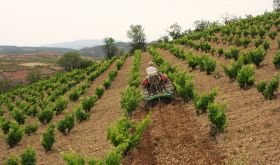
The result was that the potential tonnages were huge (Bob Campbell MW took this picture of one of the mechanical harvesters on which the region depends at Oyster Bay last month). In Sauvignon we would normally expect 50 to 55 clusters a vine with 78 berries a cluster. This season, thanks to the 'happy confluence' detailed above, we had a mean of 90 clusters with a mean of 110 berries. The rain immediately prior to the Sauvignon flowering topped up the soil moisture and there was no water stress over flowering to set – the result (with the heat) being that the larger flowers were fertilised as well as the smaller ones. The long term average berry weight is 1.8 g (Sauvignon) and we are looking at this being 1.95 g. I weighed clusters in mid April that were 318 g! (The long term average is 145 g.)
Although it doesn't apply regionally, one client and I discussed, at pruning, the future of the industry. We decided to reduce his bud number by 25% (three canes rather than four). He doubled his historically highest tonnage to a potential yield of 35 tonnes per hectare. As he was expecting 13 tonnes initially thanks to the reduced bud number, this came as … a surprise.
With the world financial crisis, the major wineries got together and effectively decided to crush only 170,000 tonnes of Sauvignon – the volume they believe they can market in the circumstances. To achieve this they enforced (for the first time), stringent yield restrictions and fruit quality parameters. In general this was 12 tonnes per hectare (for Sauvignon). At the same time they reduced the price to NZ$1,700 a tonne from last year's NZ$2,400.
The estimate – in January – was for a regional production of 200,000 tonnes of Sauvignon plus 40,000 tonnes of other varieties. We have a processing capacity of about 200,000 tonnes – this allowing the wine companies the security of knowing that Coles/Woolworths/Tesco couldn't come in and buy large volumes of fruit and have it processed (as they are doing in Australia).
With these restrictions in place, much very heavy fruit thinning was done – and this was followed by even more thinning to reduce the botrytis incidence. Indeed the client mentioned above in the end harvested about 9.5 tonnes per hectare – a little less than was likely in January.
The weather and the heavy thinning of the botrytised clusters has meant that we have harvested some superb fruit. I suspect that there will be a subtle change in the flavour profile of Marlborough Sauvignon wines.
Volumes soar, prices plummet
That subtle change in flavour may be favourable for the US market – and of course the UK market which appears to prefer the greener/cat's pee style will be catered for by some makers' harvesting early. Styles such as the Grove Mill Sauvignons (which have always had more mid-palate depth) may well become more characteristic of the region.
There has been a huge speculation in vineyard planting in Marlborough. In spite of misleading official figures from the Wine Institute (or perhaps because of them), planting has risen to between 25,000 and 26,000 ha. Though not all of these vineyards are in production yet, the impact of those vineyards coming on stream almost guarantees an annual increment of 20,000 tonnes of Sauvignon.
By 2011 – if not one extra vine is planted from now – I foresee over 240,000 tonnes of Sauvignon as being our 'average' harvest with 6,000 to 7,000 ha in the Awatere Valley (95% Sauvignon) cropping lower than the Wairau at say 10 t/ha and 20,000 ha in the Wairau Valley (90% Sauvignon) cropping at 12 t/ha. The pressure is now on for all those speculative vineyards – many of whose owners used to process their fruit and sell to the starved wineries at $NZ6.50 a litre. Suddenly they have no market – and that is this year. The indicator is the spot price. In 2008 it was $3,200 a tonne and currently (if you can sell it) it is $500 a tonne.