It's funny how new ways of looking at wine can come from the most unlikely directions. Mexico is hardly at the forefront of the wine world, but it was a Mexican who recently refreshed my entire outlook on the liquid that has inspired my working life.
Hugo D'Acosta is himself rather inspiring. He was introduced to wine while studying agriculture in Mexico City, then studied winemaking at Montpellier and Turin, returning to Mexico in 1983. The Mexican wine scene of the 1980s, dominated by big spirits companies with less than half a heart in vineyards, was not a natural fit with a young man fizzing with ideas and he soon took off again, 'to California, like a wetback', as he puts it. He absorbed even more working in the Napa Valley for celebrated winemakers Cathy Corison and Tony Soter and finally returned to Mexico, initially working at Santo Tomás, with L A Cetto and Domecq one of the three big wineries in Baja California in the far north west of the country, where 90% of all Mexican wine is produced. There he established strong links between wine, travel and the spicy local food, helping to establish Ensenada as the gastronomic capital of Mexico.
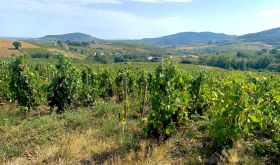
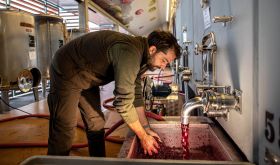
In 1997 he decided to start his own winery, Casa de Piedra, in the Valle de Guadalupe, a dry, sandy valley less than 100 km south of the American border and, crucially, open to the cooling influence of the Pacific that is here so dramatically cooled by the Humboldt current. This is what makes the valley a suitable wine region but what sets D'Acosta apart is what he has done for it. With his architect brother Alejandro, he has set up a winemaking school in a local village, a simple adobe building strengthened by such unexpected recycled objects as bedsprings and empty wine bottles, in order to give the locals a way of supporting their own families in an economically deprived area. Local trainees establish ownership of their barrels with a red wine handprint on each. They can vinify their own grapes, buy grapes from other growers or buy grapes from D'Acosta's own vineyards. The result has been a flowering of interest in wine in Baja California generally, where there are now about 4,000 hectares (9,880 acres) of vines and nearly 40 wineries (the industry was dominated by just three until the late 1980s).
But the significant aspect is how local and grounded it all is. 'Young people are getting interested in and proud of Mexican ingredients and with them Mexican wine', D'Acosta told me on a rare visit to London earlier this year. 'But we need to be very careful to make better and better wines at good prices so as to give a solid foundation to the next generation. This is not just a fashion. It's the first time that winemakers are actually winery owners, even if half of the wineries produce fewer than 25,000 bottles each. At first we thought we had to export, but then we realised that the most important market is Mexico itself. We don't want to become a slave to California.'
You will be getting a picture by now of a very committed and innovative producer and it was typical of this spirit that he brought over to London for me to taste 22 of what he thought were the best wines from 'Baja', as it is known, many of them made by his neighbours. They were highly individual, very varied yet uniformly direct in their appeal, and obviously artisanal (which is not in this case a shorthand for prone to faults).
But it was while tasting the first wine, one of only two whites, Casa de Piedra, Emblema Sauvignon Blanc 2008 Valle de Guadalupe, a searingly tart, deeply individual, bone dry, vibrant, unoaked, thoroughly un-New Zelanad Sauvignon, that D'Acosta used an expression that brought me up short. 'We make "context wine",' he explained. 'This wine is specifically to be drunk with our great local fish.' (Thanks to that Humboldt current, the seafood here is so exceptional that Aeromexico now has a direct overnight 'tuna flight' from Tijuana to Tokyo.) He does not mean context as it is sometimes used, in the sense of the drinking context which can add so much to the experience of enjoying a wine, but context in the sense of where a wine is produced. 'To make wine in context you have to participate as little as possible, but try to be part of the vineyard. If you want to be part of the context, you have to start learning what is around you. For example, to make wine in France, you need to buy a baguette – no? Only then do you start to be part of the context, by trying to be part of the movement of the place.'
I was tasting with Simon Farr, D'Acosta's UK importer and collaborator on a joint-venture wine, a hearty red blend Estapor Venir, made at the wine school and named after the pueblo where it is located. Farr's company Bibendum Wine has been involved with winemaking projects all over the world and he obviously recognised 'context wine' as a growing phenomenon. 'It's true that anglo-saxon winemakers had a tendency to go in to wineries and try to control everything, to do it their way', admitted Farr. 'That was ok 20 years ago, but now it's just not appropriate.'
It is my contention that making wine according to a recipe externally imposed from a distant boardroom may well be most expedient for branded wines. But as the world's wines become increasingly polarised between brands destined to be the commercial footballs of the big retailers and wines that really do have their own story to tell, 'context wines' will become increasingly understood and valued.
More and more consumers will realise that true wine appreciation rests not in evaluating a glass of wine in isolation, awarding points according to its performance against some notional objective paradigm of wine quality, but in learning as much as possible about where, how and why it was produced. If wine drinkers are prepared to go part of the way to meet the wines they drink – rather than treating them like supplicant actors in a brief audition with the implicit 'go on then, impress me' – then there will be real encouragement for the world's wine producers to offer us a broader and broader range of styles, sensations and stimulations. Who knows? We might even learn something.