Making And Moving Wine Without Modernity: Illahe Vineyards’ ‘1899’ Pinot Noir
It begins with draft horses. Next come bicycle-powered pumps, then a stagecoach, then canoes. By the time bicycles deliver the wine, Illahe winery has not only created a sustainable wine but reinvented a complete cycle from production to distribution that predates electricity or mechanized shortcuts. Sustainable certifications may litter many a bottle’s back label. Illahe too flaunts their environmental accreditations as much as anyone. But beyond being earth-friendly, winemaker Brad Ford manages to keep one grape-stained foot in the scientific present and the other in a slower past. Illahe’s ‘1899’ Pinot Noir recreates a time when winemaking was hard work that latched its maker not only to their land but to the challenging network that shipped and sold wine.
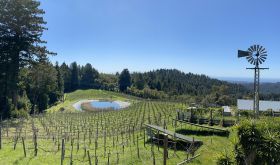
Even the name ‘Illahe’ (pronounced Ill-Uh-Hee) means ‘earth’, ‘soil’, or ‘place’ in native Chinook. That place sits smack dab in the middle of Oregon’s Willamette Valley: one hour’s drive south of Portland and a mere twenty minutes west of capital Salem. It runs up an eighty-acre, south-facing slope of clay, first planted in 2001 by Brad’s dad and now hosts sixty acres of seven varieties with Pinot Noir dominating fifty-nine of them. Their three-story gravity flow winery, and rain catch, allow no new-fangled electricity or gas for production (although the winery has solar panels). Brad even crafts his own clay fermenters from scratch.
Illahe’s hand-printed, hand-applied labels show off a quilt of sustainable plaudits. One, the LIVE (Low-Impact Viticulture and Enology) certification program demands a ‘whole-farm and whole-winery approach to sustainability. The entire property, including non-grape crops, landscaping, building operations, labor practices, even packaging must be managed to LIVE standards’.[1] Illahe also ties in LIVE’s Salmon-Safe certification, which protects water quality and restores watershed health and habitat.[2] They are also members of Oregon’s Deep Roots Coalition, (humbly referred to as ‘drc’), which argues that, ‘wine should reflect the place from which it emanates: its terroir. Irrigation prevents the true expression of terroir. In most cases, irrigation is not a sustainable method of farming’.[3] Thusly, Illahe proves their ongoing adherence to sustainability.
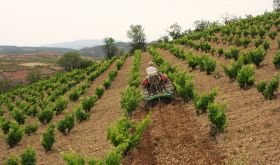
Illahe’s farming blends ancient methods, like selection massale, dry farming, hand pruning and green harvesting after veraison, with modern sustainable standards, such as cover crops, minimal sulfur sprays, and leaf pulling. But more indicative of their sustainability is the lack of any machinery in the vineyard. Instead, two Percheron draft horses, Doc and Bea, pull an Amish mower to cut the cover crops and, at harvest, transport grapes to the winery in short totes or five-gallon buckets.
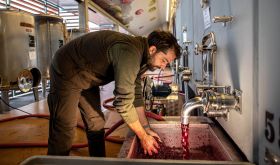
Once the horses bring in the grapes, the human appendages get to work: hands sort, destem or dump grapes into a feet-powered bicycle destemmer, which then pumps grapes into open wood fermenters, where foot stomping or manual punch downs begin. Native ferment carries through a ten-day soak. Instead, hands press must with a wooden basket press, then the bike pumps wine into barrel, where malolactic conversion carries on without inoculation. Later, horses Doc and Bea transport the wine to age in their 200 case cave. After two years, hands bottle the wine without gas, add cork, wax top and the letterpress label. Illahe’s ‘1899’ Pinot Noir never touches dry ice, canned nitrogen, enzymes, stainless steel, forklifts, packaged yeast, electric pumps, or filters.
But many sustainable wineries attempt variations of the above. What makes Illahe’s ‘1899’ the most sustainable wine is what comes next. They put the wine in a mule-drawn stagecoach, which carries it to the river. Then, finally, they float 96 miles in canoes up the majestic Willamette River. After four days they reach their distributor, Casa Bruno, in Portland, who carts the wine to warehouse with cargo bikes. Even the distributor’s sales representatives, I hear, are instructed to bicycle the wine to tastings with prospective buyers.
Illahe’s process may seem inefficient and impossible on a large scale. However, by keeping small, stripping away modernity and nullifying carbon concerns, as Brad sees it, ‘historical winemaking slows down the process, makes it more romantic, it also gets you involved with the materials you’re using’.[4] But beyond production, Illahe renders distribution, an oft forgotten but deep damage to the environment, sustainable as well. For $65 you and your wine glass can time travel over 150 years to when only human hands (and a few livestock hooves) helped make and deliver our wine.
Bibliography
Image: Illahe Website ‘Illahe 1899 Expedition’, Sunday, 12 August 2018
Deep Roots Coalition, ‘Main Page’
Illahe, Website
Illahe, ‘Illahe 1899 Pinot Noir’ video
Kovatch, Kristen, Horse Nation, Horsing Around The World, ‘Horses, Historical Winemaking & A Pinot Noir’s Epic Journey Illahe Vineyards’, 16 March 2017
Salmon Safe, ‘About’