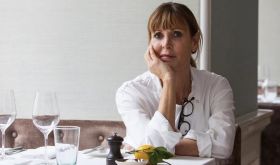
Today in New York a memorial is being held for Peter Max Sichel, a great man of wine and much else, who died earlier this year at the age of 102. He had a cousin, also called Peter Sichel, who was a great man of wine in Bordeaux and died tragically early, in 1998 at the age of 66. Peter Allan Sichel (as he was called to distinguish him from Peter Max, creator of Blue Nun and CIA operative) was equally wise and humane. His annual reports on the latest Bordeaux vintage were admired all over the world. Always smartly dressed and extremely polite, Peter Allan Sichel, pictured further below, wore his considerable knowledge lightly and had a nicely quiet, quizzical outlook on life.
In the late 1980s his sister died and he took his brother-in-law on a soothing trip to Collioure on France’s westernmost Mediterranean coast (see this World Atlas of Wine map of Roussillon). On the way back they decided to follow a straight line back to England, which soon took them through a tiny, remote village called Cucugnan at the southern limit of the Corbières appellation, fortunately well south of this year's terrible fires on the Corbières Massif. He was so struck by the quiet beauty of the wild countryside here, and could see that such vines as there were produced wine with real character, that he decided to buy land and plant his own vines.
He eventually bought a little bergerie (shepherd’s cottage) where he would come to get away from the demands of his busy life in Bordeaux. But he didn’t live to see his wine, a Corbières eventually sold as Château Trillol, enjoy much success. In fact the landholding has been a drain on the finances of the Sichel wine enterprises now run by his five sons. They kept on investing in the project because their father loved it so much, but always at a loss.

Alexander Sichel (above), eldest son of Peter’s eldest son Allan, had an idea, however. Like many of the sprawling Sichel family, he had been brought up in the wine village of Margaux so was no stranger to vineyard work, and did a basic wine course at Bordeaux university. While studying at Oxford Brookes, he’d interned at a winery in Bordeaux’s Entre-Deux-Mers region and also at Moss Wood in Margaret River, Western Australia. His first full-time job was, of course, with the family firm, selling Sichel wines initially to restaurants in Bordeaux and then, from 2014 to 2018, in the US.
A shorts, T-shirt and small-town kind of guy, he did not find trailing round wine stores in Los Angeles especially congenial. When driving me to Cucugnan this summer, he recalled having his seminal idea on a flight from Oklahoma to LA. He then tasted a range of old vintages of Trillol and was impressed by the potential. ‘I felt I owed it to my grandfather to continue his work. It took me two years from that thought to writing out a plan. I submitted it to the family in September 2018, expecting them, if they liked it, to put it into action. Instead, they approved it and handed the whole thing over to me.
‘At that time we’d tried everything with Trillol and couldn’t fall any further. The only way was up. Though thank God I’d already proposed to my wife [a Bordeaux labour lawyer].’
Thus was born Domaine Peter Sichel, a potentially risky enterprise run entirely by his idealist grandson and five Cucugnan locals. His not entirely original idea is that wine is an expression of place, that Cucugnan is a very special place, and his job is to transmit its character in a bottle. ‘It’s some of the best terroir in the Languedoc and my mission is to express it.’

The first thing he did was to decide not to use the Corbières appellation, a particularly extensive one that varies from the tame flatlands of the north to a craggy, geologically fascinating landscape of green oaks overlooked by the ruined Cathar castle Quéribus in the south, which looks as dramatic as the Scottish highlands. Here, tiny Cucugnan, surrounded by mountains in a protected, biodiverse natural park, is only 8 km over the hill from Roussillon’s vinous hotspot Maury.

Sichel now uses IGP Cucugnan on his labels, in some ways a throwback to the 1960s, when, he assured me, this little village of 130 inhabitants was producing 1.5 million litres of wine a year. Presumably viticulture then was pretty unsophisticated because his second decision was to dramatically shrink the domaine’s total vineyard area from 45 ha (111 acres) to a more manageable 13 ha (32 acres) that could be tended with care by the small available workforce and protected from local wild boar and bears by electric fences.
The climate here is extreme, too dry and windy for the usual vine diseases to be a perennial threat. The isolation is part of Cucugan’s magic – as well as Sichel’s biggest challenge. ‘If we need a tractor part, for instance, we have to drive all the way to Perpignan. You can lose days that way.’ He was pleased to read the wine historian Roger Dion’s observation in Pascaline Lepeltier’s recent book Mille Vignes (Hachette 2022, translated as One Thousand Vines) that France’s most respected wine regions owed much of their fame simply to being located on trade routes.

Another decision he took was to withdraw his wines from the Sichel sales network and build the domaine’s reputation himself. He admits he made a few mistakes with his first vintage, 2019, but feels he really got into his stride in the small, workmanlike cellar outside the village with the 2022s. ‘Everything just clicked’, he said. Last year he was finally admitted by the extremely punctilious biodynamic certification body Biodyvin, whose members have to submit their wines for approval as well as proving their ecological worth. Last November he was invited to show his single-vineyard Syrah at a smart wine dinner in Paris alongside a Jamet Côte Rôtie, a near-mythical Syrah from the Rhône. And then last January Domaine Peter Sichel was made ‘discovery of the year’ by France’s principal wine magazine La Revue du Vin de France. Clicks indeed.
Next year he is confident that the domaine will finally make a profit, for the first time in nearly 40 years – about the same financial trajectory, he pointed out, as that followed by Château Palmer, the Margaux classed growth, after his great-grandfather bought it, with other families, in 1938.
He also pointed out that his grandfather Peter was particularly interested in value in wine, and that it had been his idea to establish a Sichel winery in the unloved Entre-Deux-Mers (where Alexander is currently transforming 1.5 ha (3.7 acres) of vines on limestone into a rather winning red bordeaux called Ocha) to take advantage of what the best growers there had to offer. I couldn’t help wondering what Peter would have made of Bordeaux’s current travails.
Alexander admitted, ‘I get quite emotional when I think about my grandfather. I was 10 when he died and we spent a lot of time together in Margaux. In my next life I look forward to meeting him and talking about wine for hours and hours.’ A portrait of his grandfather hangs above the printer at Domaine Peter Sichel.

Domaine Peter Sichel’s wines
All IGP Aude, Pays de Cucugnan.
Montanha 2024 12.5%
Light, fresh, mountain, ‘infused’ Grenache from Cucugnan vinified as whole bunches. Raspberry juice?
£18 Harrods
Cucuniano 2022 13.5%
Harmonious, complex, savoury blend of Syrah, Grenache and Carignan from vineyards around Cucugnan. The domaine’s principal product.
£20 Harrods, £25.50 Berry Bros & Rudd
Roussanne Vieilles Vignes 2023 12%
80-year-old vines on the almost-hidden second site north-west of Cucugnan. Concentrated herbal, floral perfume. Low acid but lots of character. Rich food wine.
£28 Harrods, £38 Berry Bros & Rudd
Triby Syrah 2023 12.5%
Youthful, gentle, ripe, oaked single-vineyard Syrah with a leathery finish. Very clean and fresh. From a 19-year-old vineyard, planned by the late Peter Sichel, at 350 m.
£30 Harrods for the 2022
Petite France Carignan 2023 12.5%
Miraculously luscious Carignan from a steep, 35-year-old vineyard opposite the winery at 450 m.
£37 Berry Bros & Rudd
Terre Rouge Grenache 2023 14%
Unusual high-elevation Grenache from a vineyard originally planted by Peter Sichel himself on the domaine’s second site an hour’s tractor ride north-west of Cucugnan at 500 m. Much darker, denser and more structured than the Montanha bottling. Persistent flavours of strawberry compote.
£41 Berry Bros & Rudd
For tasting notes, scores and suggested drinking dates, see our tasting notes database. For international stockists, see Wine-Searcher.com. Image at the top of this article is © Vinyara.
Back to basics
| Why aren’t Languedoc wines better known? |
|
The Languedoc is a vast region stretching from west of Carcassonne to east of Nîmes and almost as far south as Perpignan. Inevitably it has an enormous variety of appellations (none of them desperately famous), grape varieties and terroirs, which makes it difficult to get to grips with. Historically it has been dominated by co-ops, which were vital at one point, not least because their hundreds of members wanted to grow vines rather than make wine, but have not proved good at sales and marketing.
There is now a handful of big companies in the Languedoc such as Gérard Bertrand and Grands Chais de France which do their best but the most interesting producers are tiny, often isolated, family-owned enterprises such as Domaine Peter Sichel. The best of them make some of the best-value wines in France with really interesting flavours and terroir influence, but most of their effort goes into producing rather than selling.
The main appellations are sparkling Limoux; Minervois, Corbières, St-Chinian, Faugères, Terrasses du Larzac and Pic St-Loup making mainly red blends of Syrah, Grenache and Carignan; and white La Clape and Picpoul de Pinet. More common, and generally inexpensive, is varietal IGP Pays d’Oc that can come from anywhere in the Languedoc or Roussillon, the wine region to its immediate south. |