When Hemmingway spoke about love between two people transcending death he was not thinking about an old adobe bungalow surrounded by twisted vines, cats, chickens, dogs, and the odd artist in Maipú Mendoza, but as I think back and remember what I saw there I certainly am. Two people in love may only have eyes for one another but when they harness that love in a shared project, we all become beneficiaries.
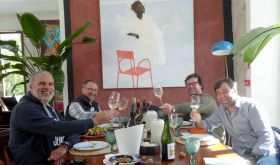
Eduardo and Emilia Armando de Soler (pictured above) are the couple behind Ver Sacrum, the sustainable wine label which began when they and a group of friends enjoying asado were inspired by a sublime bottle of Spanish grenache; the ten (later only three) decided there and then to reintroduce Mediterranean varietals back into Mendoza, largely replaced by Malbec in the 1950s. Today there are a mere 27 hectares of grenache in Mendoza province, when Ver Sacrum began there were 22.
Eduardo and Emilia are, like most Argentinians, robustly attractive but they are also endowed with intellect and a deeply sincere love of nature. The philosophy behind Ver Sacrum really is the beat to which they order their lives. Eduardo with his Robert-Powell-as-Jesus eyes is a bona fide mountain man who spent his former life manning ski slopes and running outdoor adventures. The erudite slender Emilia is a whip smart corporate lawyer who now happily resides amongst the vines and gardens; she is the brains behind the brand’s detailed and meaningful art nouveau aesthetic and it was her who came up with the Ver Sacrum name.
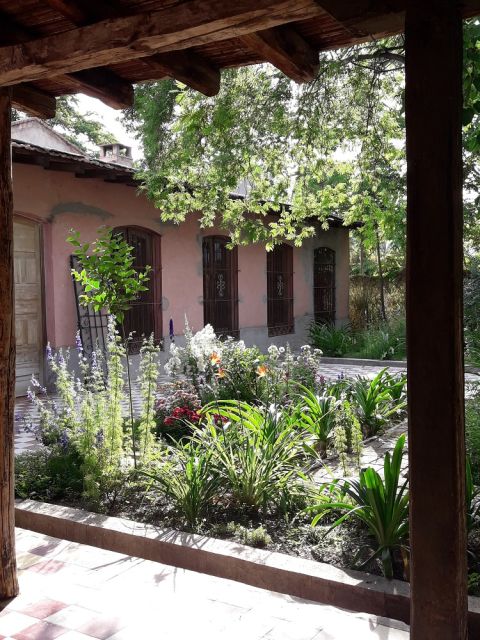
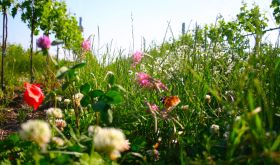
The adobe house in which Eduardo and Emilia live still bears the scars of the last earthquake in its cracked and repaired baked mud walls but it no less magical for that. The land is farmed organically, they are eight years into certification (it takes ten) bio diversity is hugely important to them and this is blindingly obvious not only from the rich plant life but the never ending parade of animals that accompany your every exploration (dogs are to Argentina what sacred cows are to India). The property is defined by its wide open courtyard and movingly beautiful false pepper tree (schinus molle), with it tumescent trunk and vast canopy it dapples the light and bestows a deep shade on the vines whilst providing shelter for the eagles that serve as useful predators for the migrating parakeets that gorge on berries. Emilia cultivated this secret garden and it serves as the perfect habitat for the myriad of bees and rich insect life that enjoy residence in this magical place. Biodiversity corridors encourage insect migration and weeds too are positively encouraged, these are mowed when water competition becomes an issues, the resulting waste an ideal vineyard mulch. The two of them even customised a special brush to get rid of the weeds close to the trunks.

Old houses in Mendoza province are rare because of intense seismic activity. In 1861 an earthquake of 7.2 on the Richter scale killed 4,300 of the then 12,000 residents. Mendoza sits at the foot of the Andes, where the Pacific Oceanic plate and the South American Continental plate overlap so most of the houses on the wide colonial vistas are low level to withstand tremors. It seems drama everywhere in Argentina, even the humble rubber plant is transformed to the most incredible beast of a tropical tree visible in every Mendozan square. The condor bird, a relative of the vulture grows to the size of a ten year old child.
The name Ver Sacrum may be familiar as the title of a radical Viennese successionist magazine at the end of the 19thcentury; the centre piece of a movement of artists that pre-dated art nouveau but informed its development and obsession with organic forms. The original meaning (sacred spring) refers to an ancient pagan right reputedly practised by post bronze age indo-europeans, Greeks and then the Romans as they strove to populate new lands in Spring by sending young adults out in small groups armed with a nothing but a few vines, supplies and the potency of youth.
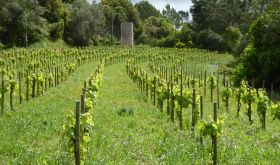
Not long after Ver Sacrum was born Eduardo was told of an eighty five year old man living near their home in Maipu who was in possession of a hectare and a half of ancient grenache and a hectare and a half of grenache and Mourvèdre mixed, planted in 1947 under an olive grove and left untended for a decade. This supplied the fruit for their first two vintages, 2013, 2014 and when Don Carlos died and the vineyard was lost, they used cuttings and cloned the grapes at the house where they have a nursery. The newly purchased virgin plot, bought with the two asado friends 3,700 foot up in the Uco valley at Los Chacayes was the beneficiary of these precious clones.
Being desert Mendoza does not require the spraying of fungicides on anything close to a European scale; the air is crisp and bone dry, rainfall is approx. 200 mm a year. Ver Sacrum do not use weed-killers in any of the plots and only use Bordeaux broth for fungal control when absolutely necessary; some funghi is accepted here. Problems are treated on a needs basis there is no prophylactic approach.

The biggest issue is water, ants and the recently evident vine moth (lobesia botrana) that is rumoured to have crossed the Andes from Chile in 2010 but is actually a European species. Precision viticulture is applied in earnest when addressing these moths, pheromones being released at exactly the moment the vine moths are spotted with the aim of interrupting the mating cycle and preventing the subsequent caterpillar formation within the clusters.
Water is assiduously preserved and nothing is wasted, from the taking of baths to the washing of barrels, everything is reused and plans to further refine this system with a filter that will allow absolute purification of tainted water are afoot. Water is finite and comes from Andean meltwater still for the most part transported by channels dug by early settlers and indigenous peoples who farmed the area before. Drip irrigation is installed at the Uco Valley site which is about as high tech as it gets for Ver Sacrum.
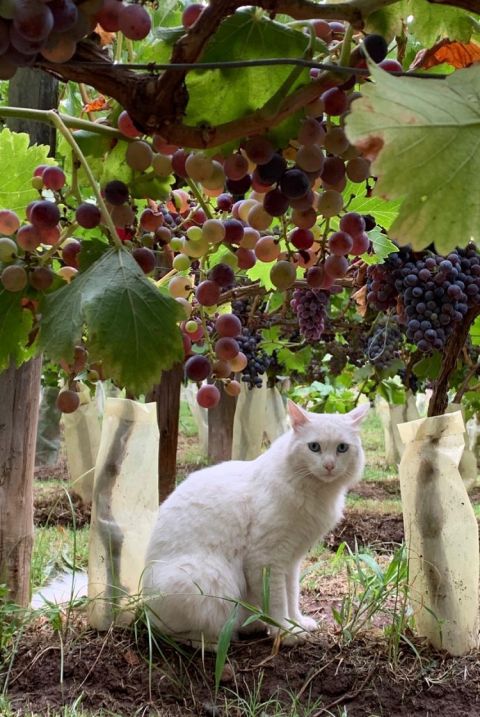
All of the vines are hand tended and there is a tiny family of staff who tend them as well as Eduardo and Amelia themselves. The embryonic vineyard manager, not yet twenty, is also home grown, the grandson of a local respected viticulturalist, Ver Sacrum is funding his training and it is he that tends the vines together with a family that live onsite at San Martin. Eduardo and Emilia very much want to nurture an intimate understanding of the vineyards in their workers, the idea that you share the walk of the vines with a second or third knowledgeable eye is very appealing.
A lack of mechanisation amounts to a significant reduction in CO2. They use a borrowed horse to till the rows, Eduardo wants to get their own but Emilia is rightly worried about the gorgeous garden she has cultivated (let’s face it the horse would scoff the lot). They’ve already got six dogs, countless chickens, 5 cats, a handy eagle and a few local visiting raptors.
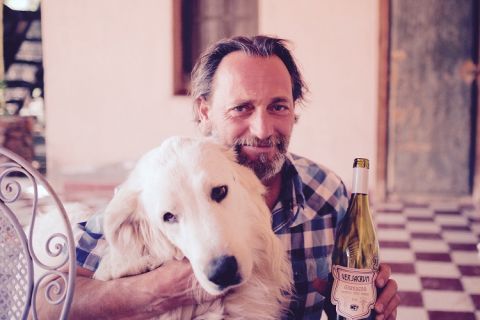
The beautifully individual art nouveau labels are all printed with green ink, the bottles are the lightest they could afford and the Diam corks they used are Origine made with beeswax, double the price but they have made this investment out of principle. The cardboard for the boxes is recycled.
The winemaking is unusual too, reds best served slightly chilled and are noticeably paler and lower in alcohol; hand harvested, slightly early (23 brix). Concrete eggs are used, Eduardo makes his reds like a white wine without the skins during fermentation and a touch of semi carbonic before. The purest expression of the grape is the aim, no tweaks, no additions. This is mostly to do with the philosophy but also because there is no money for technology. No pump overs, a hundred and ten-year-old basket press and high-quality fruit, it goes without saying that the yeast is indigenous.
Seventy percent of Argentina’s huge wine output is based in Mendoza and Eduardo is one of the growers who is leading the march toward sustainability and holistic change which he says has to take place; everyone from the suppliers of stoppers to packaging to transport, the wine shop, the power provider, everyone has to be part of this seismic shift. He says that the Argentine wine industry is an example of how all players, even competitors can work together and that there is a huge shift toward sustainable farming which the government is backing financially, organised by COVIAR. 2030’s plan is dominated by rules on sustainability but the larger growers with deep pockets and smaller growers with a hands-on approach are best placed to make changes, for the squeezed middle. Initial change is costly and labour intensive and cash flow is a problem, hyperinflation and COVID bring additional pressure.
There is a market imperative here. Ninety percent of Ver Sacrum’s sales are in the US where sustainability is not a new trend, there are wine shops, restaurants that will only stock wines with the right credentials and Eduardo says in these outlets Ver Sacrum occupies prime space. For him and Emilia, sustainability touches everything from the people they employ, to operating on fair trade principles, promoting education, opportunities for employment and giving back to the community in which they live. It is a huge web which he likes to divide into three steps, sustainable farming being the first, the second is organic and the third is biodynamic. Ver Sacrum is nearing the second stage, the ultimate goal being the passing of the project into younger more Spring-like hands.