From €14.67, 18.90 Swiss francs, $21.95, CA$29.99, 199 Danish kroner, £21.95
As you can tell from many articles here about Grenache and Garnacha, most recently Grenache and Garnacha redesigned, I’m a big fan of what you might call the new style of these varietals, emphasising sweetness and transparency rather than concentration. Those who make them successfully often cite Ch Rayas, the iconic but hugely distinctive Châteauneuf-du-Pape, as their inspiration.
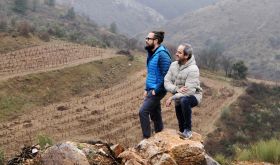
I was delighted therefore to find that a red 2019 from a newish Sardinian wine producer was just this sort of wine. Antonella Corda, pictured below with her husband Christian Puecher, is a Sardinian wine producer with a history. Her mother Maria is the daughter of Antonio Argiolas, who did so much to put the wine of this beautiful Italian island on the map. The famous viticulturist died at the age of 104 and doubtless inspired his granddaughter to study agronomy. He also left her two of his most prized vineyards not far north of the Sardinian capital Cagliari.
Antonella Corda began to work with the family’s 15 ha (37 acres) of vines and 12 ha (30 acres) of olive trees in 2010 and by 2016 was producing her own bottled wine, rather smartly packaged. According to Puecher, the constant wind off the sea is an important factor influencing wine quality here. She also makes white wines from Vermentino (included tomorrow as one of my recommended winter whites), the local Nuragus and an ageworthy IGT Isola deli Nuraghi blend called Ziru.

But it was the Cannonau (the name used for Garnacha by Sardinians, who claim their island is the birthplace of the variety) that I was moved to score 17.5/20 with this tasting note:
Pale ruby. Gorgeously sweet, fresh nose of unadulterated Grenache/Garnacha. Beautiful balance and freshness with some rose-petal aromas and a little saline bite on the end with a light suggestion of some fine sandy tannin. (Off to the beach then?) This definitely belongs in the group of the most-winning examples of this grape. So gentle, refreshing and, despite the alcohol, pure and ethereal.
The Cannonau comes from Antonio Argiolas’s Mitza S’ollastu vineyard on the outskirts of Ussana just north of Cagliari in the south of the island. Antonella Corda replanted the Cannonau in 2012 on drought-resistant 110R rootstock, which helps control Cannonau’s natural vigour.
The vineyard is an old river bed with an unusually (for Sardinia) high percentage of pebbles, which help drainage and encourage the roots to delve deep for water. Antonella has apparently observed that the more pebbles there are, the better-balanced the vines, which have been spaced 2.2 x 1 m, so 4,545 plants per ha (1,840 per acre).
Initially the vines were Guyot-trained but now that they have achieved balance and there is no danger of them producing too much wood at the expense of the canopy, the wires have been removed and they grow ad alberello, as bush vines, thereby reducing yields. Each vine provides between four and six bunches so a maximum of 1.5 kg (3.3 lb) of fruit per vine. The Antonella Corda vineyards are being converted to organic farming and 2021 will be the first fully organic harvest.
She describes 2019 as ‘one the most beautiful ones we have done’. Leading up to the harvest, alternating sun and rain resulted in small berries with concentrated flavour and sugar, partly thanks to evaporation. This encouraged Antonella to pick the Cannonau much sooner after the Vermentino harvest than usual and, even so, the resulting alcohol is 15%, the highest ever known – but the wine certainly isn’t heavy or hot. (Nuragus is generally the last to be harvested.)
The grapes were hand-picked and given a cold soak at 10–12 °C for no more than 24 hours before fermentation in a special tank called Tecnogen Eureka that is filled only two-thirds full. The carbon dioxide given off by the alcoholic fermentation pushes the cap down. Once the valves open, the cap quickly re-emerges on the surface. This allows for an extraction of the pulp from the skins without totally destroying the skin but simply ‘pushing’ the juice out of the grape skins without any mechanical pressure. Halfway through fermentation, a délestage is done. Then after fermentation is a week’s maceration cooled by dry ice. After the racking, the skins are gently pressed. Malolactic conversion is completed in stainless steel. After this, between 15 and 20% of the wine is aged in non-toasted small François Frères barrels for at least six months while the remaining wine ages in tank. The two components are then blended together and aged further in tank before being bottled and spending at least four months in bottle before the wine is released on the market.
The 2019 is currently available in the US, Belgium and from many British independents according to Wine-Searcher.com. Best price in the UK seems to be from Exel Wines. But Walter also loved the 2018 (17/20 and this enthusiastic tasting note), which is available at prices from just under €15 a bottle in Germany and also, at increasing prices, in Italy, Austria, Switzerland, the US, Canada, Luxembourg and Denmark.
I thought this wine was delicious now but, although the tannins are far from emphatic, it has too much character and integrity to be a fly-by-night. I suggested a drinking window of 2020 to 2025, pretty much the same as Walter suggested for the 2018. Antonella has apparently recently tasted a bottle of her 2016, which she reports was still ‘definitely young after four years’, so we may even be underestimating the ageability of this wine. Certainly I don’t think you’d be disappointed drinking it any time during the first half of this decade.