
'One of the greatest vintages in Austrian history.' This upbeat assessment of 2011, just coming to a close, comes from Josef (Pepe) Schuller MW, founder and managing director of the Austrian Wine Academy and recent chairman of the Institute of Masters of Wine, after he had joined Willi Bründlmayer's team to pick Riesling in the Heiligenstein vineyard near Langenlois in Kamptal.
Schuller's passing comment to Jancis came on Friday, the same day as the official harvest report from the Austrian Wine Marketing Board (AWMB), in my opinion one of the best generic wine promotional organisations around. As with all bodies whose main role is promotion, they are inclined to focus on the positives but if Schuller is right, then perhaps the Austrians didn't need to resort to air brushing this year.
2010, by contrast, has been described as 'the year of challenge' in Austria, including rain and cold during the flowering season, rain in August, cool and damp in September and wet weather at the end of October, such a crucial time for the top-quality Rieslings, dry and sweet. The result was a harvest 14% lower than average, following the very short vintage of 2009. Which is why the producers are particularly relieved to have in 2011 not only a healthy harvest but also a generous one: 2.45 million hectolitres in the cellar, a massive 41% up on 2010, and this despite the volume reduction caused by hail and frost damage in some regions.
This year the weather was far kinder: 'Even though there were cold winter temperatures, frost damage at the beginning of May, a dry period in July and even some hailstorms, there was still plenty of optimal weather to be had. The beautiful flowering period led to a good fruit set, and the sunny and warm weather of late summer delivered a good ripening phase. The continuous lovely weather conditions allowed for the luxury of choosing a harvest day according to the ripeness sought, and of "waiting it out" periods if desired. This resulted in a varied and long harvest – for example, by the beginning of the main harvest period on the Wagram, already the first bottled young wine from the Seewinkel in Burgenland was on the table. Thanks to the dry weather, there were very few fungal diseases. There was some heavy wasp infestation in a number of regions.'
The main concern, mentioned several times in the regional summaries below, seems to have been potentially low acidity levels, making canopy management and accurate harvesting times particularly critical.
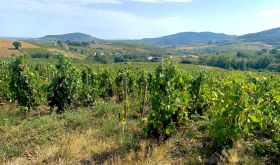
Here's the AWMB's round up of the regions. (The photo shows vineyards in Leithaberg, Burgenland.)
Burgenland
The weather here was similar to that in other wine-growing areas. The earlier-than-usual flowering and harvest dates as well as good weather conditions allowed for well-planned work without any of the stress that was so prevalent last year, when the danger of rot had propelled the harvesting to be undertaken in the shortest time possible.
There were some problems with regional dampness and winter frosts, the cold at the beginning of May and the hailstorms on 23 June – which hit 1,600 hectares very hard. But the sunny and dry weather nurtured the healthy, undamaged grapes that were brought into the cellars. Because of the acidity, however, good nerves were required for optimal maturation to be reached. The harvest here was status quo with an estimated 715,200 hl – up 54% from last year. This is just as pleasing as the wine quality itself: firm fruitiness and pleasant acidity accompanied by – in the red wines – a distinctive deep, dark colour.
Niederösterreich
Taking into account the varied conditions in the different regions during the year – frost and hail, for example – an average volume of 1.5 million hl is estimated. The Weinviertel and the Thermenregion are showing volumes lower than their long-standing averages (Weinviertel down 9%; Thermenregion down 3%). Throughout Niederösterreich, wasps were a very disturbing element for the grape pickers as well as for the wine quality. In fact, some of the harvest was completed early because of wasp damage. Otherwise, the acidity became the main focus, as warm temperatures sparked a partial rapid decrease – to achieve just the right balance between physiological ripeness and good acidity backbone.
Steiermark
This year, the Steiermark was favoured by the weather. There was little frost and, even despite some hail damage, the average volume increased by 19% in comparison with the five-year average. The estimated 226,600 hl reflects a 28% increase over last year. Because of the early and relatively short flowering period, also the harvest began somewhat early and was completed rather quickly in order to 'catch' the right acidity and sugar content. The main harvest was over by mid October, and good leaf management brought fruity and full-bodied wines.
Wien
The hailstorm on 4 June is now a bad memory for the vintners of Döbling and Stammersdorf. Damage and yield loss were left in its wake. Nevertheless, Vienna boasted very good quality and a yield just slightly below the long standing average. As in other regions, the work in the vineyards determined the high gradation and acidity content. A multi-faceted selection of fruity and bodied wines is expected.
I'm looking forward to finding out if Pepe Schuller is correct.