21 may: My apologies. In my haste to fly off to Washington DC for 24 hours to preview the 3rd edn of the Oxford Companion at Book Expo America, I must have set this article for members only. Sorry to have caused confusion all round. DC looking very beautiful and I had the great pleasure of meeting Terry Theise and the celebrated ex restaurateur Karen Odessa Piper for the first time there.
See tasting notes for ratings of 66 Brunello 2001s
See tasting notes for ratings of 66 Brunello 2001s
The Sesti family, who planted their vines near the Tuscan town of Montalcino in the early 1990s, celebrated Easter 2001 with a platter of warm hard-boiled eggs, anchovies and wine round the fire at six o’clock in the morning. This had nothing to do with an early mass and everything to so with the sub-zero temperatures which had threatened their embryonic 2001 harvest the night before. They had spent the moonlit night setting fire to bales of straw and then creating a protective blanket of smoke over the vines by pouring water on them. Their vines escaped serious frost damage even if some of their neighbours were less fortunate. Apart from this everything went pretty well for Brunello di Montalcino in 2001, the vintage just released.
If you are a Brunello di Montalcino fan, think of buying some 2001, rather more classically styled wines than the super-opulent 1999, because this may be your last chance for three years. Rain devastated the 2002 and 2005 vintages while the heat of 2003 resulted, as in 2000, in many unbalanced wines, particularly in the hotter southern part of the zone. Producers are very thrilled by 2004, and 2004 Rosso di Montalcino, the more accessible little brother of Brunello, is also worth investigating.
Brunello di Montalcino is not a wine to be trifled with. It is the single most famous, highest-priced Italian red produced south of Milan. Often retailing at well over £30/$50 a bottle, it is a potentially magnificent expression of Sangiovese grapes (known as Brunello here) ripened in southern Tuscany where the extra warmth and open slopes can give it an intensity, vibrancy and longevity rarely seen in the wines made in Chiantishire to the north. Brunello has long been the jewel in the crown of many an Italian wine list.
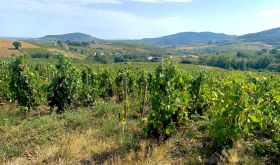
But much has changed recently in the prestigious Montalcino wine zone encompassing a greater variety of terroirs than one might expect for a virtual square 10 miles across. In the last 20 years plantings have doubled to almost 2,000 hectares (5,000 acres) while the amount of Brunello bottled has doubled in the last 10 years with an unprecedented amount currently maturing in even more cellars than ever. In 1990 there were just 87 producers of Brunello. Today there are 200.
The wine used to be predictably and majestically solid and, for many more years than the statutory minimum of five before it can be released, relatively unapproachable. It was a wine that positively demanded to be left alone. And it was not necessarily particularly deep-coloured, with Brunello made from vineyards in the higher, northern zone in particular being quite high in nervy acidity.
The other day I tasted 66 new releases of Brunello di Montalcino 2001 ferried over to London in an attempt to charm British buyers and found the proportion of wine that deviated from this traditional style even greater than when I had tasted the 1999s a couple of years ago.
But it is not just the wines that have changed. The market has too. The many new investors in the zone must be kicking themselves that demand in Germany, Switzerland and the US for great Italian wine has shrivelled in line with the German economy and the dollar exchange rate against the euro just when there is more Brunello to sell than there ever has been.
Not only have many of the old peasant growers become wine bottlers themselves, the zone has seen a great influx of investment from outsiders – people like the Canadian couple who have established themselves just next door to another outsider, Piemonte’s most famous wine producer Angelo Gaja at San Restituta. Under the awkwardly-accented name Máté, they – typically – are also growing varieties other than the classic Sangiovese.
A special new denomination has been created, Sant’Antimo, for wines made within the Montalcino zone from vines other than Sangiovese – although so far it has been used mainly by the American-owned Castello Banfi, the giant of Brunello built on the fortunes of importing Lambrusco into the US and, disastrously, initially predicated on an imagined thirst for a sweet, light white called Moscadello di Montalcino.
When Banfi arrived in the south of the Montalcino zone in the 1980s they pioneered a ‘commercial’ style of Brunello made more obviously for the American market than for Italian and German-speaking traditionalists for whom the great, decades-old vintages of Biondi-Santi or the super-savoury wines of Gianfranco Soldera at Case Basse represent the acme of Brunello di Montalcino. Today it seems as though the majority of new producers are seeking to make a richer, darker, more approachable style of Brunello than the long-term classicists.
A major ingredient in this new recipe has been the French oak barrique. In the old days Brunello had by law to be kept for 42 months in large old oak tonneaux but this requirement has been systematically relaxed so that today Brunello needs only to spend two years in any sort of oak, as small and flashy in its effects as the consulting oenologist suggests. Many of the deeper, lusher, sweeter wines I tasted seemed to owe some and sometimes much of their character and colour to small new oak barrels.
I’d say a good third of the Brunello di Montalcino 2001 bottlings tasted closer to an archetype of modern red wine than to anything even particularly Tuscan which seems a shame. Those whose 2001s struck me as particularly over the top in terms of oak, extraction and/or ripeness were Corte Pavone (despite organic practices in the vineyard), La Fornace, La Mannella, Mocali, Pietranera, Podere Bellarina and Santa Lucia.
The current global tendency to produce similar wines all over the world is undoubtedly dangerous, but in Montalcino there are – as in Bordeaux – examples of obviously ‘modern’ wines that are very competently made, a pleasure to drink and will appeal to those whose palate and brains are uncluttered by any notion of great traditional archetype. Among these I would include, for the 2001 regular Brunello bottling specifically, Frescobaldi’s CastelGiocondo, Cupano (a new, organic, French-run property in the far west of the zone), Fanti and Siro Pacenti.
The best, more classically styled wines I tasted in this array of regular Brunello di Montalcino 2001 bottlings were from Agostina Pieri, Fattoria Barbi, Capanna, Caparzo, Ciacci Piccolomini d’Aragon, Collemattoni, La Fortuna, Fuligni, Il Poggione, Poggio di Sotto, Salvioni, Tenuta di Sesta, Sesti, Silvio Nardi (Manachiara bottling), Talenti, Tornesi, Uccelliera and Villa Le Prata.
The even better 2001 Riservas will be released only next year, and there were a few regular Brunello 2001s that tasted as though they were the rejects from a superior wine rather than a great wine themselves – which they should be at current prices. Many producers, such as Gaja and Soldera, are yet to release their 2001s but now is a good time to take your pick of the wines that managed to escape the frost.
See www.winesearcher.com for international stockists and see tasting notes and ratings of 66 Brunello 2001s.