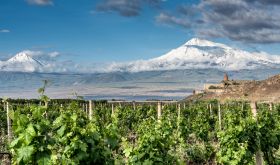
While the wine world shakes its head in disbelief at the prices of red burgundy, it’s worth considering in detail some of the best Pinot Noirs produced outside Burgundy.
In my experience there are legions of really well-made, varietally recognisable Pinots out there – see Back to basics below. But those familiar with the most convincing (and annoyingly elusive) red burgundies may find these substitutes wanting. Good non-Burgundian Pinots are typically delightfully pure and fruity with no excess of oak but they can lack what I might call the ‘grunt’ of the best red burgundies. Red burgundy can easily be disappointingly tart or, in recent hot vintages, unrecognisably sweet but the best have a depth of flavour, a complex undertow that may be attributable to particularly senior vines and/or a terroir effect that is more satisfying than the majority of alternatives. And they generally improve in the glass, often – wild generalisation alert – being more impressive at the end than the beginning of the tasting experience, whereas simpler Pinot Noirs are often all about aroma rather than development on the palate and persistence.
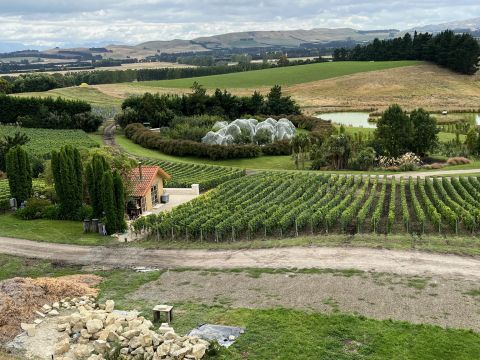
This set me thinking about non-Burgundian producers of Pinot Noir that, in my opinion, can offer some of the thrill of a really good red burgundy. Rippon of Central Otago springs to mind. This long-established family estate on the ultra-scenic shores of Lake Wanaka was a pioneer of biodynamic viticulture in New Zealand. The wines take time to evolve and understand but they have long been more captivating than most. Valli’s Central Otago Pinots also reward cellaring, as do Kusuda’s from Martinborough/Wairapa, and the Burgundy-inspired Pinots of Bell Hill in North Canterbury, pictured below (NB limestone), are magical.
The state of Victoria has Australia’s longest history of making complex Pinot Noir, with Bass Phillip, a Gippsland estate initially planted in 1979 with Cabernet Sauvignon and switched to the Burgundy grapes in the mid 1980s, having attracted the compliment of being acquired by Jean-Marie Fourrier of Gevrey-Chambertin, no less. Bindi and Curly Flat have demonstrated the potential of the Macedon Ranges in high country on the other side of Melbourne.
In South Africa, some of Master of Wine Richard Kershaw’s Pinots are getting there. He’s seen below, commanding one of the Cape’s cooler landscapes.

Oregon established itself as America’s Pinot Noir state, building on foundations laid by David and Diana Lett in the 1960s at The Eyrie Vineyards, and Eyrie’s Pinots are still Oregon’s closest to the Burgundian prototype. The whole ethos of the cooler state’s burgeoning wine culture was built on the fact that it was ‘not California’, but California has its own fascinating Pinot Noir history with some surprisingly burgundian wines despite ostensibly seeming too warm for this notoriously fickle, early-maturing grape variety.
In the wooded Santa Cruz Mountains south of San Francisco, on the hill that is now occupied by Mount Eden Vineyards, Martin Ray produced some serious still Pinot Noir as early as the 1950s, based on plant material from Burgundy imported by sparkling-wine producer Paul Masson.
But in at least one way the most influential producer of burgundian Pinot Noir was a Yale history graduate who went on to row for Oxford in the Varsity Boat Race, Josh Jensen. He became besotted by wine and burgundy in particular and blagged his way into an internship with the most famous Burgundy producer of all, the Domaine de la Romanée-Conti. He also forged a lasting friendship with Jacques Seysses as he was founding the widely admired Domaine Dujac in the late 1960s.
Jensen was determined to find in California a plot of the limestone so revered on Burgundy’s Côte d’Or. After two years’ scouting and geological study, he identified land round an old lime kiln, calera in Spanish, at up to 2,500 ft (762 m) in the Gabilan Mountains in Monterey, well south of San Francisco (shown on this World Atlas of Wine map).
It’s a desolate spot, so difficult to reach that when I visited the Calera winery last year, at 1,200 feet (366 m), it was suggested I didn’t even try to visit the much higher vineyards, six of them planted by Jensen on the land he bought, each with a different aspect and elevation. The site turned out to be desperately short of water and yields are now almost ridiculously small. The thick-skinned berries yield small quantities of wines that can be extremely tannic in youth but brilliant after a decade or two in bottle – and therefore probably quite like the burgundies that initially seduced Jensen in the 1960s.
He sold the property in 2017 to what is now the extensive Duckhorn portfolio in private-equity hands and died in 2022 but Calera’s distinctive wines live on, still made by Mike Waller, the winemaker Jensen chose in 2007 to succeed him.
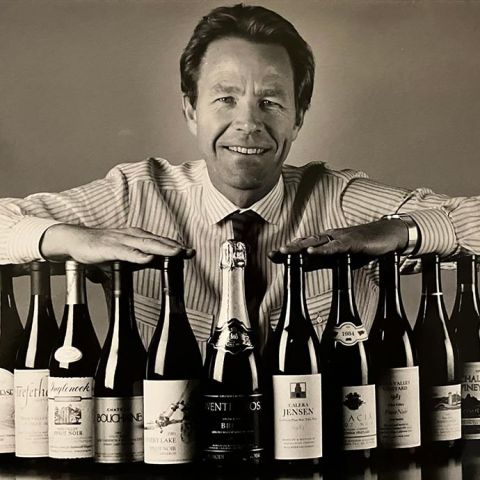
Calera may have pioneered single-vineyard bottlings but Jensen’s lasting legacy is not in wines but vines. He carefully chose plant material in Burgundy and planted his mysterious ‘suitcase’ field selection in California, aided and abetted by his friend Dick Graff of nearby Chalone vineyard, bypassing the thorough quarantine required. All over the state nowadays vine-growers boast of having the ‘Calera clone’ in their vineyards. It’s regarded as a ‘heritage clone’ making especially concentrated wine as opposed to the newer generation of certified clones from Burgundy known as the Dijon clones or the clones many have imported from Guillaume nursery in the Jura.
At more or less the same time as Jensen started out, Pinot Noir was planted in the famous Sanford & Benedict vineyard in what is now Sta Rita Hills in Santa Barbara County but Sonoma in the north of the state has an even stronger claim to be California’s Pinot Noir hotspot – or rather cool spot as far as the newer vineyards on the coast are concerned. Pioneers there were Hanzell in the 1950s, also inspired by time spent in Burgundy, and, in the 1960s, Joseph Swan, whose own Swan clone makes especially burgundian Pinots. A 2006 was delicious recently.
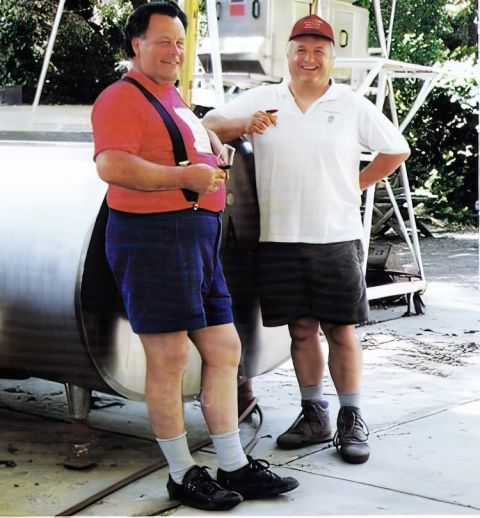
As well as Davis Bynum and Gary Farrell, Rochioli, Merry Edwards and Williams Selyem put Sonoma’s Russian River Valley on the wine map with their Pinots in the 1970s and early 1980s. A sign of the times is that the last two are now majority-owned by French wine producers, Louis Roederer of Champagne and Faiveley of Burgundy respectively. Rochioli is still a family concern, however, and continues to supply fruit to Williams Selyem, founded in 1979 by burgundy lovers Burt Williams and Ed Selyem. The ‘old boys’ weren’t interested in growing their own fruit but American vintner John Dyson, to whom they sold initially, in 1998, wanted to concentrate on estate fruit and chose to feature Calera vines heavily in Williams Selyem’s own vineyards. Today, winemaker Jeff Mangahas makes 25 different Pinot Noirs, of which the bottling from the Allen vineyard, site of Burt and Ed’s relatively primitive winery once, is the most Burgundian in my experience.
Below, Burt and Ed are pictured below with one of the horizontal open-topped dairy tanks in which they, unusually, did all their fermentations. The Faiveley team have been so intrigued by the cap-to-must ratio that the tanks offer that winemaker Jérôme Flous has one in Nuits-St-Georges.
Williams Selyem’s legacy of burgundian Pinot Noir is alive and well in a draughty warehouse on the outskirts of Santa Barbara in the south of the state. Here Drake Whitcraft continues his father’s dream of making such wines, inspired by Burt Williams and the wines of Domaine de la Romanée-Conti – but not without difficulty. His father loved burgundy and aspired to make Central Coast versions of it but didn’t much like accounting. Drake inherited his father’s bankruptcy in 2011 when Whitcraft’s total production was hardly 150 cases.
He has slowly built it back up to 2,500 cases a year, still in the slightly ramshackle premises close to the ocean chosen by his father as being suitably cool. He makes 25 different wines, all from bought-in fruit, including, like most Pinot Noir producers, some Chardonnays, and clearly takes red and white burgundy as his model. No new oak, no pumps, no filters, no vines. ‘I work with farmers who want to make good wine’, he says simply.
None of these wines is cheap but most are cheaper than the equivalent wines that inspired them.
Recommended burgundian Pinot Noirs
Rippon, Mature Vine 2020 Central Otago13.5%
£51.95 Lea & Sandeman
Bell Hill 2020 North Canterbury 13%
£168.58 Brunswick Fine Wines & Spirits
(2020 not tasted by me but earlier vintages were extremely promising)
Bass Phillip, Estate 2019 Gippsland 14%
£390 per case of 6 in bond Bordeaux Index Live Trade
Kershaw Wines, Clonal Selection 2021 Elgin
£42.99 Strictly Wine, £43.99 Ratcliffe Wine Merchants, £46.50 VINVM
The Eyrie Vineyards Pinot Noir 2021 Dundee Hills 13%
£49.50 Savage Selection
Calera, de Villiers Pinot Noir 2019 Mt Harlan 14.5%
£74 Hedonism (see this note on the 2021 vintage)
Williams Selyem, Rochioli Riverblock Pinot Noir 2022 Russian River Valley 13.5%
£200.95 VINVM
Williams Selyem, Allen Vineyard Pinot Noir 2017, 2018 and 2020 Russian River Valley
$89 Baron Wines USA, Washington DC (see these notes on earlier vintages)
Whitcraft, Chêne Vineyard Pinot Noir 2023 Edna Valley 13%
819.90 Norwegian krone Vinmonopolet
For tasting notes, scores and suggested drinking dates, see our tasting notes database. For international stockists, see Wine-Searcher.com.
Back to basics
Where is creditable Pinot Noir grown? |
|
Good, if not necessarily burgundian, Pinots are grown in cooler parts of Oregon, California, Germany, New Zealand, Australia, South Africa and, increasingly, England. This means the Willamette Valley just south of Portland in Oregon; Sonoma Coast, Anderson Valley, Russian River Valley, Carneros, Santa Cruz Mountains, Mount Harlan, Chalone, Santa Maria Valley, Sta Rita Hills and Santa Ynez in California; most German wine regions; Martinborough, Marlborough, North Canterbury, Waitaki and Central Otago in New Zealand; Adelaide Hills, most of the state of Victoria, Canberra, Tumbarumba and Tasmania in Australia; Hemel-en-Aarde, Elgin and Walker Bay in South Africa; and mainly Crouch Valley in England.
Because Pinot Noir, like its pale-skinned Burgundian partner Chardonnay, is an early-maturing variety, warmer places tend to ripen the grapes before much flavour has been built up, which is why, for instance, most of Spain and Argentina are unsuitable – although high latitudes and elevations can help. |