
Many restaurants face an uncertain future, thanks to fewer tourists, fewer office workers and even a lower income from their once-lucrative private dining rooms, as the number of customers allowed in them is curtailed by social-distancing rules. (Many a booking has had to be pruned recently in the UK thanks to our new ‘rule of six’, prohibiting larger groups.)
They will have to adapt by closing on days that were only marginally profitable (see Why restaurateurs don’t like Mondays) and by making use of every available outdoor seat until the northern-hemisphere winter kicks in.
And from now on they will be even more dependent on the skills of their chefs. A restaurant’s future will depend even more on its head chef’s abilities to staff a brigade that is capable not only of meeting demand but also of generating the gross profit from their menus that will enable the restaurant to survive.
This is happening at a pivotal time, as summer – a season of plenty, when writing menus is relatively straightforward – gives way to autumn, when British produce is arguably at its very best and certainly appetites are at their keenest, which then, in turn, gives way to winter, when produce can be at its most limited.
This situation is particularly critical in Britain with the prospect of Brexit only months away. Many chefs have already been forced to turn their backs on their favourite varieties of French strawberries, plumping instead for their British equivalents, since sourcing from Rungis, Paris’s central food market, has become too expensive and, thanks to quarantine regulations, too slow.
But before even considering the relative quality of precisely which ingredients constitute any dish, it is the responsibility of any chef to juggle the quality and make-up of his or her brigade, particularly as labour costs are the second-biggest factor, after rent, of every restaurant’s profit and loss account.
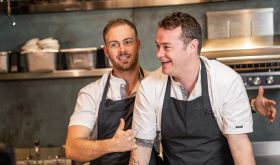
This situation is at the forefront for Henry Harris (pictured) as he reopens the kitchens of the four restaurants (The Hero of Maida, The Coach, Three Cranes and The Crown) he oversees. ‘Projecting less turnover means we will have to cook with smaller brigades as part of our overall cost control. Smaller menus will be the result. This will not result in fundamental changes but rather a different method of production. So our steaks will more likely be served with a cold horseradish sauce or perhaps a Roquefort butter rather than a sauce made to order in a pan.’
Other options, he continued, may include ‘charcuterie that can be sliced and served on a board with pickles and good bread; making compotes with gluts of fruit; and serving pre-mixed cocktails that can be served quickly across the bar’. Yet these changes should be subtle rather than obvious, in Harris’s opinion. ‘My responsibility, and I believe, that of any conscientious head chef, will be removing the barriers for greater efficiency so that a "food runner" can wash up, and a barman, when the bar is quiet, jumps in and serves the food. All of this will help keep the quality standards up and the running costs down.’
Another subtle change will be the move for many chefs to embrace British produce even more. Julian Marshall is head chef of the Bleeding Heart, three French restaurants in London’s Hatton Garden that were founded 37 years ago by a Scot and his New Zealand wife, Robert and Robin Wilson. Over the past few months Marshall has become a convert to British produce.
‘Scottish raspberries, girolle mushrooms, English strawberries, cherries and apricots have all been fantastic this year, certainly as good as those we once relied on for an importer to bring to us from France. And I have been serving English bobby beans instead of fine green beans which were once flown in from Kenya, saving me money and the planet air miles. There were even, this year, some fantastic red and yellow endives that were homegrown but normally I have had to buy in from Holland or Belgium’.
These trends – of shorter menus, the less-specific naming of ingredients, and a shift towards British produce – are only likely to continue, with certain obvious modifications. One such was voiced by Tim Sheehan, head chef at the long-standing Franklins in Dulwich. ‘I am having to eschew all expensive ingredients on the menu for the foreseeable future so this is the first year in 20 that we have not had grouse on the menu. Instead, my brigade has been busy preparing pickles and preserves for the winter and experimenting with storing vegetables on hay to increase their flavour. Celeriac seems to be the most successful so far.’
Sheehan’s gloom is not shared north of the border by Tom Kitchin, chef/proprietor of three of Edinburgh’s most appealing restaurants. Having urged me to come up and enjoy the grouse that will feature on all his menus until the end of the season, he went out of his way to thank Rishi Sunak for his successful Eat Out to Help Out campaign that encouraged people to eat out at the beginning of the week.
‘My menus may contain the odd orange, lettuce and tomato but principally they are very focused on Scottish ingredients and that is where this campaign has been so successful. Instead of being able to give business to our suppliers for three days a week we have been able to increase this to six days a week.’
Whatever is on the menu, chefs hope that customers will return. ‘There is more to life than homemade sourdough’, quipped Jesse Dunford Wood, chef at London’s Parlour.