Because new tends to mean as-yet-undiscovered and therefore good value, I follow the burgeoning Spanish wine map with close interest, but at the end of last year I found myself in a wine region in Tempranillo country in north-west Spain that was previously completely unknown to me.
Stretching 20 miles north east along the Pisuerga river from the old capital of Castile Valladolid, Cigales was denominated as a wine region as recently as 1991 and its modern incarnation dates effectively from the late 1990s. Once Philip II had uprooted the local forests for the Spanish Armada, any agriculturally viable land in this barren, impoverished countryside was devoted to cereals. Vines were grown on only the very poorest soils, and their produce funnelled into sturdy dark-pink wines, of local interest only, made from mixing red and white grapes. Viticulture was a weekend hobby and every one of the 11 villages in the region has a castle and a cluster of tiny domestic bodegas burrowed into the hillside where families still come to roast lamb and feast as a sort of Castilian alternative to tending an allotment.
The great advantage of Cigales' never having been a dynamic wine region is that viticultural methods have remained doggedly traditional. The climate is dry and harsh. At 650-800 m altitude, and with relatively low rainfall, agrochemicals have rarely been used to any great extent. Drought and frost are the chief enemies of the vine here, not disease. Cigales is higher and cooler than Toro to the west so its wines tend to be rather more structured. It is much smaller and very much less famous than Ribera del Duero to the east, so land and wines tend to be considerably less expensive. But the best of them seem to have very promising ageing potential and – a big mark in their favour in my book – very few of them suffer the over-oaking that seems endemic in status-conscious Ribera del Duero.
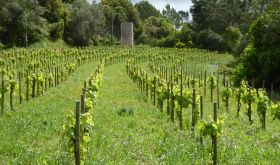
There is the other advantage that, since most growers have treated their holdings as a hobby, there has been little incentive to keep replanting vines, so that more than half of them are more than 60 years old. One of the oldest producers, César Príncipe, lays claim to 17 ha of vines that are between 60 and 100 years old. Valdelosfrailes, part of the Matarromera group which owns no fewer than three bodegas in nearby Ribera del Duero, claim that the vines in their Costanas vineyard are 125 years old and pre-date the vine pest phylloxera's predations. The 2003 made from them certainly seemed to be a wonderful expression of altitude and minerality. Old vines are capable of producing particularly concentrated fruit, particularly from the bushvines that predominate on the impoverished pebbly soils over particularly hard clay of the region's higher ground.
As Jaime Echevarri of the most cosmopolitan producer, Finca Museum, described their top vineyard to me, 'it's similar to Châteauneuf-du-Pape but with concrete underneath'. Another producer, Enrique Concejo, claims that the soils responsible for their Carraduenas bottling are more like Pomerol. Either way, the rash of hopeful, new exporting producers here do not lack ambition.
Typically, César Príncipe made dark pink clarete for the bars of Valladolid for years until their oenologist persuaded them that the quality of the region's dark-skinned grapes – mainly Tempranillo with a little Garnacha Tinta (the juicier Grenache) – was far too good to be diluted by the local Albillo and Verdejo white grapes. But it was two women, itinerant winemaker Ana Martín, and María Pinacho, who claim responsibility for 'the first modern red Cigales'. Their Traslanzas is a dense, spicy, ageworthy wine made from a Tempranillo vineyard planted in 1940.
The late 1990s saw a flurry of incomers and locals who woke up to the vinous possibilities of these old vines and the harsh climate, but none was more dramatic than the arrival in 1999 of representatives from the publicly quoted Baron de Ley in Rioja way to the east, owners of Spain's biggest branded Rioja El Coto. General manager Echevarri admits that they actually wanted to expand into Ribera del Duero, but left it so late that prices were already silly. They planned to take a look over the border at port country in the Douro Valley in Portugal but Spanish wine writer Andres Proensa suggested the company prospectors stop off in Cigales.
'We were immediately fascinated by what we found,' he told me while driving me at high speed towards the region in his top of the range BMW. (The young lady who represents Cigales wine region drives a small white van.) 'We saw a purity that was unique in Spain – not spoilt in the sense of Rioja. The land was terribly fragmented but the quality was such that it was worth doing lots of individual negotiations. We contracted 60% of the vineyards over 60 years old for 10 years. That meant 800 hectares, but with average yields of only one to two tonnes per hectare, it was not that much wine. The Castilians are a bit like the Scots – very suspicious and closed. They called us 'los Americanos' at first because the contract guy was blonde.
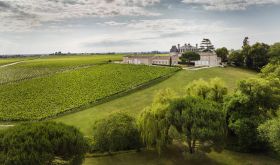
'The grapes here may be Tempranillo, as in Rioja, but they're much thicker-skinned and need very different winemaking. After 10 years, we're just learning how to crack it.' In 2000 Baron de Ley started work, on top of a hill, on a 15-million euro ('probably too much') palace of a bodega for their new Museum project in Cigales. To say that it is different from the Cigales norm would be an understatement.
But they have cleverly recruited Isaac Fernandez, nephew of famed winemaker Mariano García, who has already made wine at his uncle's Mauro bodega and in Bierzo to the north west, whose wines he thinks lack the structure he finds in Cigales. Museum has the muscle to get the name Cigales known in markets such as the US, surely an asset for the growing number of accomplished producers in this small but characterful region.
Top picks
Traslanzas 2005
Sinforiano Vaquero Reserva 2005
Museum Real Reserva 2004
Valdelosfrailes, Pago de las Costanas 2003 Cigales
César Príncipe 2000, and 2005
Full tasting notes here.