See also my full tasting notes.
Last month I found myself being driven at high speed across Belgium towards an assignation in a brick-lined basement in Düsseldorf, a town where I knew no-one, with a man I had never met and who, as far as I knew, was not known to anyone I knew. At least my husband knew which city I would be in, but I had given no-one details of the address into the bowels of which I was about to disappear. And when I finally set eyes on the man, he did look a little messianic, with his black beard, permanently raised thick black eyebrows and stream of impassioned explanation of his feelings (for Portugal) as soon as I arrived. I even spotted a fold-up bed in one corner of the cellar. Was this where I would be expected to live for the rest of my days?
Last month I found myself being driven at high speed across Belgium towards an assignation in a brick-lined basement in Düsseldorf, a town where I knew no-one, with a man I had never met and who, as far as I knew, was not known to anyone I knew. At least my husband knew which city I would be in, but I had given no-one details of the address into the bowels of which I was about to disappear. And when I finally set eyes on the man, he did look a little messianic, with his black beard, permanently raised thick black eyebrows and stream of impassioned explanation of his feelings (for Portugal) as soon as I arrived. I even spotted a fold-up bed in one corner of the cellar. Was this where I would be expected to live for the rest of my days?
It occurred to me then that perhaps I should have done a few more security checks before accepting this wine enthusiast’s invitation to come and taste an unrivalled selection of Portuguese wines. But, as it has obviously turned out, in the late afternoon I and my blackened palate were free to go, even if not exactly with a spring in my step after tasting 88 relatively tannic, tart wines in four hours.
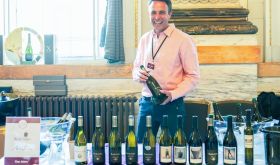
Carlos Quintas is a Portuguese economist married to a German journalist. Hence his Düsseldorf domicile, frequent trips back to Lisbon and passion for (some) Portuguese wines. His historic cellar in the oldest part of Düsseldorf was lined with case after case of fine Portuguese red, many of them far older than are normally found in commercial circulation. He sells loosely via gatherings of friends and acquaintances in this slightly kitschy 14,000-bottle cellar with its sofas, soft lighting and artworks. His aim is to promote Portuguese culture via these wines, highly personal booklets and regular tastings. I was relieved to learn that one was planned on the day after my visit to mop up all the leftovers.
He claims he was initially inspired to collect fine Portuguese wine by a little book I wrote on the subject, with tasting notes and scores, for a Portuguese publisher in the summer of 1999. This was based on an epic journey made by the publisher and his son over the Pyrenees when they drove two bottles of each wine from Lisbon to our house in the Languedoc and I tasted my way through them systematically over the summer. I became extremely popular with my neighbours on account of the leftovers which had so much more guts than the wine at the local co-op.
Now, eight years on, I was to be given a chance to revisit some of these wines and see how they had developed, as well as acquaint myself with many younger vintages of the same wines.
Carlos had grouped them cleverly in flights of whites, assorted reds, and verticals (several different vintages) of some of the more famous wines – especially those from the regions in which he seems to take a particular interest, the neighbouring regions of Dão and Bairrada in the north of the country.
By the end of the tasting one wine stood out, not in fact either a Dão or a Bairrada. It was, perhaps inevitably, the oldest, a bottle of the 1965 vintage of what was for decades Portugal’s only famous fine table wine, Barca Velha, an unfortified wine from the Douro valley made by the house of Ferreira from port grapes traditionally grown mainly on the Quinta do Vale Meão. When Ferreira was acquired by Sogrape (once famous for Mateus rosé) in 1994, Ferreira’s previous owner kept this well-placed wine estate himself so that Sogrape have had to find alternative sources for Barca Velha fruit, much of it from vineyards near Quinta de Leda nowadays. I must say that the 1999 vintage tasted alongside the hauntingly delicate 1965 (both opened six hours before I tasted them) seemed a very galumphing, ungracious beast. Perhaps it too will need 42 years to show its best?
There were many such instances of enormous differences between older and younger vintages with, in general, the young wines seeming much closer together in style to each other than the older ones, even if from quite different regions. This mirrors a phenomenon even more pronounced globally whereby more and more wines are made sweet, concentrated and rather heavy. Overall however, the average quality of Portugal’s table wines continues to soar, and there is much, much more fruit in wines made today than a decade or two ago. Furthermore, since the country has kept so many of its exciting arsenal of indigenous grape varieties in the ground, sensibly resisting the temptation to replace them all with Cabernet Sauvignon and Chardonnay, Portugal can offer the wine drinker really distinctive flavours and styles that cannot be found anywhere else – until the Touriga Nacional cuttings imported from Portugal by growers in places such as Australia and Spain mature of course.
The only slight problem, as witness the very existence of that little book I wrote, is that the Portuguese themselves have developed such a vibrant wine culture that wine guides have proliferated and demand for the most garlanded wines has soared, along with their prices.
Carlos was particularly delighted to be able to see me re-taste and enjoy Santar’s red 1997 Dão made from the Alfrocheiro Preto grape about which I had written ‘This is just the sort of wine that sells so well in British supermarkets” remarking on its “ultra-fruity, hyper-modern nose”. I would not have thought it would still have such a haunting fragrance at 10 years old, and Carlos was quite right to point out that Santar’s work in reviving this once-obscure Dão grape was fully vindicated by this bottle.
Several vintages of Quinta dos Roques’ white Dão certainly vindicated my initial enthusiasm for another local grape, Encruzado, which can make serous, dry, full bodied whites with every bit as much gravitas as fine white burgundy. The same property’s varietal Touriga Nacional seemed just as good in 1996 as the 2005, and overall Quinta dos Roques’ 1996s seemed to have lasted just a bit better than those from the other great Dão producer Quinta da Pellada.
Tasting several dozen wines from Bairrada showed that Luis Pato, who has left the official Bairrada appellation, partly in disgust over the authorities’ move to embrace imported international grape varieties, still makes many of the best wines of the region. His reds have real nobility and, like all good Bairrada, great ageing potential but are not too austere in youth. Even his white Vinha Formal 1998 made from the local Bical grape (not tasted in 1999) was extremely impressive. The Bairradas of Sidónia de Sousa are highly regarded in Portugal but can seem a very hard on non-Portuguese palates, and this tasting of nine of their reds was generally an exercise in pretty dry tannins although their 1990 Reserva was stunning and their 1997 Garrafeira pretty impressive.
Douro reds, made in the mould of Barca Velha, are now some of Portugal’s most highly regarded. The 2004s are looking particularly exciting
Below are some of my favourite current Portuguese wines, tasted variously in London and Düsseldorf, but on the basis of my Düsseldorf cellar experience, I would expect them to be worth keeping longer than many of their counterparts made outside Portugal.
Some current Portuguese favourites
WHITES
Quinta do Cardo Síria 2005 Beira Interior
Quinta dos Roques Encruzado 2005 Dão
Paulo Laureano Escolha 2005 Alentejo
REDS
Erva Pata 2005 Estremadura
Casa de Mouraz 2004 Dão
Quinta dos Roques, Alfrocheiro Preto 2003 Dão
Quinta dos Roques, Touriga Nacional 2005 Dão
Quinta dos Roques, Reserva 2005 Dão
Álvaro de Castro, PAPE (Baga + Touriga) 2005 Dão
Dão Sul, Quinta de Cabriz Tinta Roriz 1999 Dão
Luís Pato, Vinha Barrio 2001 Beiras
Luís Pato, Vinha Pan, 2005 Beiras
Luís Pato, Vinha Barrosa Vinhas Velhas 2005 Beiras
Pintas 2005 Douro
Quinta do Vallado Reserva 1999 and Old Vineyards 2005 Douro
Quinta do Vale Dona Maria, 2004 and 2005 Douro
Lemos & Van Zeller, Curriculum Vitae 2004 and 2005 Douro
Jorge Moreira, Poeira 2004 Douro
Quinta do Mouro 2004 Alentejano
Mouchão, Tonel 3-4 1999 Alentejo
For stockists see www.winesearcher.com
See also my full tasting notes on more than 80 fine Portuguese wines.