See our 1,900 tasting notes on 2010 burgundies
Eric Rousseau, the quiet holder of the reins at the world-famous Domaine Armand Rousseau in Gevrey-Chambertin, is not given to hyperbole. While many in the wine trade are currently touting the unexpectedly high quality of the 2010 vintage in Burgundy, especially those dozens of British wine merchants currently making en primeur offers of it, Rousseau admits that it was by no means clear during the harvest that they were picking something special. 'We knew it would be good only after the malolactic fermentations,' he admitted during my tasting last month in his enviably extensive cellars.
The day before Romain Taupenot had gone further. 'In mid September 2010 it was almost unimaginable that we would be able to produce wines with such precision and concentration,' he told me, marveling at what his increasingly assured Domaine Taupenot-Merme in Morey-St-Denis managed to produce in 2010.
At the other end of the Côte d'Or, in the heart of white wine country, Jean-Marc Roulot went as far as to say, 'I'm more confident about the 2010s now than I was in the spring. They were too acid then.' Roulot, who has managed to make some of the most precise white burgundies of the entire vintage, Meursaults of premier cru quality from his relatively humble vineyards, feels there is no hurry to bottle these high-acid wines and, like Pierre-Yves Colin-Morey whose whites are similarly styled, has no plans to do so much before March.
Here is an extract from a report from Gareth Skidmore, a specialist wine translator and longstanding Burgundy resident, on prospects for the vintage, written on 16 September 2010 just before the first 2010 grapes were picked: 'It will need a magic wand to turn the poor sugars and slow maturity of this bad summer 2010 (particularly August into September) into a good vintage.'
It is true that the 2010 crop was substantially reduced by hail in some of Santenay, and that some vines on lower-lying land had been killed by particularly low temperatures on the night of 19 December 2009, but the main reason for relatively small volumes in 2010 was also the reason why the wines have turned out as well as they have. A mild spring saw fairly early bud break but the weather turned unsettled and grey in May and then in June, for the all-important flowering, were three cold, wet weeks that Raphael Coche of Coche-Dury described as 'catastrophic', resulting in some rot even at flowering and dramatically reducing the number of berries. For his father Jean-François Coche, 2010 was the smallest crop ever, after a wet July and cool August.
Jeremy Seysses of Domaine Dujac is more sanguine about a poor flowering, arguing that now that Burgundy's vineyards are no longer plagued by viruses, it no longer spells financial disaster but is simply nature's way of limiting yields. 'And anyway, with a poor, wet summer such as we had in 2010, you need the concentration that a poor flowering brings. It's not disastrous, and helps because the bunches aren't too compacted.'
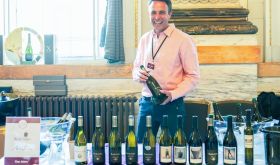
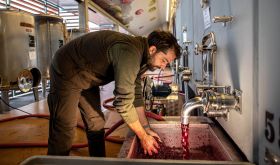
Jean-Marie Fourrier of Gevrey-Chambertin (pictured above) says that 2010's were the smallest berries he had ever seen (at the top of the village Sylvie Esmonin likened them to petits pois) – so much so that he had to adjust the size of the holes in his sorting table. The fact that bunches were so loose saved the grapes from the ravages of threatened fungal diseases, and because the berries were so small, they could be ripened sufficiently even by the relatively cool conditions of late summer 2010.
Apart from those struck by hail or rot at flowering, yields in the Côte de Beaune were close to normal but further north it was a different story. Lalou Bize-Leroy of Domaine Leroy reported average yields of just 10 hl/ha in 2010 when the norm for her cosseted biodynamic vineyards is 24. For her neighbour Anne Gros of Vosne-Romanée, average yields in 2010 were 32 hl/ha when they had been 40 hl/ha in 2009, but they were 'dream grapes'. Storms threatened in late September so rising star Arnaud Ente of Meursault, for example, felt forced to pick three days earlier than he had intended. Both Coche and Pierre-Yves Colin pointed out that it was most important not to pick too late, to keep the tension in the wines.
Acid levels in both reds and whites are notably high in the roughly 1,200 2010s I have tasted, and the uncommonly late second softening malolactic fementations seem to have turned uncomfortable tartness into acceptable crispness in most cases. Some long-serving Burgundy enthusiasts will remember the 1996 vintage which showed very well at this early stage but then became increasingly dominated by their acid content. But the smallness of the berries in 2010 does seem to have left most whites in particular chock full of flavour, even if some of the wines can seem a little short of juice and drying on the finish at this stage.
A few wines are simply too thin and/or tart. Despite the smallness of the berries, the reds are not notable for their depth of colour. I have been able to commute between tastings without having to issue a black-teeth alert. In general the reds are a pretty cherry red and standards of winemaking have been cheeringly high. In virtually all the wines I have tasted, the precise characteristics of each vineyard's fruit has been, admirably, allowed to express itself without the intervention of excessive oak – and excessive alcohol was simply not a possibility in the cool autumn of 2010. Most of these wines are around 12.5 to 13.5%, many of the Bourgogne Rouges just 12%.
For Bernard Dugat of Dugat-Py, 2010 was 'the first vintage when I did no acidification nor chaptalisation'. It is worth remembering that acid levels were relatively low in the two vintages flanking 2010, which serves only to flatter the 2010s which are looking so much more beguiling than the other recent Burgundy vintage born of a cool summer, 2008. The relatively low temperatures in September meant that the grapes were particularly cool when picked in the second half of the month and into October in some vineyards in the Cote de Nuits, which has clearly helped to preserve lovely fresh fruit flavours.
With the exception of a few seeking to 'reposition' themselves, and some of the most sought-after wines, growers have generally been less rapacious than they might have been with their prices for 2010s. Next week I will be highlighting some of the less predictable successes of the vintage.
BURGUNDY'S BLUE CHIP NAMES
These are Burgundy's really heavy hitters, the sort of names that, unfortunately, appeal to investors as well to the best-heeled drinkers. Many names are almost as sought after. Burgundy's best value is to be found elsewhere.
Domaine J F Coche-Dury
Domaine des Comtes Lafon
Domaine Leflaive
Domaine Leroy
Domaine de la Romanée-Conti
Domaine Georges Roumier
Domaine Armand Rousseau
Domaine Comte de Vogüé
See our 1,900 tasting notes on 2010 burgundies and wine-searcher.com for more offers.