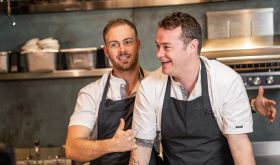

At this time of the year, I usually write about the best meals I have had over the past 12 months. In 2020, I can summon up only five candidates: Sunda in Melbourne (pictured); Davies & Brook in London; Single Thread in Healdsburg, Sonoma; Maison Troisgros in Ouches, eastern France; and Zoldering in Amsterdam.
And that’s all the looking back I intend to do in this column. I want to look forward instead – to the summer of 2021 perhaps when enough people have been vaccinated and the world of hospitality is returning to something approaching what was ‘normal’ until March 2020.
It will still be very different from the world we all knew as recently as last February. Some favourite restaurants may simply not be reopened. The long closure periods will have forced restaurateurs to reconsider their exposure; exigent landlords will provoke tenants to walk away; the drains on cash flow will force many to sell up – if they can.
In the UK, the situation has been compounded by the timing of the second and third lockdowns and all the subsequent terrible restrictions. The run-up to Christmas and the New Year is usually the busiest time of the year for restaurateurs, who expect their profits from this six-week period to keep their businesses buoyant until the clocks go forward in March.
Yet there has also been a great sense of optimism about the future in general, particularly among my colleagues in the US. Some believe this new world of hospitality won’t just be very different but far more exciting. Buildings occupied by the usual suspects, invariably bankrolled by venture capitalists, will surely be a thing of the past. Landlords will have to take risks – or leave their properties vacant – and should, therefore, be more responsive to the independent sector. Lower rents will favour the smaller, more ambitious restaurateurs, who have been priced out of the most attractive sites for the past 20 years.
Still, I fear this new dawn may be some time in breaking. The consequences of the pandemic will still be felt next summer. That so many restaurants are still closed in New York, Paris, San Francisco and London does not augur well for the immediate future. As Viewpoint Partners, accountants to many in the British hospitality industry, wrote in their recent report, ‘These are still choppy waters to navigate in smaller boats and we’ve been at sea a long time.’
And yet, there is still room for hope. A restaurant’s success depends on its mastery of the three Cs I outlined in this recent article. Conviviality, that magical combination of food, alcohol and service. Connectivity, a restaurant’s ability to act as a neutral space for individuals to meet (as a restaurateur, I used to say that I would sacrifice the profit on all that we were selling in return for a small commission on the deals concluded over lunch or dinner). And there is the local community, which has become increasingly important in the absence of so many travellers. Master these three Cs and your restaurant will prosper.
So what would I like to see? Above all, more restaurants that are owned by individuals or small restaurant groups, and that bear the imprimatur of a talented chef and a welcoming restaurateur. At the same time, I hope to see more properties offered on a turnover-only basis for the rent, which would mean that the restaurateur would not be liable for a fixed rent. Both landlord and tenant would have to share in the risk, in contrast to most current agreements which specify that the rent can only go up. This is the most equitable way forward. There would be no more guarantees for the landlord and it would minimise the risk for the restaurateur. The first major landlord to offer such attractive, but inherently safe, terms to restaurateurs will be the first one to turn around their ailing property portfolios. The restaurateur would still have to fit out the property and would lose that capital if she or he were to fail.
And where could the capital come from to finance this new wave of small, independent and not-terribly-profitable restaurants in this country and beyond? I have given this question a lot of thought – and this terrible virus has provided the basis for a possible answer.
COVID-19 has badly hurt the world’s wine and spirits producers as well as the hospitality industry. Many have pivoted to selling directly to personal clients but without making up for losses in sales to pubs, restaurants, bars and nightclubs. Yet many wine producers, for example, are part of large regional or national organisations that have huge budgets and plenty of incentive to see that hospitality flourishes worldwide. In short, restaurants need cash and these organisations have it. Quite how it should flow from one to the other I am not entirely clear, but I do believe that something along these lines is at least possible.
The blueprint for such a solution may provide some welcome optimism in 2021 for the world’s restaurateurs and their customers.