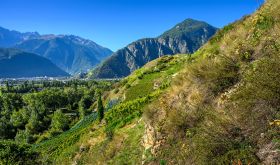
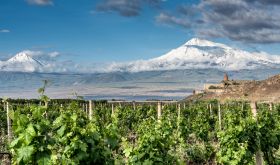
The last wines from the 2001 vintage are only just starting to ferment. They are horribly difficult to make, can inflict frostbite and ruin winemakers' Christmas celebrations, and I am not 100 per cent certain that I think all the effort is worth it.
Icewine (Eiswein in German) is a strange beast. It is made from the juice of grapes frozen on the vine, which means grapes picked long after the main harvest, so grapes have to be expensively protected from birds and, in parts of Germany, wild boar. It can be made only if the weather cooperates. The grapes must be picked in temperatures at least eight degrees Centigrade below freezing, which can mean picking in the dark.
When picked, these grapes are as cold as ice and as hard as bullets. They sound like marbles as they fall into the buckets in which they're collected and pressing the juice out of them is like squeezing a pebble. But this is the point. The purpose of pressing the grapes when they are frozen is to leave the water in the grape behind in the press as ice and to ferment juice containing the most concentrated form of acids and grape sugars so that the resulting wine is both exceptionally sweet and exceptionally tart.
Because it is so difficult to make, icewine tends to be rare and expensive – at least £20/$30 for the half-bottles in which is customarily sold. (It is the only sort of wine I have also seen sold in a bottle only big enough to fill one small glass.) But because it has established itself as something some people will pay a fortune for, production has been steadily climbing and it is by no means so rare today as it was in the 1960s when some German producers set about making it systematically, or in the late 1980s when one or two Canadians realised this could just be the trump card of the Canadian wine industry.
Canada's vineyards just west of the Niagara Falls in Ontario are routinely frozen every winter, as usually are those of the Okanagan Valley in British Columbia inland from Vancouver. So all it takes to make icewine is a great deal of determination, a team of typically Vietnamese pickers (whose genes have surely not equipped them for work in these temperatures) and the diligence to press extraordinary amounts of frozen grapes, often over the Christmas holidays. The country reckons to fill between one and two million half-bottles with icewine each year.
This winter, the Germans are celebrating a particularly successful Eiswein crop in 2001 which should yield, according to arch proponent Dirk Richter of the eponymous family winery in Mülheim in the Mosel, for example, about 120,000 half-bottles in the whole country. And he had to pick his finest Eiswein from the Helenenkloster, which he grooms for Eiswein production every year, on December 24, a date when most Germans have other things to do.
Vine-growers may have to wait until well into January, incidentally, for temperatures to fall low enough to harvest frozen grapes, but the resulting wine still carries the date of the growing season that produced it.
Like most things vinous and Canadian, icewine production is intensely political. The Canadian wine industry prides itself on having stricter criteria for icewine production than producers of Eiswein in Germany. But the rules were tightened further in British Columbia in 2000 after one producer tried to counter the mild winter of 1999 by trucking his grapes up into the mountains in search of freezing temperatures.
The winemaking accoutrement most abhorred by producers of true icewine/Eiswein (most numerous in Germany, Canada, Austria and Slovenia where there are strict regulations on practice and labelling) is the refrigerator. There are wine producers elsewhere in the world, notably the United States, Australia and New Zealand, who make similar wines from grapes that are picked before being deliberately frozen in cold storage. Bonny Doon's Vin de Glacière made from a blend of grapes grown in California is one of the best-known, and certainly the cheekiest answer to icewine.
It is fine and fun but seems rather facile next to an icewine with chattering teeth and frozen mitts by moonlight behind it. Only certain sorts of grapes have skins thick enough to withstand rot for the months they are expected to stay on the vine. Germany's producers favour the noble Riesling, while Canadians have generally specialised in both Riesling and Vidal, a particularly suitable, though slightly less crystalline-tasting, hybrid.
So popular has Canadian icewine become in Asia, however, that an increasing number of producers are attempting to satisfy another Asian passion, for red wine. Cabernet Franc icewine is the result and increasingly commonplace in Canada, if strange to taste and only faintly red to look at. Dornfelder is being essayed simply because its juice is redder.
The other kosher way of making serious sweet wine is to use grapes whose sweetness and acidity has been concentrated by the famous noble rot, or botrytis mould. These wines, such as the best from Sauternes, Monbazillac, the Loire, Tokaj and Germany's Beerenauslese and Trockenbeerenauslese (TBA), have much more complex flavours than icewine and have the additional attribute of becoming yet more interesting with age.
A really good icewine/Eiswein tastes like a cross between the purest form of grape juice and a slap in the face, so vibrant is the acidity. In my experience there is not much point in ageing them. Youthful freshness, as in Sauvignon Blanc, is their strong point.
A few favourites among wines tasted recently are listed here, together with an absolutely first-class book whose title, for once, is no exaggeration.
My recommendations:
Icewine – The Complete Story by John Schreiner, Warwick Publishing, Toronto
Lorenzhöfer Riesling Eiswein 2000 Karlsmühle
Finely etched frozen Mosel juice.
Oberhaüser Brücke Riesling Eiswein 2000 Dönnhoff
Miraculously good 2000 from the master of the Nahe Valley.
Paradise Ranch Chardonnay Icewine 1998 Okanagan Valley
Interesting and very toothsome variation on the theme from a BC icewine specialist. Like Thévenet's Mâconnais wines, proves Chardonnay can make fine sweet wine.
Pillitteri Estates Riesling Icewine 1999 Niagara Peninsula
Seeringly pure, fragrant offering from ex-competitive figure skater Sue Ann Staff who recommends such wines with fruit-based desserts.
For your nearest stockist see WineSearcher.