I suspect there are many people reading this article who find the concept of a non-alcoholic or low-alcohol (henceforth, NOLO) beverage anathema. The purpose of consuming an alcoholic drink is precisely to feel the intensity of aromas and flavours of a well-crafted beverage, allied to the feel-good dopamine hit. Take away the latter and what’s the point, one might ask.
Well, choice is the point, and a commercial proposition too. To have the sensorial experience of consuming your favourite beverage without the effects of alcohol is an increasingly popular decision for many. We are all well aware that alcohol has its downside and the relationship between consumers and alcohol seems to be heavily influenced by generation. While baby boomers and generation X continue to party like it’s 1999 (one for the Prince fans there), millennials and the upcoming generation Z seem to have entirely different relationships to booze.
There is much more awareness of ‘wellness’, both physical and mental, and a marked measure of self-control in these younger generations. During non-COVID-19 times, they tended to go out less and drink in more – a result of being more cash-conservative than their parents, and having the ability to socialise via their screens.
Ultimately, if there is demand for a certain kind of consumable item, somebody is going to service it, and that is what we have seen with beer especially. Technically in the UK, a non-alcoholic drink is one with no more than 0.05% alcohol (although, rather confusingly, the limit is 0.5% alcohol throughout Europe and this level is used by many UK NOLO producers). A low-alcohol drink is one that sits at 1.2% alcohol or lower. Drinks between 1.2% and 3% alcohol are drinks that would be considered lower alcohol by the consumer, although producers can’t label them as such.
Although not a new concept (Beck’s Blue, anyone?), NOLO beers have moved beyond being solely designed to sate the beery desires of the designated driver, to being a thriving category in their own right. NOLO options are available from a wide range of larger and craft beer brands, and we have seen the emergence of breweries such as Small Beer and Big Drop that are entirely dedicated to brewing NOLO beers.
NOLO beers appear to work well as a concept, and from an organoleptic point of view, much better than NOLO wine, as Tam reported. The perceived difference in flavour, body and intensity between a beer and its NOLO counterpart will be less than for wine because the alcohol differential is much lower for beer. Once alcohol isn’t present, one realises just how important it is for providing mouthfeel and texture. And from a process point of view, it is much harder to create NOLO wines than NOLO beers – all that gorgeous, natural sugar in the grapes just gets in the way!
So, this is where cider comes into play. Being a fruit fermentation, it is able to retain aromatics, body and character but, with a naturally lower sugar content than wine, the alcohol differential between a regular and a NOLO version is more akin to the difference in a beer. You could say that NOLO cider provides the best of both worlds. NOLO ciders are created via three methods: de-alcoholisation (the removal of alcohol using a process such as reverse osmosis); dilution of cider with juice and water; or halting fermentation part-way through its conversion of sugars to alcohol, which of course results in a sweet cider.
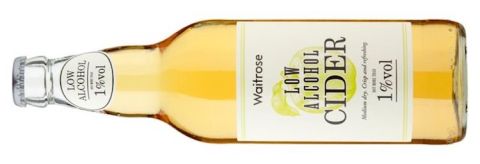
A number of excellent NOLO ciders are already in the marketplace. In the UK, Westons has been making low-alcohol ciders for decades, so they’ve had some time to hone their craft. In fact, once upon a time, I was the cidermaker helping to produce these great drinks. My pick of the crop is the Waitrose own label Low Alcohol Cider (£1.20 for 50 cl) weighing in at 1% alcohol and produced by Westons. It received the trophy for the best NOLO cider at last year’s International Cider Awards.
Another great option comes in the form of the Sassy Poiré (£32 for a dozen 33-cl bottles; £35 for six 75-cl bottles). This is a classic French perry (made from fermented pears rather than apples – to be investigated further at a later date) and is a lower-alcohol drink, coming in at 2.5% alcohol thanks to clever arresting of fermentation, but bursting with intense, brisk, citric acidity and lip-smacking sweetness.
And if you’re after a fully fermented cider, with not a drop of alcohol remaining, then look no further than Thatcher’s Zero, pictured at the top of this article (£20.30 for a dozen 50-cl bottles from the producer, or £1.80 each at Sainsbury’s). Providing soft, appley tannin, a touch of acidity and mellow fruitiness, this is a great option for those determined to avoid ethanol completely.