28 May - You might like to know that Oxford got their revenge at Bollinger in Champagne in April, as described in James Flewellen's blog.
The crews in today's Varsity Boat Race may suffer nerves, then exhilaration or depression, but almost certainly no more so than the participants in another Oxford v Cambridge needle match held a month ago, the 58th Varsity wine-tasting competition. I have never before seen such agony, angst and euphoria associated with the arcane art of blind tasting wine as on the neutral ground of the Oxford and Cambridge Club in London's Pall Mall last month. And never thought that my annual judging of same would lead to a comparison of bed widths in Cambridge college accommodation and US Army quarters in Iraq.
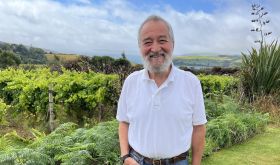
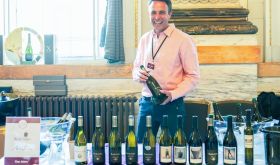
Like the boat race, this was not a particularly British contest. The two tasting teams of six plus a reserve apiece included a German, a Spaniard, a New Zealander, a Bruneian and three Americans, of whom David Beall, 30 (middle in the picture below), is a graduate student of international relations from the US Army, having served two terms in Iraq and one in Afghanistan. (He told me, during the anxious wait for the results of the competition, that his living conditions in Cambridge are much more Spartan than they were in Fallujah.)
There was a general element of military precision about the triumphant Cambridge team, who were just three points ahead after the white wines had been tasted (368 to 365) but ended up winning by 669 to 611. All five light-blue men were in matching ties. Their individual total scores, out of a possible (actually, impossible, given the difficulty of the tasting) total of 240, varied only from 103 to 125. And all competitors are graduate students. Apparently their performance as blind tasters had consistently been so uniform that it was almost impossible to decide which of them should be the reserve. In the event, Eric Denton (currently at Trinity writing a thesis on 'The Anglo-Latin Hagiography of Æthelred II (978-1016)'), had a cold during the trials so was made reserve but ended up with the second-highest total of any competitor.
It was specifically the frightening accuracy of the president of the Cambridge University Wine Society and man of the cloth, that impelled Pol Roger, sponsors of this annual tasting torture, to devise the most difficult blind tasting challenge I have ever undertaken. When, during preparations for the final taste-off, the champagne house's Cassidy Dart witnessed the soon-to-be Reverend Dr Gareth Powell identify the mature white rioja Viña Tondonia 1987 precisely, he was shaken. He had already been impressed by both teams' performance during his training sessions.
A Master of Wine student himself and therefore no stranger to the rigours of blind tasting, Dart therefore decided the competition would simply be too easy for these teams unless really obscure wines made up the majority of the six whites and six reds. So, they included the decidedly off-piste wines listed here. And one of the few wines that looked easy on paper, the Savigny, was a red burgundy so short of fruit that it was virtually unrecognisable.
This was ridiculous. Considering there were five marks to be had for the predominant grape variety and for the tasting note itself, three for each of the country of origin and the 'sub-district' plus two each for the 'main viticultural region' and vintage, I would have expected the average wine professional to have scored a total of no more than 60 points out of the distinctly theoretical total of 240. There were only two bankers among the dozen wines: a 2009 Cru Beaujolais (from the most obscure cru, Regnié) and a super-fruity 2009 QbA Riesling from Dönnhoff in the Nahe (neither of them suggesting any clear option for what should be entered into their relative 'sub-district' boxes).
As it was, various tasters managed to spot that the extremely tart, characterless first wine as indeed a Muscadet (though why an old 2008 had been chosen was beyond me). Many of them correctly guessed that the Roussanne (which tasted so much richer than most Roussannes that I wondered whether the original cuttings had been labelled correctly) was a southern Rhône grape. And one of them even correctly identified the Primitivo by its California name, Zinfandel. Geniuses all, even if apparently there was a serious, and entirely understandable, loss of nerve in the room where, in anguished silence punctuated by slurps and spits, the teams competed.
Meanwhile, as usual, my fellow judge Hugh Johnson and I also tasted the wines blind in private, were duly humbled, and noted all the incorrect guesses we thought were acceptable on the basis of how the wines showed. For example, we decided that we would accept Sauvignon Blanc as a good enough guess for the Sauvignon (Fié) Gris; and we allowed three points for both Cabernet Franc and Gamay as guesses for the Blaufränkisch that would earn the full five points. And we were indulgent over virtually any high acid, neutral grape variety in place of the Melon de Bourgogne responsible for the terribly tart Muscadet.
The Oxford team, which included the only undergraduate in the competition, nephew of the owner of Britain's biggest fine-wine trader Farr Vintners (left in the picture below), was much more varied in its individual performances than the Cambridge one, but the Oxford captain James Flewellen, 26 (foreground in the picture top left and right in the picture below), was the single most impressive taster of the lot – as he had been the year before. He somehow managed to score a total of 152, with exactly the same total for whites as for reds. I sat next to him at the celebratory/commiseratory lunch and found myself staggered by his many achievements.

Having, unusually, completed first degrees in both Physics and English Literature in his native New Zealand, he is currently researching the ways in which bacteria such as E. coli move, developing holographic, three-dimensional microscopy techniques that monitor how they swim. I was silly enough to ask whether he is taking advantage of his time in Oxford in any other ways and discovered that he not only rows for his college but sings (counter tenor) in Christ Church choir – he is from Christchurch and his grandfather and cousin had only narrowly survived the earthquake the day before the contest – and has done some acting and directing. Oh, and he writes a bit of poetry too.
Most excitingly for those of us in the world of wine, he is seriously considering a vinous career. Snap him up, someone!
WHITES
Dom Le Fay d'Homme 2008 Muscadet £9.50
Domaine Paul et Marie Jacqueson 2009 Bourgogne Aligoté £12.95
Ch de Roquefort, Clairette 2009 IGP Bouches du Rhône £10.75
Dönnhoff QbA Riesling 2009 Nahe £14.95
Rustenberg Roussanne 2010 Stellenbosch £15.50
Dom de l'Aujardière, Fié Gris 2009 Vin de Pays de Loire £14.95
REDS
San Donaci, Anticaia Primitivo 2009 Salento £8.95
Domaine Rochette 2009 Regnié £11.50
Bodegas Docampo, Mencía 2009 Ribeiro £11.95
Nittnaus, Kalk und Schiefer Blaufränkisch 2007 Burgenland £14.95
Château des Tours 2007 Côtes du Rhône £16.50
Dom Joël Remy, Aux Fourneaux 2005 Savigny-lès-Beaune £17.50
All prices at Lea & Sandeman shops in London, for single bottle purchases. There are substantial discounts for orders of a mixed dozen.
Photography courtesy of Jennifer Segal, JSNewMedia.