A few years ago the world of wine was alerted to the catastrophe about to befall the beautiful Greek island of Santorini. Tourism was triumphing over viticulture. Land that should be upholding the island's ancient vine-growing tradition was being sold off for hotels and villas. Mass-market tourism would soon wipe out the indigenous Assyrtiko vine almost as soon as it had demonstrated that it could produce world-class dry whites.
Back from my first visit to the island, I am not so sure that Santorini's wine industry is in danger of collapse. Indeed it looked pretty vibrant to me. There were signs advertising wineries, winery visits and wine museums everywhere, and all the smartest hotels seemed to make much of their wine connections.
It probably helped too that the vineyards are quite exceptionally green and healthy this year, thanks to an unusually wet winter and spring. Normally by July the vines are starting to yellow and dry out. Since vines are still by far the dominant crop on the island – even if considerably less than the 48,000 hectares (120,000 acres) or three-fifths of the entire island area that was devoted to supplying imperial Russia with sweet wine in the mid-19th century – this makes a huge difference.
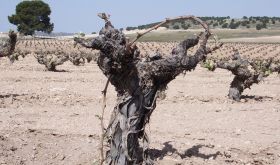
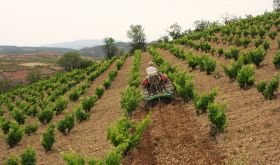
On the pale flakes of pumice and sand that are what passes for soil on the volcanic island of Santorini, vines, never ravaged by the pestilential phylloxera and therefore ungrafted, creep along the ground rather than grow vertically, and are trained circularly into low basket shapes (so that uprooted vineyards provide relics sold in tourist shops to adorn the conservatories of northern Europe).
By now the harvest on this hot, southern Cycladean island will be in full swing and the small but growing number of wine producers will be vying with each other for who can pay best prices to the canny local growers – all of whom deliver their grapes by donkey, but to increasingly modern wineries fitted with stainless steel and temperature control.
Last year and the year before, crops were so small (for climatic rather than socio-economic reasons) that yields of eight hectolitres per hectare, one-sixth the average in Bordeaux's smartest vineyards, were common and prices rose to 420 drachma per kilo. This year a relatively bountiful yield of two or even three times this is expected and prices will be paid in the euros that prevail in the island's tavernas and hotels.
Only one wine producer on the island, Sigalas, owns any substantial area of vines. Paris Sigalas took over his family winery off the road from the capital, Fira, to the north of the island in 1991 and specialises in organically grown grapes. I did not know this when tasting his 2002, transfixed by an apricot sun sinking into the Aegean, the island's nightly entertainment. But this wine did stand out from every other one I tried on the island for its extreme raciness and nerve. All of the good dry white wines of Santorini have a certain citrus and mineral quality – even the better examples poured by the metal jug in the most basic tavernas. But this particular one had something extra about it, the sort of extract without alcohol you might find in a great wine from the Saar in the upper Mosel. (And in my tasting book there are few compliments greater than that.)
Haridimos Hatzidakis, ex-winemaker of the big, most touristically attuned winery Boutari, goes one better. He cultivates his five acres of vines biodynamically (there cannot be much call for fungicides in this climate, after all). His tiny winery really is in a cave. He describes it as just out of the hilltop village of Pyrgos 'in our way to the monastery of Pr. Helias' [sic]. I would describe it as on the way to the extremely important eastern Mediterranean listening station on top of Santorini's highest peak.
He, like most winemakers here, there and everywhere, is experimenting with oak-aging these delicate whites (not entirely laudably in my view) and also with grape varieties other than the noble Assyrtiko. Aidani adds particularly floral notes to the steelier, crisper Assyrtiko while in his hands the island's best-known (ie, not very well known at all) red wine grape Mavrotragano produces a rather Beaujolais-like light, fruity, slightly tart red.
His British importer organised a trip to Greece for British wine writers which included a visit to Santorini earlier in the year. This led to much enthusiasm for a wine written up as 'Lauropivn', usefully illustrating the complications of transcribing labels written in the Greek alphabet.
The coop Santo Wines makes the lion's share of the island's wine (and probably most of what is poured in tavernas) and Boutari is also well distributed. The most actively exported dry white Santorini is probably Thalassitis from the innovative Gaia winery. Gaia's owners ship in winemaking equipment from their other winery in Nemea each year because their harvests are always more than a month apart. Thanks to the recent meanness of Nature, they have yet to use their spanking new winery, built in 1999, at anything like full capacity. Pride and joy is their vinegar store, in which they are oak-aging something to be released in a few years' time to give the best balsamicos of Modena a run for their money.
Some of the Santorini's most distinctive wine is its very sweet vissanto, the name imported from – or was it to? – Venice which controlled the island in the 13th century. This can be delicious but is perhaps an even more specialised taste than that bracingly marine and mineral dry white.
UK – Gaia Thalassitis 2002 is £9.59 from larger Oddbins stores. Hatzidakis' wines are imported by Eclectic Wines (tel 020 8941 9222, web www.eclecticwines.com.
US – Sigalas 2002 is available at $12.78 from Viscount Wines & Liquor, Hudson Valley, NY – a steal. See WineSearcher for more examples.