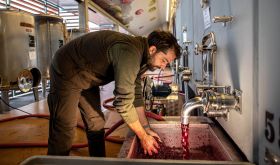
Number 22 in our series of articles entered into our wine writing competition comes from Luc Giezenaar, who says this of himself:
Writing this was a welcome distraction to studying for my last WSET Diploma exam in November [he has since passed the Diploma – congratulations! RH]. I’m Dutch, live in Maastricht in the beautiful south of the Netherlands, closing in on 50, married to Brigitte and proud father of two daughters. I earned my living as trainer and IT consultant at Mercedes-Benz, quit my job and travelled the world with my wife and first daughter. Since we got back I have been self-employed, co-own a small craft beer and wine company with a beer expert, where we do combined beer and wine tastings (the worlds of craft beer and wine are slowly coming together), teach wine courses and daily dream of becoming a professional wine writer. Okay, that last bit is not entirely true, but writing for JancisRobinson.com would be the holy grail for me. I hope you enjoy my contribution.
You can read more of Luc's work at bottleblogger.com.
Cabernet Sauvignon from the Dutch mountains
Cabernet Sauvignon is the world's most widely planted grape. Except for Antarctica, it is probably grown in wine regions across all continents where the sun shines plentifully, as it is a late ripener. Some consider Bordeaux to be the most northerly region to properly grow Cabernet. But it is exactly this marginality of place that produces some of the best red wines in the world.
If Bordeaux is already challenging Cabernet country, how crazy must one be to plant Cabernet vines in the Netherlands. The low lands near the North Sea, home to the world's best DJs and infamous for coffee shops and Dutch directness, are not immediately associated with wine production.
Still, there are some 250 ha (620 acres) planted with vines and roughly 130 winegrowers operating commercially throughout the Netherlands. Furthest south, the hilly province of Limburg has the largest area under vine with 90 ha, followed by the provinces of Gelderland (70 ha), Overijssel, Noord-Brabant and Zeeland. Gelderland has the largest group of winegrowers registered, 40 no less, so average ownership of land is quite small.
Predominant varieties are white Vitis vinifera grapes such as Chardonnay, Riesling and Auxerrois and so-called hybrids that withstand cold and fungal diseases due to humidity. It rains quite a bit in Holland and the weather is as unpredictable as the US presidency.
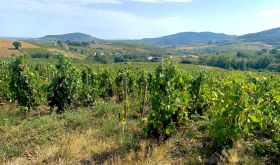
Therefore, being a winegrower in the Netherlands is not a walk in the park. So, why on earth would anyone make it even harder for himself and try to grow Cabernet Sauvignon so far north? Enter Ruud Verstegen, amicable owner of Landgoed Overst in the undulating countryside near Voerendaal, a village in Limburg, close to the German border.

A former supermarket owner, Verstegen took over the Overst estate in 2002 and while making wine only since 2003, he won the Dutch Winemaker of the Year award in 2010. Granted, there’s not that much competition to beat, but it is still a recognition of his meticulous work in the vineyards and cellar. The soil in this landwijn region (landwijn is equivalent to the French IGP, there is no hierarchy in appellations – each wine is labelled Landwijn plus the name of the region), consists of marl and loess, but at Overst a unique soil called Kundersteen dominates, a combination of hard marl and clay, named after the hamlet Kunrade, next to the vineyards.
At Overst, they grow seven varieties: Auxerrois, Riesling, Müller-Thurgau and Pinot Gris for white wine, Pinot Noir and Dornfelder for red wine. They also make a rosé from Pinot Gris and Pinot Noir and sparkling wine, both carbonation method (O'Secco) and traditional method, the latter apparently exclusively for a local restaurant.
Careful readers that counted only six grapes, you are right. The seventh and latest variety is indeed Cabernet Sauvignon. In 2011, several rows were planted at the northern edge of the vineyards, next to the A79 highway Maastricht–Heerlen. As it turned out, this spot enjoys the most sunshine hours and seemed like a good place to experiment. To put things in perspective, Bordeaux has on average 2,000 hours sunshine per year; Voerendaal has 1,400 hours.
The first vintage was 2013, not an easy year. In fact, it was quite a disastrous year for winegrowers in the northern hemisphere. Not much sun, lots of rain, causing diseases like powdery mildew and downy mildew, that resulted in much less yield than normal. Despite the challenges in his vineyard, Verstegen managed to harvest enough grapes by hand to largely fill one 225-litre used oak barrel, but needed to top up with juice from Cabernet Cortis and Cabernet Cantor to completely fill the barrel. Both are relatively new non-vinifera varieties, created in Germany to better resist mildew and frost. They resemble the noble Cabernet Sauvignon in colour, tannins and aromas. In this case, the juice was obtained from St Martinus in Vijlen.
Fermentation lasted for three weeks at 28 ºC during which part of the wine was separated to make rosé. The aim was to enhance the intensity of the flavours due to the higher skin-to-juice ratio. After four months of ageing in stainless steel, the wine aged for another two years in French oak. The wine was bottled half way through 2016.

Enough with all the background talk, what's in the glass? Dark purple and that typical Cabernet cassis smell, with oak coming in left and right and a greenish, herbaceous note that throws it off balance a bit. Low in alcohol (12%) with rather high acidity. Tannins are subtle but present, definitely not coarse, two years oak seems to have mellowed it all down drastically. It is lacking the complexity that Cabernet can reach in the right hands. But, hats off to the team at Overst for a first attempt as Dutch Cabernet. It is certainly not a glass to chuck away after a first sip.
And there is more to come. The 2014 vintage will be 100% Cabernet Sauvignon, and by the looks and taste of 2013, Verstegen is definitely on his way to defy all wine-course textbooks on grapes and their boundaries of climatic zones with his Overst Cabernet.