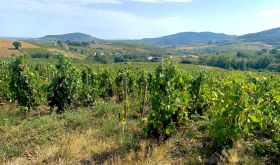
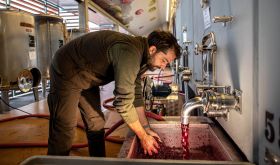
As a brand manager, a great deal of my time and sanity is spent on getting sales people and customers to support specific producers – no matter what I think of them. So when I work with a winery that is effortlessly fascinating, it makes my job much more pleasant. Sometimes all it takes is popping the first cork and getting a taste of something superb. Rarer still are the occasions when my heart leaps just reading about a producer – and that was most certainly the case with Château Maris and Bertie Eden.
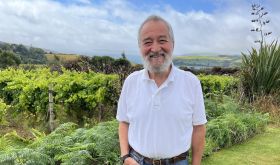
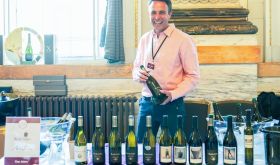
Even before we get into sustainability, Château Maris already has a tale worth telling. Bertie Eden (pictured above), great nephew of Prime Minister Anthony Eden, was asked to leave school after teachers discovered his first secretive forays into fermentation. He ended up in Australia where he found work on a vineyard before trotting the globe for a few decades making wine and eventually settling in the Minervois. I once asked him why this corner of France managed to keep hold of him when nowhere else had managed. He said something along the lines of: ‘Just look at it. Every day I wake up and feel lucky to be here.’
Given this adulation for natural beauty, it is perhaps unsurprising that along the way Bertie became a fierce champion of sustainable, organic, and biodynamic viticulture. He has channelled this into Château Maris, which has been farmed biodynamically since the early 2000s, which has resulted in an abundance of certifications: Ecocert 2002, Biodyvin 2004, Demeter in 2008, and most recently B Corp in 2016.
Château Maris are especially proud of the last, given that they were the first winery in Europe to win this all-encompassing certification. You can read more about this accolade here, but in a nutshell, B Corp rigorously assesses a company’s social and environmental efforts as a comprehensive whole: supply chain, employment, charitable giving, products, the works. Moreover, the award can only be retained through further improvement, which is assessed each year, encouraging an unflinching eye for ecological efficiency.
At its centre, B Corp is aiming to make ethics and sustainability good for business, a boon not a box-ticking exercise, and promote fundamental change. It is easy to see why Bertie was drawn to it, as he stands a staunchly outspoken advocate of this approach to making wine. You need only watch a few minutes of him speaking on the subject to be drawn in by his knowledge, fascination, and passion. (I recommend his webinar on bees, particularly 13.30 onwards, if only to hear the joy in the way he says the words ‘waggle dance’.) Of course, the wine itself is a fantastic ambassador for his methods, showing the quality and value that can be produced ethically and sustainably, without sacrificing anything in production.
The meticulous detail of this winemaking process is quite astonishing. Biodiversity is prized with around half of the estate’s land given over to local fauna – figs, broom, thyme, olive groves, oaks, and pines. Where possible, the vineyards are not irrigated to minimise water usage in an often drought-stricken area of France, and all vineyard work is done manually. Even the plough is horse-drawn.
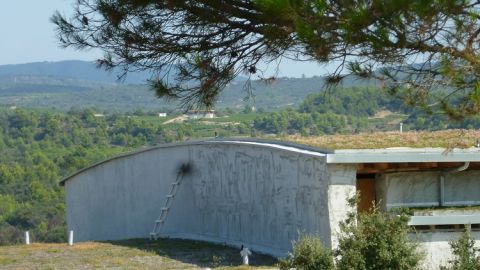
However, the winery itself is the pièce de resistance. The first of its kind, it was built out of compressed hemp bricks over eight years. This biodegradable material is around 50% lighter than commercial brick so was more efficient to transport and allowed construction to be carried out almost entirely by hand. Hemp was chosen for its natural insulation and the winery’s temperature is self-regulated through this breathable material and a double-walled design. The walls also passively absorb carbon dioxide, an effect compounded by the fact that the roof is covered in indigenous succulent plants. Ovoid fermentation vessels minimise the power needed for cap management, and the whole structure was built over three levels to facilitate the use of gravity. Every aspect of the design has contributed to the winery becoming entirely self-sufficient and carbon negative: it actually removes more carbon dioxide from the atmosphere than it contributes. This winery is purpose-built to represent Château Maris’ entirely uncompromising approach to making wine. The vision and initiative of this project is quite literally awesome.
The best part of Château Maris is that the wheels never stop turning in Bertie Eden’s head. The last conversation I had with him was taken off on a broad tangent about how to serve wine by the glass more efficiently: reducing carbon footprint in transport, minimising wastage both of wine and packaging, even the time spent serving. There is an understanding of the entire process of wine production that ties in very neatly to the fundamental biodynamic principle of considering the vineyard in its totality, treating it as a complex living organism. It is with some relish that I note d’Artagnan in the Three Musketeers came from Lupiac, just across the border in Gascony – the concept of ‘all for one, one for all’ is certainly close to home for Château Maris.