Time flies! Two years ago, when I submitted an entry for the summer 2018 writing competition, I was just starting at Eataly Chicago, June 2018. Gosh, I feel like I have been living dog years, because it seems like 10 years since then, with all the world events that have gone on and the sorry state that my home country, the US is in right now. Walking into the wine store was one of my happy places. I put all the anxiety about the state of things aside and focused on the guests in the store and the wines, whether setting up a display, restocking the shelf or teaching a class. Pre-COVID, the store was constantly abuzz with people and lots of them.
I took the job at Eataly to challenge myself, to learn more about the dizzying world of Italian wines which in turn would help with my WSET Diploma studies. The first few weeks were a blur. There were thousands of wines on the shelves organized by white, red, rose, sparkling, sweet and the still red and whites by region. I would go home with a headache from trying to remember as much as I could and get up to speed as quickly as possible (if there is something as getting up to speed in Italian wines). But the great thing about the shelves, was the variety of native grapes that were represented, particularly in regions like Piedmont, and the vast number of producers in regions like Tuscany. The challenge was trying to sort it all out. The 2 regions, that overtime, I seemed to find myself in or fielding questions on or sorting out the shelves were Piedmont and Tuscany. One other big attraction about working in the department was that although I was not a buyer of wines, we would still get to taste with producers if they were in the store during my shift. Many times, if the manager knew ahead of time and let us know, I would come in on a day off to meet the producer. The next best thing to being in Italy at a wine estate is tasting the wines with the producer leading you through them.
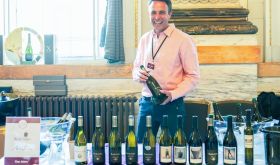
Well, even though my first week was an absolute whirlwind, I got to taste the wines of Salcheto Winery in Montepulciano with Michele Manelli, the owner (pictured above). We had a lot of his wines on the shelf. His bottles were distinctive with hands drawn on the label and the willow tree with a hand as its roots. (Salco, means willow tree and Salcheto is the name of a stream running through the estate.) He was very passionate about his sustainability efforts at the winery and with his long hair [now cut] and glasses looked like a college professor. I didn’t take very good notes but what I did take away was that Manelli was extremely focused on sustainability in all aspects of winemaking, from the vineyards to the cellar, focusing on minimizing inputs and in turn minimizing outputs. Salcheto was named Gambero Rosso 2014 Sustainable Winery of the Year. His vineyards are certified organic, and he practices biodynamic viticulture. The thing that stood out the most for me was their wine bottle which was unlike any other bottle on the shelf. Once you pick it up there is a world of difference in the weight, it is much lighter than any other bottle out there.

Salcheto was the first company in the world to have certified the carbon footprint of a bottle of wine (according to ISO 14064 standard, in 2011.) On their website is a CO2 calculator that indicates in a dynamic way, the emissions related to each bottle’s consumption, all the way through to the location where it was corked. The bottle style is called Bordolese Toscanella, reminiscent of the historical bottles used in Tuscany. It is the lightest and most ecologically friendly bottle on the market.
At the small, curated tasting bar within our department, the wine buyer had recently put Salcheto’s Vino Nobile di Montepulciano on the list. When I attended to guests at the wine bar counter that summer and gave them tastes of the wines we were pouring, I would have them pick up the Salcheto bottle and then compare its weight to one of the other bottles we were pouring. They always would be surprised at how much lighter it was. Most times, after tasting his wine, with such a fresh, approachable, clean style of Sangiovese (Prugnolo Gentile), they would pick his wine to drink. These bottles although so light did not break any more often than other bottles on the shelves. The wines were sitting in the Tuscan aisle not on a high traffic area display. If a bottle fell on the floor it broke (unlike what I call miracle bottles that even if they fall on a concrete floor they don’t shatter) and very obviously the cases were a lot easier to unpack.
Little did I realize at the time, I was such a new employee, that Manelli is one of the leaders of framing a sustainability model for Italian wine. Having worked for Edible Chicago magazine, I had been immersed in organic food, food sustainability and food welfare. I was happy to see in joining the team at Eataly, how many of the producers from different regions were focused on diminishing use of pesticides and biodiversity. By the end of 2019, our department head had set aside a separate shelf to highlight some of the organic and natural wine producers. However, even without starting to research and get into more of the details, Salcheto immediately came to mind as a sustainable producer to focus on for this piece because he was evaluating sustainability at his winery in such a comprehensive way.
Salcheto produces an annual sustainability report that focuses on the winery’s carbon footprint, its water footprint and they are testing a tool called a biodiversity index. They have even adopted a welfare plan for their employees. This report follows a standard set by Equalitas, an organization formed to promote the sustainability of the agrifood and wine supply chains. Equalitas was founded in 2015 by Federdoc (the group that supports all the DOCGs, DOCs of Italy). Michele Manelli is Vice President of Equalitas. Their objective is to formulate an approach to sustainability built on social, environmental and economic pillars and to ultimately provide a model and branding that consumers can recognize as a standard of sustainable practices in Italian wine. CSQA, the leading Italian agrifood certification company, Gambero Rosso, Italy’s largest food and wine publisher and 3AVino, a financial company based on the wine industry were partners in the project.
Whenever a guest asked about a low sulfur wine or an organic wine, Salcheto was one of my ‘go to’ wines. The moment a guest picked up the Salcheto bottle and compared its weight to another bottle, the lightness of the bottle was its own subliminal messaging for sustainability in packaging. COVID and being furloughed, plus Unit 3 of the WSET Diploma, Still Wines of the Entire World (2021 test), lead to my looking at other wine selling opportunities in Chicago. As I close the chapter at Eataly Chicago, writing about one of my first producer experiences of many at the store, I am excited as I move onto selling wine for the largest wine retailer in Illinois, Binnys. I am happy to say that Salcheto and its distinctive bottle with its sustainable story is on their shelves.