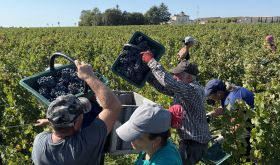

21 September 2022 What happened after the long, hot and extremely dry summer? Above: Merlot grapes being sorted at Le Pin earlier this month. See our guide to coverage of Bordeaux 2022.
On Saturday 17 September the temperature in the morning dropped to 10 °C (50 °F) with a bright, sunny but breezy 22 °C (72 °F) following in the afternoon. Much the same is expected this week, when a good percentage of the 2022 Cabernet Sauvignon will be harvested in the Médoc and Graves and the harvesting of Merlot on limestone-clay soils in St-Émilion will already be finished. It’s the ideal weather for both grapes and pickers, allowing the skins on the former a final tweak of refinement and the harvesters some respite from the heat that prevailed before. And, as yet, rain still hasn’t really made an appearance
Heat and drought are the markers of this Bordeaux vintage along, of course, with frost, hail and forest fires. Frost hit during the nights of 3 and 4 April and will have an impact on quantity (and occasionally quality) but less so than in 2017 and 2021. Likewise, the hail that laid waste to vineyards just north of St-Estèphe, the far south of the Médoc, Bourg, Fronsac and certain generic zones further east on 20 June. All told, 10,000 hectares (24,700 acres) suffered damage to some degree or another. This and the hot, dry conditions mean that yields in 2022 are expected to be low, the present estimates putting Bordeaux’s 2022 wine production down 2% on the five-year average but 12% up on 2021, which totalled a lowly 3.77 million hectolitres (99.6 million US gallons).
As for the forest fires, two broke out on 12 July, one near the holiday resort of Arcachon on the coast and the other on the edge of the Graves region at Landiras. Over 20,000 hectares of woodland were destroyed over a two-week period and there was concern that smoke taint could filter into grapes and eventually wine. But only a tiny percentage of vineyards (in the Graves) were close to the fire and a prevailing wind took much of the smoke away from vineyard areas. Laboratory analysis has so far allayed fears but checks will need to be maintained, especially since smoke from a more recent forest fire on 12 September to the west of the Médoc near Lacanau could be discerned in and around Bordeaux a couple of days later.
Earlier and earlier
This has turned into one of the earliest harvests ever. ‘The solar character of the vintage started from the first days of May leading to an early and qualitative flowering’, says vine-to-wine consultant David Pernet of Sovivins. Temperatures in May were 2.5 °C (4.5 °F) above average. Flowering started 16 May and was completed successfully by the end of the month, putting the vintage 10 days in advance of 2021. The heat then continued with peaks above 35 °C (95 °F) occurring in mid June, the second half of July and the beginning of August.
As for rainfall, winter precipitation in November and December had topped-up water tables but by mid June water deficiency was already being felt. This was somewhat alleviated by a stormy period between 20 and 30 June when rain (and hail) fell in varying quantities (75–150 mm/3–6 in) around the region. Thereafter, it wasn’t until mid August that rain fell again, with a frugal 26 mm (1 in) total for the month registered at the weather station in Bordeaux-Mérignac. One of the consequences of the hot, dry weather has been a reduction in size of the berries, another major reason for the drop in yields.
The white wine harvest started as early as 16 August with the majority harvested the week beginning 22 August (dates for Ch de Fieuzal, for instance, were 18–23 August). The heat and drought have reduced acidity levels (as is also the case for reds) so pH levels are generally a little higher than ideal. On a case-by-case basis there will probably be some recourse to acidification [though the university counselled against this, pointing out that acid levels tend to increase after fermentation – JR]. Thereafter, the quality of the aromatic profile is variable so it looks like a heterogeneous year for dry whites with yields on the low side.

The harvest for Merlot started the beginning of September on early-ripening sites and for many right-bank châteaux is already over. I spent a day in St-Émilion and Pomerol on 13 September and found that Ch L’Église-Clinet had already finished both Merlot and Cabernet Franc (harvest dates 31 August to 9 September) while Ch Cheval Blanc had harvested all the Merlot in six days (29 August to 3 September) and had just started harvesting the Cabernet Franc when I arrived. Christian Moueix later confirmed that Merlot at the Moueix properties in Pomerol had been picked 1–13 September and that the little Cabernet Franc they possess would probably be picked this week. Picking on later-ripening, clay-limestone sites started a little later but many will be finished by the end of this week.
On the left bank, the Merlot harvest started around 5 September and is now mainly over. As mentioned, the heart of the Cabernet Sauvignon was due to be picked this week with the last bunches next week. For Bordeaux, it means that, except for the region’s sweet wines, the harvest will be pretty well over by the end of the month. Despite the continuing clement conditions, the precocity of the year and extreme weather conditions mean 2022 is not a year for any delay in picking. In Sauternes and Barsac the grapes are looking ripe and healthy but noble rot has yet to set in. Fingers are crossed that, with the cooler mornings experienced this week, conditions will become more accommodating for the development of the fungus [poor growers had to wait until the beginning of October – JR].
Certain vineyards have clearly suffered from the heat and drought, in particular those with young vines and those on drier, sandy-gravel soils, but in general I have been surprised to see how resilient the vines have been this year. Leaf canopies have remained green and full and there hasn’t been the same wholesale yellowing and loss of leaves as seen in 2003. The heat regime has been similar (the drought more in line with 2005) but the feeling is that the vine is now better adapted to these conditions, as are viticultural techniques. Another plus for 2022 has been the virtual absence of fungal disease (grey rot and powdery and downy mildew) so the fruit has been coming in clean and treatments for disease were much reduced.
So far what is evident about 2022 reds is that they should have a rich, tannic base due to the small size of the berries and ripeness of the skins and, exceptionally so, the pips. Alcohol potential is also high. Merlot at some of the properties I visited was 14.5% and over, the Cabernet Sauvignon estimated at 13.5–14%. Acidity levels, on the other hand, are low with the malic acid in particular reduced by the heat and lack of rain, which means relatively high pHs [though in fact pHs ended up at lower levels than expected – JR]. Fruit quality depends on picking dates and judicious winemaking decisions. So extraction will need to be tempered and expertise required to bring everything into balance. The contrast with 2021 is certainly marked.
The potential for some very good, even excellent wines in a modern, solar vein is there, particularly from vineyards with sufficient clay and limestone in the soils. Here, the vine suffered less and aromatic finesse is more likely to be found. But there will be disparity based on terroir, vine age, yields and viticultural practices. Chaptalisation has been allowed up to 0.5% for reds and 1% for whites and rosés, an indication that vines shut down and grape maturity was blocked here and there. As to the authorisation to irrigate in Pomerol, St-Émilion and Pessac-Léognan, this seems a non-starter as relatively few growers complied and even fewer have sufficiently efficient underground or drip-irrigation systems in place to make a difference.