Volcanic Wine Awards | The Jancis Robinson Story | Mission Blind Tasting

The MW exam revisited

• 2 min read
MW
Institute of Masters of Wine logo

As our Sam Cole-Johnson and 216 others prepare to take the MW exams next week, we look back at the very first exam, set in 1953.

When writing yesterday’s FT article about the wine relationship between the British and the French, I wanted to research the original MW syllabus as I’d heard that it concentrated on France, plus the two fortified wines that were very common then, port and sherry, and the German wines that were so much more popular in the 1950s than today. So I asked the Institute of Masters of Wine’s executive director Sarah Harrison for details of the initial syllabus and she responded by sending me the first set of exam papers.

What struck me immediately was that these pre-dated the formation of the Institute of Masters of Wine because the papers were headed ‘The Worshipful Company of Vintners and The Wine and Spirit Association of Great Britain (Incorporated)’, the two UK trade organisations that originally fostered this now world-famous professional qualification. It was restricted to members of the UK wine trade until 1984 (when I was the first person outside the trade to qualify) and four years later was opened out to international candidates, in time for Michael Hill Smith of Australia to become the first non-British MW, each of us having passed exams very different from the original ones.

On the morning of Monday 11 May 1953 the handful of candidates then were asked to sit Paper IA on ‘Cultivation of the vine’ followed by an hour-long practical exam involving six faulty wines and several corks, all of which had to be assessed. In the afternoon came Paper IB entitled ‘Production of Wine’.

Tuesday morning’s paper was the most fascinating to me, Paper II on ‘The technique of handling wines, and general cellar procedure’ reproduced below. This clearly shows that most wine then arrived in the UK in cask, making adulteration and fraud much more likely, or at least possible, than today. The job of a UK wine importer in the 1950s (and 1960s) crucially involved treating bulk wine and bottling it. Even in the 1970s I remember encountering at least five working wine cellars under the streets of central London.

The fact that so much emphasis was put on wine faults in the first practical paper also indicates how common they then were. I can attest to the fact that when I started drinking wine, as a student in the late 1960s and early 1970s, only one bottle in three on average was free of such flaws as an excess of sulphite additions or oxidation. Whites were particularly prone to faults since temperature control was still relatively rare. Wine drinkers today are so much more fortunate.
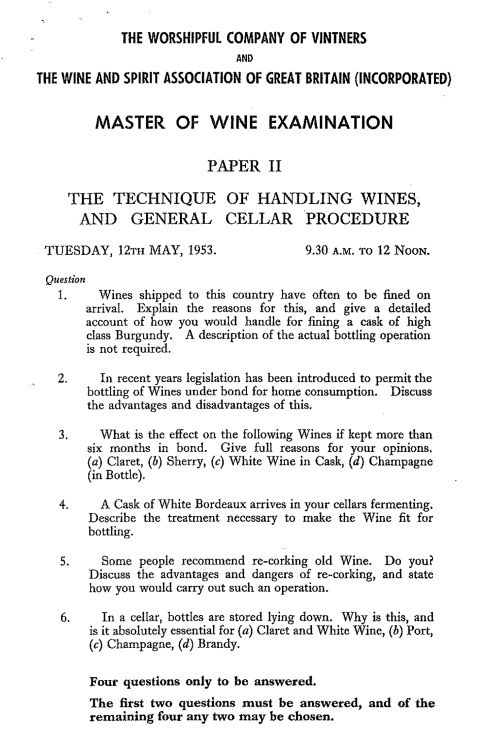
Paper II from the 1953 MW exam
Paper II from the very first (1953) MW exam

The second practical paper at the end of Tuesday morning involved identifying six white wines and matching a range of bottles to types of wine – again indicating how important bottling then was in the UK wine trade. The Tuesday afternoon paper was on ‘The history of wine and the Wine Trade’ (Wine Trade always capitalised!).

The exams finished at 1 pm on Wednesday after a morning paper entitled ‘General regulations affecting the sale of wine and marketing methods’ (hogsheads were mentioned several times even in this paper) and the third and final practical exam involving identifying six reds and a range of wine-related objects, all doubtless related to treating wine that arrived in barrel. See the Oxford Companion entries on château bottling and domaine bottling for a survey of when wines started being bottled at source.

As for the thrust of my initial enquiry, I was completely wrong in my assumption that the original MW syllabus was entirely focused on Europe. South Australia is mentioned twice and the Australian state of Victoria once in this set of 1953 papers. 

Best of luck to all those attempting the 2026 versions!

Book now for the Institute of Masters of Wine 2027 International Symposium to be held 15–18 April 2027 in Adelaide, Australia.

Wählen Sie Ihre Mitgliedschaft
Mitglied
$135
/Jahr
Über 15 % jährlich sparen
Ideal für Weinliebhaber
  • Zugang zu 294,675 Weinbewertungen und 16,075 Artikeln
  • Zugang zu The Oxford Companion to Wine und The World Atlas of Wine
Inner Circle
$249
/Jahr
 
Ideal für Sammler
  • Zugang zu 294,675 Weinbewertungen und 16,075 Artikeln
  • Zugang zu The Oxford Companion to Wine und The World Atlas of Wine
  • Frühzeitiger Zugang zu den neuesten Weinbewertungen und Artikeln, 48 Stunden im Voraus
Professional
$299
/Jahr
Für Weinprofis (Einzelnutzer)
  • Zugang zu 294,675 Weinbewertungen und 16,075 Artikeln
  • Zugang zu The Oxford Companion to Wine und The World Atlas of Wine
  • Frühzeitiger Zugang zu den neuesten Weinbewertungen und Artikeln, 48 Stunden im Voraus
  • Gewerbliche Nutzung von bis zu 25 Weinbewertungen und -punkten für Marketingzwecke
Gewerblich
$399
/Jahr
Für Unternehmen in der Weinbranche
  • Zugang zu 294,675 Weinbewertungen und 16,075 Artikeln
  • Zugang zu The Oxford Companion to Wine und The World Atlas of Wine
  • Frühzeitiger Zugang zu den neuesten Weinbewertungen und Artikeln, 48 Stunden im Voraus
  • Gewerbliche Nutzung von bis zu 250 Weinbewertungen und -punkten für Marketingzwecke
Bezahlen Sie mit
Visa logo Mastercard logo American Express logo Logo for more payment options
Abonnieren Sie unseren Newsletter

Erhalten Sie die neuesten Beiträge von Jancis und ihrem Team führender Weinexperten.

Mit dem Abonnement erklären Sie sich mit unserer Datenschutzerklärung einverstanden und stimmen zu, Updates von unserem Unternehmen zu erhalten.

More Gratis für alle

The Bull interior
Gratis für alle Great wine and pie in the Shires. Charlbury is pretty much the first stony outcrop of the Cotswolds that you...
Capsules-congés
Gratis für alle A look at Anglo-French love through the lens of wine. Plus a guide to the UK’s fine-wine traders. A shorter...
WWC26 announcement graphic
Gratis für alle 28 May 2026 Breaking news – Alecia Moore, aka P!NK, will be our guest judge for this year’s WWC. Moore...
2026 harvest at Mora
Gratis für alle A vintage that unfolded like a novel, with tension and twists and an ultimately satisfying ending, says Sophie Parker-Thomson MW...

More from JancisRobinson.com

Acered vineyard
Verkostungsberichte In celebration of Aragón’s entry into the upcoming World Atlas of Wine , Ferran explores the wines of Zaragoza. Above...
Alexandre Delétraz's (Cave des Amandiers) vineyards in Valais @ Leif Carlsson
Verkostungsberichte Red, white, young, old – there’s no shortage of diversity or deliciousness available in Swiss wines. You just need to...
Mt Ararat overlooking vineyards
Verkostungsberichte Reasons to drink more Riesling; best buys; and far-flung finds – highlights from a month of tastings. Above, Mount Ararat...
Dar Sinclair, Tangier
Unverblümte Meinungen Foreign parts feature heavily this month, including the villa above overlooking Tangier. But that’s far from all. I hope you...
Sally Abé of Teal
Nick über Restaurants An exciting new addition to the East London restaurant scene. Above, Sally Abé. Everything is on the small side at...
Niepoort rabbit illustration
Weine der Woche A traditional, versatile and inexpensive white port that is both dry and sweet – and doesn’t take itself too seriously...
Chianti Classico Collection 2026 banner
Verkostungsberichte Two notoriously difficult vintages, with very different outcomes. The image above, from Collezione Chianti Classico 2026 in Florence, is courtesy...
Three wine glasses and three miniature bottles, all containing small amounts of red wine
Verkostungsberichte From theory to practice: an MW critiques his own tasting prowess. Or lack of. Inspired by Sam’s Mission Blind Tasting...
Weininspiration wöchentlich direkt in Ihr Postfach
Unser Newsletter erscheint jede Woche und ist für alle gratis
Mit Ihrem Abonnement erkennen Sie unsere Allgemeinen Geschäftsbedingungen an.