
Kids these days.
Last weekend it was sunny in Portland. Walking back from the grocery, I spotted a group of brunching young women, the sun glittering off their cans of hard seltzer. Later, at dinner, a young man next to me ordered a blueberry vodka soda with his pasta Bolognese.
I should be used to it. It’s been almost a decade since White Claw repopularised the clear craze. But I was really hoping that we could bury it next to Zima.
Instead my sister (10 years my junior) fills me in on fresh horrors each month – gleefully telling me about the use of BORG (black-out rage gallon – composed of a fifth of hard liquor, electrolyte powder and water) as an acronym in the cultural zeitgeist or about an exciting new flavour of Buzzballz (dyed and flavoured RTDs packaged in a PET ball – a modern twist on MD 20/20).
I shift impatiently, trying to form a response to this unsavoury information. What can I give her? Maybe a frothing tirade on the cultural and gastronomic merits of wine?
But then what? Enlightenment? Hardly. I’ll just come off as yet another obnoxious wine pedant … and she, along with most of her friends, will head off in pursuit of whatever lighter, fruitier, easier beverage is shiniest.
So, something shiny.
The next time I see her, I hand her a bag full of goodies for her birthday. Inconspicuously nestled in the bag is a bottle of appetisingly saline, pale pink Txakoli. A wine that, like Prosecco, or rosé, the wine industry has, in days gone by, dismissed or maligned for being ‘lacking in concentration’, ‘solely primary-driven’ or ‘not ageworthy’ (alluded to in Ferran’s Txakoli – not to be dismissed), as if those are faults instead of selling points.
A gateway into wine. Pure bottled joy. Effervescent, fruity, saline, mineral, low alcohol. A refreshing and energising wine that you are encouraged to pour, out of a small pitcher, from as much of a height as you can manage, directly into your mouth, before passing the pitcher to the next person. Kitsch? No – cultural cachet!
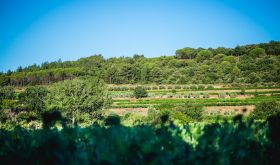
To be clear, Txakoli is not normally pink. Generally speaking, it is white. But the name is shorthand for the wine that comes from a group of Denominaciónes de Origen (DOs) rather than a specific grape variety – so producers can, if they choose, make it in any colour. However, in practice, not much of the area lends itself to red wines. The wine hails from the Basque Country, or ‘Green Spain’ – a delightfully romantic moniker that conjures up the lushness of the region rather than the very wet winters that blow off the Bay of Biscay to create that lushness. The area that produces Txakoli gets 1,000–1,750 mm of precipitation each year (39–69 in) and is classified as a cool climate – all of which means that it’s an anomaly as far as Spanish wine production goes. Producers struggle more with ripeness than with drought and so the wines that are considered the ‘most serious’ are those grown in the slightly warmer, slightly drier regions of Bizkaiko Txakolina or Arabako Txakolina, where there is the potential for more fullness and roundness.

But, as I am currently concerned with what I view as the very serious business of fun, I am recommending a Getariako Txakolina – an area that, due to the wet, cool climate, generally produces the lowest-alcohol, spritziest, most early-drinking wines. If I were queen of the world, I would insist it come in at least litre-sized bottles (luckily for the world, I am not).
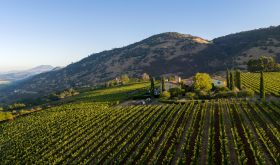
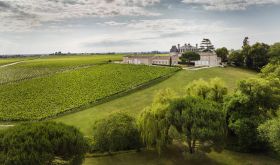
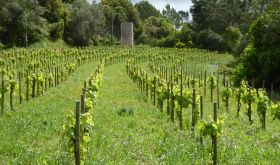
Within Getariako Txakolina resides the Ameztoi family – referred to by those who know them as the Criquet family due to the cricket’s symbolism as a creature of joy, happiness and pride. The fifth generation, Ignacio Ameztoi, is currently in charge of the 20-hectare (49-acre) estate that clings to the cliffs around the Bay of Biscay that rise 50 to 200 m (164–656 ft) in elevation. He, like generations before him, sticks resolutely to growing the native varieties Hondarribi Zuri (white) and Hondarribi Beltza (red).
But just because the varieties are the traditional ones does not mean that the winery has not adapted. In the early 2000s, there was very little interest in the red wines produced from Hondarribi Beltza. Many growers ripped out the vines. But the Ametzois were loath to rip out vines that had been planted as early as the 1840s and they saw a different solution. Rosé was booming, so they created the region’s first rosé, an almost instant success.
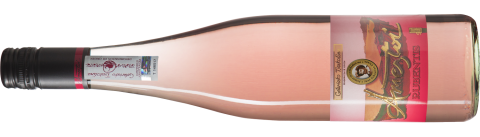
To make this wine, Hondarribi Beltza and Hondarribi Zuri are hand-picked before being completely destemmed and pressed together, with about equal parts of each variety. The must is then transferred to stainless-steel tanks where ambient yeasts take hold, and it ferments at 15 °C (59 °F) for around 20 days. To create the tell-tale effervescence the tanks are closed towards the end of fermentation to trap the last bit of CO2. After fermentation the wine is held at near freezing for 6 months on the lees with occasional stirring to create a bit of texture.
The 2022 is pale salmon-pink and smells like the sea, jalapeño peppers, crunchy red plum and warm linen. It’s bone dry and light-bodied with a lively effervescence and bracing acidity. It is commonly drunk, very cold, directly from a porrón* or poured from a great height into a steep-sided water glass to create a rush of bubbles. (To avoid spills, many opt for a speed pour that is fashioned to fit the neck of the bottle.) It is absolutely as good out of a wine glass.
Personally, I think it’s best paired with sunny days, fresh seafood and your favourite young person.
Please, tell the kids.
(And yes, in case you’re wondering, my sister is a convert. And the irony of my age is absolutely apparent to me.)
Members can explore another 100+ Txacoli in our tasting notes database.
All photos courtesy of De Maison Selections.
*Kerri Lesh, an anthropologist specialising in food and wine who holds a PhD in Basque studies, alerted us to the fact that the porrón is not traditional to the Basque Country. The association in the US, the largest export market for Getariako Txakolina at 60% of exports, may be due to the fact that the importer who has most enthusiastically promoted the wine, De Maison Selections, uses the porrón as their logo as 'a visual representation of communally sharing wine’, says Noah Chichester, explaining the photo at top. 'Even the French De Maison producers have used a porrón.’ Ferran Centelles, our Spanish specialist, points out that the porrón is traditional to Catalunya, parts of Aragón and Valencia, and that in the Basque Country you are more likely to experience escanciado service (a ritual in which the server pours from high above their head). So, while you are encouraged to consume however you like, don't expect porróns to be on hand in the Basque Country.