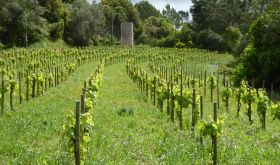
The 2009 Champagne harvest starts today in some of the grands crus of the Côte des Blancs such as Cramant, Avize, Chouilly and Le Mesnil-sur-Oger. Picking of the first black grapes – Pinot Noir and Meunier – began in the less well known, southernmost villages of the Côte des Bar region including Bar-sur-Seine, Buxeuil and Celles-sur-Ource on Tuesday (8 Sep), when some Chardonnay was also picked in Montgueux west of the city of Troyes. (Photo courtesy of Mick Rock, Cephas.)
Just before the Champagne harvest began, some highly unusual and important decisions about the permitted level of yield were made which have been widely mis-reported. Newspapers have got many of the facts wrong and in their efforts to sensationalise the story have often jumped to conclusions which bear little resemblance to what was in fact decided by the Comité Interprofessionnel des Vins de Champagne (CIVC) and the appellations authority, the INAO.
To an extent the Champenois themselves are partly to blame for this because of the extra layers of complication that have resulted from trying to find a solution, in the face of the recent plummeting of demand for champagne outside France, to the different needs of the two main groups involved. This year the interests of the growers, who own more than 90% of the vineyards, and those of the négociant houses, who sell two thirds of the wine, are diametrically opposed.
Before the harvest the champagne houses, or négociants, which had no desire to add to the large volume of maturing stock they already have in their cellars, were calling for 2009 yields to be pegged to 7,500 kg/ha. The growers, on the other hand, anxious to preserve their annual income, were saying they would not agree to anything below 10,400 kg/ha.
The compromise agreement the two sides came up with at last Wednesday's meeting of the Bureau Executive of the CIVC was that this year's harvest base yield would be a maximum of 9,700kg/ha, but that initially the cash-strapped merchants would have to pay for only 8,000 kg/ha in the 12 months after the harvest. The additional 1,700 kg/ha would not be awarded the Champagne appellation until October 2010 and the houses would pay for that in a one-off fifth payment to be made to the growers in November 2010. The houses would thus be able to use this extra volume for their brands only after the 2010 harvest. The growers, however, would be able immediately to bottle the full 9,700 kg/ha early next year, as is the norm in Champagne.
However, as Tim Hall quite correctly points out in members' forum, although it was far less widely reported, two days later (Friday 4 Sep) at the meeting with INAO to decide the harvest dates for the different villages in Champagne, the so-called rendement butoir, literally 'yield ceiling', was in fact fixed at 14,000 kg/ha.
This means that in addition to this 9,700 kg/ha, the growers are also allowed to put a maximum additional 4,300 kg/ha into their so-called réserves individuelles providing this does not take them beyond the maximum limit for these personal reserves of 8,000 kg per hectare (approximately the equivalent of half a harvest).
They can't therefore necessarily pick all the extra 4,300 kg/ha above the 9,700 kg/ha base yield. They can do this only if their current reserves are 3,700kg/ha or less, and in fact the average réserves individuelles holding for growers in Champagne is currently 4,900 kg/ha. So on average the maximum they will put away in reserve will be 3,100 kg/ha, making their total average yield from the 2009 harvest a maximum of 12,800 kg/ha – although 3,100 kg/ha of this will not have the right to the Champagne appellation until permission is given by the CIVC.
WHAT'S TRUE
- The harvest base yield has been fixed at 9,700 kg/ha. With 33,450 ha of vineyard expected to be in active production this year, that is the equivalent of around 275.8 m bottles of champagne.
- The houses will initially pay for just the first 8,000 kg/ha (equivalent to 227.5m bottles), in four quarterly payments following the harvest. They can bottle this champagne in the normal way early next year. The remaining 1,700 kg/ha (equivalent to 48.3m bottles) the houses have agreed to buy will effectively be declassified until October 2010, but the house will be able to add this wine to what they bottle immediately after the 2010 harvest. They will pay the growers for the extra 1,700 kg/ha in a one-off additional payment to be made in November 2010. This has never happened before.
- As is often the case in Champagne, there is an exception to this. Although the main co-opertaives were a party to this agreement and signed it, according to Ghislain de Montgolfier, président of the Union des Maisons de Champagne (UMC) and co-président of the CIVC, they have unilaterally decided to pay the growers for the full 9,700 kg/ha in four equal payments in the 12 months following the harvest.
- While the restrictions above apply to growers who sell only grapes, those who sell and bottle their own champagne, and those who do a bit of both, will be able to pick up to a maximum of 14,000 kg/ha in their vineyards (if that volume is available – which will not be universally true this year). The excess over the base yield of 9,700 kg/ha that they will be allowed to pick on average, given that there is already 4,900 kg/ha in their reserves individuelles, is 3,100kg/ha. Therefore the average that will be picked and used across the appellation will be around the 12,800 kg/ha, not 14,000 kg/ha. NB I say 'used' advisedly because some growers will be able to pick more than this 12,800 kg/ha but keep only the higher quality first pressing and discard the taille.
WHAT'S NOT TRUE
- After the harvest there will not be masses of grapes left to rot on the vine as reported in The Wall Street Journal, The (London) Times and the Daily Telegraph. This won't happen because in most cases nearly all the grapes in the vineyards are needed for the growers to reach the maximum yield they are permitted to pick, and for those that have the luxury of having more, they can harvest over that maximum and just keep the best-quality juice from the first pressing.
- Even if the absolute maximum yield was set at 8,000 kg or 9,700 kg/ha and there was no allowance for growers' reserves individuelles, they would still have to pick the lot as under the laws of the appellation any excess has to be picked and pressed and sent for distillation, not left to rot on the vine.
- 'A Champagne shortage could be just two years away' was reported in the Observer. The Champenois try to work on the basis of having three years' supply in their cellars and with demand dipping over the past 12 months, this stock has risen to closer to four years' supply, so there is no danger of a shortage in the near future, even if demand went back up above the 2007 record level of 338.7 million bottles, which no one is predicting is likely before 2012.
- There was not a 45% fall in exports in the first half of 2009 as reported in the Observer last Sunday and the Telegraph. Total champagne exports fell 36.43%, or 19.3 m bottles. The fall was greater in countries outside Europe, down 43.1%, while exports to European countries fell 31.6%, but because Europe accounts for around 60% (60.05% in 2008) of all exports, roughly equal volumes, a little over 9.5 million bottles, were lost in each sector.
- The Telegraph's suggestion that this fall is down to the fact that 'consumers in India, China and Russian have stopped buying the drink, for which they had only recently acquired a taste' is also a major exaggeration. Those three countries between them accounted for under 2.5 m bottles in 2008, much less champagne than we drink in the UK in a month.
- Total production of champagne in 2009 won't drop as dramatically as reports have suggested. While 405 million bottles were produced after the harvest in 2008, a total or around 363.94 million bottles will be made after the 2009 harvest, but initially only 275.8 million bottles of this will have the appellation and therefore could be sold, if made in a non-vintage style, from June 2011. The remaining 88 million or so bottles won't get the appellation until some future date, to be decided upon by the CIVC at the time of a shortage, whether that shortage is caused by a very small crop, or rapidly growing demand.