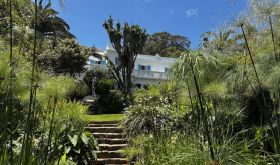
In 2011 France’s only IGP village designation, St-Guilhem-le-Désert – Cité d’Aniane, was created exclusively for one wine domaine in honour of the quality of their wines. It was for Mas de Daumas Gassac in the Languedoc.
Aimé Guibert was a tanner and glove maker, exporting worldwide. On his retirement in the 1980s an unlikely sequence of events led him to create what has become known as the grand cru of Languedoc. The domaine is now in the hands of four of his sons.
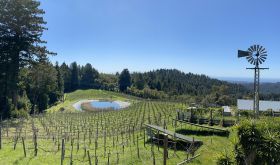
Searching for a retirement property, Guibert chanced upon a run-down domaine in a beautiful area, the Gassac Valley and its village Aniane. He was intending to plant fruit trees and maize when a friend, a professor of geography, happened to visit and discovered that the soil was particularly propitious. The soil, elevation, climate and underground water were apparently perfect for grape growing so Guibert planted vines instead. With warm days and cool nights the grapes would benefit from a long ripening period, unusual in this region.
Guibert had intended to clear forests to make wine on an industrial scale but his wife threatened to leave him if he cut down even one tree in this paradise. So he had a change of heart and decided to preserve the natural environment, particularly the living soil. He switched from quantity to quality, which was against the trend at the time.
To give the whites complexity, he sourced sélection massale scions from Bordeaux’s top châteaux for his reds and from Condrieu for his whites. For freshness he planted a large proportion of Petit Manseng, the signature grape of Jurançon Moelleux.
When visiting his former business clients around the world, he collected scions, ending up with 39 unusual grape varieties of which 18 are white. Many of these such as Neherleschol from Israel, Petite Arvine and Amigne from Switzerland and Khondorni and Tchilar from Armenia were little known. He fermented them all together.
His final stroke of luck was that the professor of geography happened to be at the University of Bordeaux with Émile Peynaud, who could not resist becoming involved in his first ‘birth of a grand cru’.
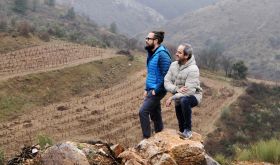
At the time, the local vignerons thought he was mad, but Guibert’s success led the way to creating a movement towards superior quality wines in the Languedoc, well ahead of their time. His sons (left to right) Roman, Samuel, Gaël and Basile are pictured by Guilhem Canal above right.
The first white wine vintage was 1986 and every 10 years a panel is invited to a vertical tasting. This tasting of their white wines in 2018 was an interesting and eye-opening experience.

A total of 23 vintages between 1987 and 2017 were poured. Not expecting much agreement between 16 tasters who were from several countries and wine backgrounds, I was surprised to see how much accord there actually was. Most tasters expressed astonishment at how well the wines had aged and many commented on the different stages of development, generally classed as ‘young and fruity’, ‘mid-life’ and ‘mature’. The stages do not reflect consecutive vintages; one of the older wines was still in its mid-life stage, for example. The wines express the vintage variations.
Depending on the stage of development of the wine, different grape varieties reveal themselves. The principal varieties are Petit Manseng (39% of the 2004, 33% of the 2017), Viognier, Chardonnay, and Chenin Blanc. The 18 rare grape varieties account for only 14–17% of the total, giving the wines complexity, interest and individuality. Residual sugar averaged 9 g/l in the wines tasted and the highest level was 12.2 g/l in 2013. Alcohol levels average 13.2%.
They have a big personality and are nothing like any other wine I know. Terms I would use to describe them are gastronomic, full-bodied, diverse flavours, plenty of fruit, rich, aromatic intensity, good extraction, fresh and lively, gentle sweetness, good length, complex. There is an intriguing balance between acidity, fruit and sweetness and the wines need to be understood to be fully appreciated.
The young and fruity stage is characterised by a limpid, light green-gold colour. Viognier or Chardonnay may show, as do citrus notes and minerality or saltiness. Freshness and vitality are particularly abundant.
The mid-life wines are gold in colour. Most have light oxidative, torrefied or caramel hints, giving more depth and character. Some had a tangy citrus-marmalade note or lime (linden) blossom; some were honeyed and some were creamy.
The mature wines are deep gold. More integrated, the sweetness is subdued and the tang from Petit Manseng makes up for any lack of acidity. Many had interesting notes reminiscent of rancio, giving them a new life. Liquorice appears in some as does caramelised quince, fatness and roundness.
We voted for the top five wines, five marks awarded for first place and one mark for fifth. All but one vintage (the 2003) received at least one vote and the top five, in descending order, were 2000, 2004, 1998, 1989 and 2016 tied with 2008. The most cited vintage was 2000 (11 times), then 2016 (9 times) followed by 1996, 1998 and 2017 (6 times).
To see if there was anything revealing about the top five, I number-crunched the wealth of data available for these elements: the harvest dates, percentage of each main grape variety, alcohol level, residual sugar, total acidity and pH. I wanted to see whether there were any common elements in the top five that differed from the rest of the wines and that could have made them the best.
Comparing the percentages of the properties of the top five with those of the other 17 wines tasted is very revealing. The Petit Manseng in the top five is 17% higher, the viognier 15% lower, the rare varieties 12% higher and the residual sugar 17% lower. These figures might well reflect the preferences of the tasters at this wonderful tasting. Who knows whether a different panel of tasters would have come to the same conclusions?