Natural wine fairs seem to occur more often than full moons these days, certainly if you live in Europe. But Brazil, whose wine industry is dominated by large companies, is perhaps the last wine-producing nation you’d expect to be involved in the natural wine scene.
Earlier this month I was in Rio de Janeiro en route back to Europe from New Zealand, where I had been working for nine months as acting editor of Wine Searcher’s magazine. My partner Brett and I decided to take a slow route back, mainly holiday but involving some stops to promote my [André Simon award-winning] Jura Wine book. I was in contact with Oswaldo Costa, a Brazilian wine lover and supporter of the book, who told me that by chance our visit to Rio would coincide with the first Franco-Brazilian natural wine encounter, and that my friends Pierre Overnoy and Emmanuel Houillon from the Jura would be present. Frankly, while the first fact was surprising enough, the second seemed to me downright impossible.
How on earth had the organisers enticed Overnoy to be the guest of honour at an event in Brazil, I wondered. Overnoy is known as one of the fathers of the natural wine movement, having made the wines from his Arbois-Pupillin domaine without any sulphur dioxide additions since 1986. Now retired, he has handed over the estate to his adopted son, Emmanuel Houillon, but neither are known as travellers. Overnoy’s wines may be revered all over the globe, from the USA to Japan through Denmark, but Overnoy has never visited these countries, so why Brazil? It took two delightful days in Rio de Janeiro to unravel this mystery.
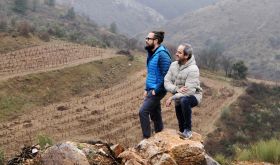
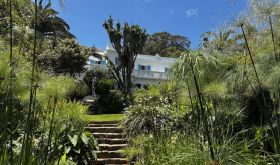
The Franco-Brazilian event (participants photographed here by Marco Daniele of Tormentas above Copacabana) brought together seven established French vignerons, well known in the natural wine world, and an equal number of fledgling Brazilian natural wine producers, all very tiny but who have adopted at the very least sustainable methods in the vineyards and who use few additives in the winery.
The event, staged first in Rio and then two days later in São Paulo, was put together by two Brazilians: Pedro Hermeto, owner of Restaurant Aprazivel in Rio, and wine enthusiast Alain Ingles. Together they also have a small French wine import business. They were assisted by Paris-based businessman Philippe Herbert, a natural wine enthusiast with good connections to the producers, who happens to spend a lot of time in Brazil.
A few years ago Hermeto and his mother, who founded Aprazivel, had been inspired by none other than Jonathan Nossiter (of Mondovino fame) to put together a more authentic wine list in their restaurant. At that time Nossiter lived partly in Brazil and loved the restaurant, but not their wines. Gradually Hermeto became enthused by French wines from small producers who worked with sustainable and organic methods – and the leap to liking natural wines did not take long. Meantime, Hermeto and his friend Ingles asked another devotee of the restaurant, Herbert, to help them organise some winery visits in France. This he did with alacrity and then asked them to return the favour in Brazil and show him the most authentic producers in the Serra Gaucha of Brazil, something they found challenging and intriguing.
And so the idea of staging an event was hatched, according to Ingles, ‘to promote the concept of natural wines here in Brazil and also the exchange of experience among the participating producers'. Less than two years later the trio turned their idea into reality, in what must have often seemed like an impossible logistical challenge.
In each city, a dinner was held on the eve of the tasting, giving attendees (who paid around US$100) a chance to try the French wines over a meal and to meet the producers – in Rio there were 54 paying guests. The following morning the 14 producers spent two hours in discussions about each other’s work before the tasting in the afternoon.
Trade and media were given earlier access to the tasting, but all had to pay for attendance (about $35) to help fund the event. Over 100 people attended in Rio, somewhat fewer in São Paulo. Each producer offered between two and four wines for tasting. Restaurateurs, sommeliers and wine-shop owners were the main visitors, but keen consumers included a smattering of media stars such as the huger-than-life, rock-jazz-fusion musician Ed Motta, a die-hard wine fan, and other artists and actors, all professing a love for sustainable wines. Throughout, there was a buzz of conversation (escalating to a loud babble later, somewhat off-putting along with whiffs of perfume) in a mixture of Portuguese, French and English, with everyone lending a hand when needed with translation. Some French producers spoke English but no Portuguese; most of the Brazilian producers spoke English or French.
The Brazilian producers were modest and grateful for the attention and support, tentatively offering their tiny-production wines, explaining sometimes that a particular wine was a projecto – an experiment – and especially proud when one of the French producers complimented them. Among them was Carlos Abarazua of Vinicola Geisse, owned by Mario Geisse, better known as winemaker for Chile’s Casa Silva. He was showing experimental sparkling wines that had undergone second fermentation with indigenous yeast. Perhaps the most accomplished wines were two Pinot Noirs offered by Mauricio Ribeiro of Vinhedo Serena, who started his vineyard in 2001 and was the first biodynamic producer in the country. A wonderful skin-contact Ribolla Gialla (the first wine made from that grape in Brazil) was shown by Dominio Vicari, owned by Lisette Vicari with her son José (who just happens to be a winemaker for the giant Salton winery). I was also impressed by their Sangiovese. Many Italian-inspired wines were shown by the Brazilians and another success was the Barbera from Tormentas, a small outfit owned by Marco Daniele. Wines from Arte da Vinha, Era dos Ventos and Vinha Unha leaned towards the more extreme side of natural winemaking but I found at least one wine from each producer that I enjoyed.
As for the French, they seemed delighted at the attention given to natural wines, intrigued by both the interest of the Brazilians and their colleagues’ efforts, and thrilled to be there in Brazil. Again and again, I heard them say they loved this opportunity to help others travel a path most of them had taken between five and 25 years ago.
Biodynamic producer Eric Pfifferling of Domaine d’Anglore in Tavel, who showed three dark-coloured rosés, two under the AOC label [one of which I much enjoyed in Paris on Saturday night – JR] and one Vin de France, made in what he termed the ‘old Tavel style', said he came because ‘we’ve been given so much and we try to give something back somewhere else'. Thomas Richaud, standing in for his father Marcel of the well-established southern Rhône producer Domaine Richaud, showed a range of delicious Côtes du Rhône-Villages Cairanne. He echoed Pfifferling’s sentiment and also said it was very rare for the domaine to participate in a fair outside France.
Sébastien Bobinet of Anjou, a real naturalista, inspired by Oliver Cousin, offered two of the most distinctive pencil-shaving/mineral-styled Cabernet Francs that I’ve tasted in a long while. He confessed that he had long dreamed of travelling to Brazil and that it was an adventure. But, he also came because of the organisers, who import a little of his wine: ‘Pedro and Alain were so kind and enthusiastic, I had to support them.’ His Loire colleague Pierre Breton, there with his wife Catherine and showing four distinctively different Bourgueils, said that he came because they were invited, effectively, by the vignerons, something that usually never happens. (The French paid their own way, but were offered all costs once in Brazil.) In addition, he said that the idea of being open, tolerant and listening to others allows the movement to progress. Beaujolais grower Jean Foillard, presenting four pristine Morgons aged in old Burgundian barrels, confessed that he loves to travel and does a lot of shows abroad, but explained his support in Brazil, saying: ‘At the start in natural wine, we shared experiences with others in France, later with those in Europe and now with the rest of the world.’
The erudite Alsacien Patrick Meyer of Domaine Julien Meyer, biodynamic since 1998, showed three bone-dry Rieslings and a Gewurztraminer, all with zero sulphur. He told me that usually he presents his wines only in Anjou at the well-known natural wine show La Dive and said emphatically and simply he was there because of Pierre Overnoy.
So why did Pierre himself and Emmanuel come along? They have no wine left to sell (it sells out on allocation each year), but generously brought along four wines to try – a Ploussard, Chardonnay and two topped-up Savagnins, including a 2004, topped up for 10 years. Pierre said simply that he came because he was invited… and Emmanuel came with him. In Rio, I saw the pair relishing every second, tasting, talking and, when the opportunity came, enjoying the trip to see Rio’s famous ‘Christ’ statue (Pierre is very religious), and drinking Caipirinhas as a post-tasting refresher.
The organisers of the event are not sure yet of plans for a repeat as it was a costly and time-consuming exercise, but they were simply over the moon with it. For me, this was truly a surprising and ground-breaking natural wine encounter, full of goodwill on both sides, with producers from every quarter of the natural wine movement, and some excellent wines.