I was thrilled when I first heard about two undiscovered wineries in Turkey: growers in the middle of nowhere, each having nurtured an obscure Anatolian variety and making wine from it. I got in touch with them to hear more about their story and to taste their wines. However, the more I got to know them, the more my curiosity turned into sadness.
These days after all, one wouldn’t want to invest in Turkish wine. The local market has become very restricted with alarmingly low consumption growing at a snail’s pace, yet newcomers face debilitating competition. And then of course our government is determined to go to any lengths to fight against alcohol use. It has already forced the closing of all company web sites and prevented any possible means of communication between producers and potential consumers (see Turkey cracks down on alcohol).
Fortunately, those people who invested in wine during the so-called ‘Turkish wine renaissance’ – the period after 1990 when the first boutique wineries started operating – are mostly smart, well-travelled people with resources and connections. They organise wine routes around the largest cities where most of our wineries are handily situated. Corporate dinners stimulate promotion by word of mouth, even if most media is limited by government restrictions. At last previously fragmented groups of wine producers are joining forces in earnest in various formations to try to break into new export markets.
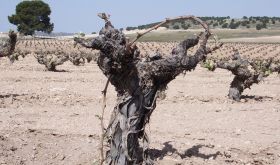
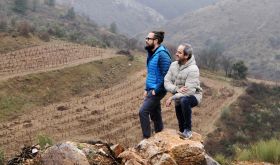
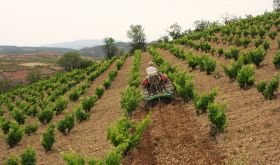
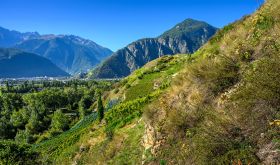
But by no means do they include Ali Ay and Erhan Özçanak, founders of Tasheli and Özçanak wineries respectively (Ali is in the middle of the picture above right, Erhan is on the right of the picture below, seen with his car-mechanic father). I found that, without the benefit of a winemaking neighbour in sight, they had no one to learn from or share ideas with. As a result, they have very little sense of wine quality, culture or the market in Turkey. They both do what they do by instinct and with limited resources, doing their best to follow the path of their ancestors. They work the soil, but the crop might equally be maize, sunflowers or wheat as much as wine grapes. Yet they chose to grow Patkara and Merzifon Karası grapes and were brave enough to consider turning them into wine. Wine that is regrettably ordinary, with faults masking most varietal character.

They were clearly in need of help but, given the conditions for even established winemakers, speculative commercial support was unlikely; it had to come from elsewhere. At about this time I heard about the Geoffrey Roberts Award offered by the eponymous trust since 1996.
‘Endeavouring to maintain a sense of continuity by awarding a bursary annually to a candidate who has a proven track record of successfully furthering the cause of wines from the New World, and who proposes to use the bursary to do something practical in the promotion and development of New World wines’, is the aim declared by the Geoffrey Roberts Trust that administers the annual award now in conjunction with The Vintners' Company .
If I could only persuade the panel of judges that Turkey, routinely marketed as ‘the birthplace of wine’, actually belonged to the New World, then this sounded like a perfect match.
Although it is now considered an emerging winemaking country, Turkey has of course inherited a wine culture that is laced with the richest of customs and traditions. Successive civilisations produced wine here, despite Turkey’s Muslim identity during the Ottoman period. Non-Muslim communities such as ethnic Greeks, Armenians and Assyrians produced wine in nearly every region and were also allowed to control its trade.
On 1 May 1923, the forced population exchange between Greece and Turkey was instituted, resulting in the migration of 1,200,000 Orthodox Greek citizens from Turkey, taking with them nearly all the remaining winemaking families then operating. In the aftermath of the First World War, the forced migration of the Armenian settlers, responsible for most of the wine production further east, had already limited wine culture in Turkey to a few Alavi and Syriac villages which persevered with winemaking only for their own consumption . Within a decade, the country not only lost all its winemaking talent, but also its connection to thousands of years of accumulated knowledge of viticulture and winemaking. When the young republic’s institutions woke up to the situation by initiating a government enterprise, it was already too late.
Hope for Turkey’s wine-growing future resides in two things: first there’s a rumoured ocean of over 800 indigenous varieties, hidden amid the vast vineyards of Anatolia, which, fortunately, were never uprooted during times of oppression but used for other purposes such as molasses and vinegar production, or simply for drying and table grapes. Second, thanks to a handful of foresighted entrepreneurs who, during the early years of the republic, had either taken over wineries from their neighbours or were brave enough to establish their own, Turkey remains a winemaking country. Many small, quality-oriented producers propelled by the positive spirit of the early 2000s constitute the diligent, present-day players in around 150 licensed wineries.
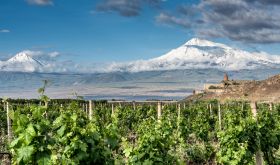
So I am very excited by the prospect of using the Geoffrey Roberts grant to partner Ali and Erhan with the established Urla Şarapçılık near İzmir, a wine enterprise that has agreed to help because of their love of adventure and indigenous grapes. We will be lending them assistance to make the best possible wine from their vineyards in the 2015 vintage so that they can be introduced to the world’s, or at least Turkey’s, wine drinkers to create some excitement. For both locations and varieties there has been no commercial bottling in recent history. However, both areas were part of the wine culture of Anatolia, as proven by the archaeological finds near the Mediterranean province of Mersin in the case of Tasheli, and the domestic fame of the wine once produced in Merzifon by the Armenian minority in the case of Özçanak in the Central Black Sea area.
Both wineries need technical assistance in the vineyard and the cellar to improve the quality of their wines, to identify the style and maturation suitable for the varieties involved. Quality is key to catching the market’s attention and being part of the limited trade in Turkey. But if we can mentor them to become successful and sustainable wineries, they might act as a role model for their peers.
And the mentors, if they can demonstrate the potential of these old vineyards and obscure varieties, might bring a sense of philanthropy rather than the rivalry that has long dominated our wine industry.
Who knows, this outing in the countryside may even help our dispirited industry blow the cobwebs away?