
If you could know the formula for great wine, would you want to? After all, nothing supernatural is involved. Wine quality depends on entirely tangible factors: weather, soil, grape variety, location, viticulture and vinification. Admittedly, these can be incredibly complex, but as analytical technology improves, it will become possible to quantify every detail and therefore to know every parameter of a given terroir, and the wine that comes from it.
There is something Faustian about such a prospect. Solving the riddle of terroir would surely rob it of the intrigue and inscrutability that is the very soul of its appeal. Perhaps the price of vinomniscience would be losing the ability to appreciate its mysteries.
Or perhaps not. After all, Faust is only a myth. Maybe terroir is too, and we shouldn’t deviate from our collective mission to decode it – because only then will we fully understand the true beauty of wine.
Either way, we are getting very close to finding out.

Costaflores is in Mendoza, Argentina, and their mission is to share every single detail of how their grapes are grown, how their wine is made, including the costs at every stage – even how it is sold, and where and when it is consumed. Furthermore, they are publishing this data online, totally free, with the aim of laying bare a process which is otherwise shrouded in secrecy.
Behind such an ambitious objective are multiple layers of cutting-edge technology, and the vision of one man. Mike Barrow is an IT professional who purchased Costaflores in 2003. He planted vines, made the first wines in 2007 but launched the open-source element only last year. He calls it OpenVino.
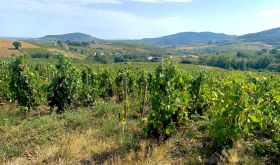
It works like this. Throughout the vineyard, sensors continually record data including temperature, wind speed, soil humidity. These numbers are automatically published online in a continuous process using a non-repudiation blockchain platform: in other words, once data has been written, it can never be modified.
As a result of this method, Costaflores define themselves as self-certified organic, since the proof of it is available for anyone to see (some examples of published data are linked to below). Additionally, 360º cameras and drones are deployed to allow anyone to view the vineyard themselves.
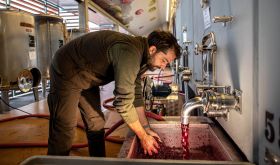
In the winery, every winemaking decision will be shared – volumes harvested, additions made, timing and temperature of fermentation and pressing – nothing will be left to the imagination.
Along the way, every cost will be logged and shared online too. A platform called OpenBravo will allow Costaflores to tell the world exactly how much was spent on corks, bottles, labels, boxes as well as taxes, marketing and even employee salaries – as this screenshot from their website shows.

But it doesn’t end there. One of the most intriguing systems governs how the wine itself is sold: as a cryptoasset. In the 2018 vintage, 16,384 bottles were produced, and exactly the same number of cryptocurrency coins were subsequently sold in an ‘initial coin offering’. These coins, known as MTB18, were released at the cost price of a bottle (in other words, with zero per cent profit), at 118 pesos each (£2.10/$2.65).
After one year in barrel and two years in bottle, the wine will be released, and whoever owns MTB18 coins can exchange them for the equivalent number of bottles. In the meantime, the coins can be traded like any other asset. Last month, MTB18 were selling for 250 pesos (£4.27/$5.62). This is en primeur for the 21st century, although Mike Barrow is keen to point out that he is not crowd-funding, or manipulating prices, but simply wants to let the market decide the value of his wine.
The technological tie-ins don’t stop once the wine is sold either. Plans are in place to print tags on the labels, which, when scanned by a smartphone, will allow the drinker to input their name, location – and the obligatory selfie, of course – allowing Costaflores to monitor how and where their wine is consumed, and above all what people actually think of it. In return for their feedback, consumers will be given a fractional share of ownership in the winery.
There is even a proposal for developing an app that allows users to help production decisions. As reported in the London Technology Club’s The Future Technology in Wine report, ‘for example, a player might be asked: “Should we irrigate the Malbec vines today?”. To properly answer the question, the player would need to check the data published by the Malbec moisture sensors. Thus, game players are validating real-world data.’
No one who has worked on an IT project of any scale will be surprised to hear that there have been some delays in implementing all this technology. Works-in-progress include a shared spreadsheet showing their daily vineyard work log, including their spraying regime among other things. Grape ripeness is recorded on their own wiki, giving a weekly record of the sugar levels, measured in Brix. You can also see a draft table of their economic model, and the step-by-step fermentation plan (in Spanish), including sulphur additions and acid adjustments.
Vineyard reports are already in a visualised form, covering soil moisture, temperature and humidity, while accounting and worklog dashboards are due to go live this month. Meanwhile, the ‘initial coin offering’ for the 2019 vintage has just gone live at a price of 199 pesos (£3.39/$4.45), and they will be available to purchase until 25 July. Below is a video explaining the process for last year's release.
Most winery websites eulogise about how their wine tastes, using florid language alongside enticing photography to describe their succulent berries or sweet spices or velvety texture. On Costaflores’s website, there is no such hyperbole. Instead, their professional practices are laid bare in a way that would horrify most winemakers.
Mike Barrow has clearly got nothing to hide, and the project is a fascinating case study in the ‘disruptive’ approach that technology can facilitate. Furthermore, by making all of these processes open-source, any other producer could implement similar schemes in order to measure and decode the secrets of their own patch of terroir – if they’re brave enough.
But perhaps it’s not that Costaflores is demystifying terroir, but augmenting it with an interactive and immersive experience. Being able to see viticultural and vinification information in real time – and potentially participate with the decisions involved – offers an emotional investment in the brand which is far more powerful than any tasting note. For those who prefer terroir to be sacrosanct and mystical, this might seem like shameless oversharing. But for the wine drinker with an open mind, the information that Costaflores are offering is a temptation of Faustian proportions.