28 March 2026 In praise of time and Sassicaia. A version of this article is published by the Financial Times. See also the tasting article 2023 in Bolgheri.
How long does an opened bottle of wine last? I am constantly being asked this by those who nobly accept my leftovers from tasting sessions, mainly neighbours and family.
At least I’m free to give my leftovers away to those who appreciate them. I remember visiting the American wine critic Robert M Parker at his home in the depths of Maryland’s woodland. He told me that Maryland state law forbade transport of open containers of alcoholic liquid so that he was unable, legally, to share his, doubtless many, leftovers with his neighbours and had to pour them all away.
I’ve found different sorts of wine vary enormously in their ability to last in an opened bottle. German whites seem almost immortal. I’ve tried wines from half-consumed bottles in our fridge on return from a long trip and they seemed only very slightly duller than when I first tried them weeks before. In general whites seem to last longer than reds.
The most vulnerable wines, wines that smell and taste stale, flat and oxidised only the day after opening, seem to me to be some of the most expensive: fine red burgundies. Natural wines may not last very long either, thanks to their low level of the sulphites that are antioxidants.
In general reds based on the Cabernet Sauvignon grape, high in tannins, last longer than those based on the red burgundy grape Pinot Noir, and southern Rhône reds based on Grenache grapes decline more rapidly than one might expect in view of their relatively high alcohol levels. I was inspired to consider all this by my recent encounter with the just-released 2023 vintage of one of Tuscany’s most famous wines, Sassicaia, named after the sassi, pebbles in the vineyards responsible for it in Bolgheri on the once-malarial Tuscan coast (see this World Atlas of Wine map). I opened the bottle I was sent to taste on 14 February and was still enjoying the dregs almost a month later. What makes Sassicaia so special?
It owes its existence to Marchese Mario Incisa della Rocchetta, who fell in love with red bordeaux. In the 1940s he planted the Bordeaux grape Cabernet Sauvignon in a little plot in the woods high above the coast on his wife’s family’s 2,500-ha (6,178-acre) estate Tenuta San Guido. For many years, it was the family’s house wine but the extended family includes the famous 26th-generation Florentine wine merchant Piero Antinori. He convinced his uncle-by-marriage that the wine was worth commercialising and encouraged him to sell the 1968 in bulk to be bottled by Antinori – at 25 cents a litre – although since the 1970s Sassicaia has been made and bottled at the estate, which is mainly a thoroughbred stud and pioneer nature reserve.
Sassicaia was always an extremely unusual Italian wine. Not only was it made from French grapes (nowadays including about 15% Cabernet Franc), and grown in a region not known for wine, Sassicaia was obviously improved enormously by time in bottle, which has only become common for the majority of Italian wines this century. Not least because of the gloriousness of the 1985 vintage, it established itself as one of the world’s great red wines made in the image of bordeaux and inevitably attracted interest from other wine regions. Many of Italy’s most famous wine producers, and the odd Californian, have invested in Bolgheri and today there are more than 70 wine estates within the general Bolgheri and Bolgheri Superiore appellations. Sassicaia is the only wine in Italy to have its very own appellation, Bolgheri Sassicaia.
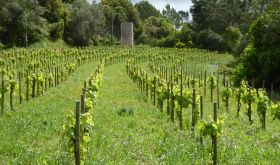
Not long after my first taste of Sassicaia 2023 in February I had a chance to compare it with 35 other 2023s from Bolgheri at the local Consorzio’s annual showing in London. (Good for them for submitting their wine to this generic tasting, ditto Ornellaia, the second most famous wine in Bolgheri.) This exercise confirmed the distinctiveness of this wine, now overseen by Mario’s granddaughter Priscilla Incisa della Rocchetta with Carlo Paoli as head of winemaking and Nicola Politi as agronomic director. They explained by email how important a part the original Castiglioncello plot of vines by the semi-ruined castle high above the Tyrrhenian Sea pictured above still is in influencing the savoury herbal/balsam flavour of the wine. Even though today its produce constitutes a fairly small portion of the blend, the vines are old and the site is higher and cooler than most Bolgheri vineyards.
In 2013 I was lucky enough to be part of a group invited by Sassicaia’s UK importer Armit to a long al fresco lunch by the Castiglioncello castle at which magnums of six vintages of Sassicaia were served, culminating in the famous 1985. We were all so captivated by the romantic, semi-ruined castle with its views down to the sea over less exalted vineyards that we asked why they didn’t do up the property – only to be told that the family had about 30 more buildings like it.
And, like Castiglioncello, Paoli explained, their vineyards tend to be surrounded by woodland, which provides the vines with a naturally healthy ecosystem, warding off pests, vine disease and drought. It’s also true that in the winery, only 40% new oak is used (almost all French), and Sassicaia is aged in barrel longer than most of its peers: 23 months for the 2023. The result is a wine that is the opposite of showy. In fact, every year I find it rather reticent at first but have come to realise that it just needs time to deliver its subtle message.
This is in stark contrast to Ornellaia. The estate was founded in 1981 by Piero Antinori’s brother Lodovico, who sold it to Robert Mondavi of Napa Valley and the Antinori’s big rivals the Frescobaldi family in 2002. After Mondavi was bought by the giant Constellation Brands in 2004, the Frescobaldi assumed full control of the estate and the wine continues to be notably opulent and attention-grabbing, perhaps partly because of its substantial Merlot component – and rather lower, warmer vineyards. My personal sample bottle of Ornellaia lost its freshness after not much more than 24 hours but it certainly doesn’t lack immediate appeal, perhaps especially to admirers of stereotypical Napa Cabernet.
In the early years Lodovico Antinori called in no shortage of winemaking expertise. The famously respected André Tchelistcheff of California originally, then others including the late Michel Rolland of Pomerol and Thomas Duroux, who now runs Château Palmer in Margaux. But when the Frescobaldi took over there was a period of stability, with German-born, Bordeaux-trained Axel Heinz making the wine from 2005 until he left to run Château Lascombes, also in Margaux, in 2023. He has been succeeded by an all-Italian team at last, Marco Balsimelli assisted by Denise Cosentino.
Intuitively I am no fan of the vast number of Italian wines, especially the so-called Supertuscans, made from French grapes that emerged in the late twentieth century and am delighted that Tuscany’s indigenous Sangiovese grape is admired and valued once more. But although I found many wines overripe, I did enjoy all the wines recommended below tasted in the Consorzio’s tasting, as well as the 2023 blend of 50% Sangiovese with Bordeaux grapes made in the hills above Bolgheri by Davy Zyw of Berry Bros & Rudd, who has just made history by being the first athlete (snowboarder in this case) with motor neurone disease to compete in a Winter Paralympics. Like Sassicaia, Poggio Lamentano 2023 (£49 Berry Bros & Rudd) is a slow burner.
2023 Bolgheri bordeaux blends
Antinori, Guado al Tasso 14.5%
£460 per case of 6 in bond, various merchants
Argentiera 14%
To be offered by Berry Bros & Rudd in August at about £60 a bottle in bond
Caccia al Piano 14%
To be offered by Ripley Wines; 2020 is £71.18
Fratini, Hortense 14%
To be offered at £175 Ellis Wines
Giorgio Meletti Cavallari, Impronte 14%
To be offered by Passione Vino
Grattamacco 14%
To be offered by Berry Bros & Rudd in October at about £60 a bottle in bond; see also Justerini & Brooks and Decorum Vintners
Meraviglia 14%
Imported into the UK by Liberty Wine
Sette Ciele, Noi 4 14.5%
2022 is £38 Swig
Sassicaia 14%
£1,250 per case of 6 in bond, various merchants
For more tasting notes, see 2023 in Bolgheri.
Image © Tenuta San Guido/MirrorAgency, photo by Lorenzo Ferroni.
Back to basics
How to keep an opened bottle of wine fresh |
|
To a certain extent, the longevity of an opened bottle of wine depends on the ullage, ie how low the level of wine is. The lower it is, the more oxygen will be in the bottle and it is the action of oxygen on wine that transforms it, potentially ageing it past repair.
I generally taste less than 10 cl (3.5 oz), often only 5 cl, from a standard 75-cl bottle so there is hardly any head space and my recipients can treat leftover bottles almost as though they were full – so long as the stopper is replaced soon after pouring the sample, which one has to do anyway with the increasingly common technical corks, mainly Diams, made of tiny little cork fragments which lack the elasticity of a natural cork (but also lack the risk of cork taint).
If a bottle is only half-full and you don’t intend to drink its contents immediately, it can be worth decanting the contents into an empty half-bottle to minimise the amount of oxygen acting on the wine.
And however much wine is left in an unopened bottle, it’s worth keeping it somewhere cool, storing even red wines in the fridge until you need them because low temperatures delay the action of oxygen on wine. |