8 March 2009 As if to prove my first assertion below, I have had more reaction to this article than to any recent FT article I can remember.
7 March 2009 This is a longer version of an article also published in the Financial Times.
People are funny about Pinot Noir. So many of them are so passionate about it that there are special Pinot Noir events all over the world.
The International Pinot Noir Celebration has been held every July in Oregon since 1987 and has spawned a copy in California’s Central Coast. New Zealand has no fewer than two Pinot Noir events, one in the capital Wellington and the other in Central Otago in ski country, vying with each other for how many attendees they can muster and how glorious an array of producers from the mother region, Burgundy, they can lure. Even Australia, which many Europeans might imagine is too hot for such a delicate variety as Pinot Noir, gave birth to the Mornington Peninsula Pinot Noir Celebration in 2003.
And all this before the movie Sideways singlehandedly turned American wine drinkers from Merlot fanciers to Pinotphiles. Since its hero Miles sang the praises of Burgundy’s red wine grape over two cinematic hours, the price of Pinot Noir grapes has rocketed so that American brand owners have been scouring the world in search of reasonable Pinot Noir, or wine that can be so labelled. (It recently came to light that the Languedoc in southern France has been exporting several times more ‘Pinot Noir’ than it grows.)
The inspiration for true lovers of Pinot Noir is of course red burgundy. This delicate, earthy, unpredictable, playful liquid gets under winemakers’ skin to such an extent that all over the world, where the climate is cool enough to allow the early-ripening Pinot Noir grape a chance of hanging on the vine long enough to develop some interesting flavours, people have been experimenting with the red burgundy grape.
Because Pinot Noir is so finicky, the results of these experiments have been much less obviously successful than when happier travellers such as Bordeaux’s Cabernet Sauvignon have been transplanted around the world. In fact, such has been commercial demand for Pinot Noir in the US that all too many wines sold as Pinot Noir there have been simply sweetish and soft rather than exhibiting any of Pinot’s delicacy and tantalisingly wide range of possible aromas: raspberries, strawberries, redcurrants, bitter cherries, violets, mushrooms, coffee (generally from barrels rather than grapes), autumn undergrowth, truffles, well hung game and many more.
A common problem with Pinots made by neophytes was that they were too dark, too heavy, too chewy and too concentrated – too Cabernet-like in fact. But all this is changing rapidly as those in what one might call the world’s Pinot Noir hotspots (cool spots?) – New Zealand, Oregon and parts of Germany and Australia – have become more proficient.
At the recent Mornington Peninsula Pinot Noir Celebration, I asked Frédéric Mugnier of Chambolle-Musigny, on his first-ever visit to Australia, what he thought of the Australian Pinot Noirs he had tasted there.'I was expecting them to be very heavy, dark, jammy wines that would be difficult to drink', he admitted, 'but in fact what I have tasted have been delicious wines, with fluidity, lightness in a positive way, wines that are definitely very enjoyable to drink. I see that winemakers have maybe changed their idea of the style they want to make.' (See my recent tasting notes on Mornington Pinots.)
And the weekend before at Central Otago’s Pinotfest, I had observed the same phenomenon. Four years before when I had attended the same event, I had been impressed by how flatteringly fruity Otago’s Pinot Noirs had been, but had rarely seen much complexity in the wines. The current crop of Central Otago, indeed all New Zealand Pinots were in general less obviously sweet, more restrained and becoming more complex and subtle. (It may be, incidentally, that the old fruit-bomb style has more mass-market appeal, but Pinot Noir has a habit of making wine professionals want to produce wines more like Burgundy’s best.) This was likely to happen as the vines, many of them recently planted, become older, drawing on a deeper root system, but I think there has been an evolution in ambition, too. (See my tasting notes on Central Otago 2007 Pinot Noirs and NZ Pinots in general.)
A key element in this transformation of Pinot styles, I suspect, has been the dramatic increase in imports of burgundy into both Australia and New Zealand. Close study of the prototype helps enormously to prove that Pinot Noir can be both delicate and absorbing at the same time (or as Paolo De Marchi of Tuscany said to me recently about his notably elegant Chianti Classico, ‘music doesn’t have to be loud to be good’).
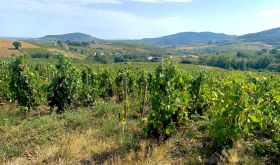
My few days in Victoria on the way home from New Zealand exposed me to some of Australia’s finest Pinot Noirs – most of them from Victoria’s cooler corners, although Tasmania can field a few challengers too. The Mornington Peninsula is reliably cooled by Antarctic influence and virtually all the Mornington Pinots (and Chardonnays) I tasted had lovely natural refreshing acidity, and were surprisingly transparent for Australian reds – the polar opposite of Barossa Shiraz, say. I then made my first visit to the producer of some of the finest Australian Pinot Noir I have encountered, Phillip Moraghan at Curly Flat in the Macedon Ranges. At 560 m elevation, he claims it is Australia’s coolest viticultural region and I can well believe him. It is barely an hour’s drive north of central Melbourne and hardly an hour from Yarra Valley to the east, where I had seen Pinot Noir grapes picked that morning, yet in the windswept vineyards of Curly Flat, the Pinot grapes were still small, hard and bright green. All over the state of Victoria are pockets of land cool enough to give Pinot Noir a delightfully long growing season and the wines that result seem to be getting better with every vintage.
Of all the world’s wine regions outside Burgundy, Oregon is the one most heavily dependent on Pinot Noir. Being so much cooler and greyer than California provided the initial inspiration for the most influential pioneer, ‘Papa Pinot’ David Lett of Eyrie Vineyards, who died late last year. Here, too, wine styles are in transition, largely as a result of experimentation with new, more burgundian clones of Pinot Noir. The earlier selections came from Switzerland and California. They resulted in slightly more obvious flavours than the new ‘Dijon’ clones but they did seem particularly well adapted to the growing season in Oregon’s Pinot Noir heartland, the Willamette Valley. Because Burgundy is so much cooler than Oregon, its treasured clones of Pinot Noir can ripen a little bit too fast in a warm Willamette summer so there is still some fine tuning in Oregon’s vineyards.
Nevertheless there is a notable contrast between the style of Pinot Noir produced in Oregon and some of the most obvious styles of California Pinot Noir, which, with the exception of wines as subtle as those listed here, can often seem just too potent and sweet to outsiders more used to burgundy, however lauded they may be in their own market. Pinot Noir-making may be yet another field in which Californians are carving their own very distinctive path.
AUSTRALIA
Bass Philip
Bindi
Curly Flat
Eldridge Estate
Epis
Freycinet/Wineglass Bay
Gembrook Hill
Kelvedon Estate
Hurley
Paradigm Hill
CALIFORNIA
Au Bon Climat
Flowers
Hanzell
Littorai
Navarro
Saintsbury
Sanford
NEW ZEALAND
Bell Hill
Felton Road
Greenhough
Julicher
Muddy Water
Neudorf
Palliser
Rippon
OREGON
Domaine Drouhin
Evening Land
Eyrie
Ponzi
WillaKenzie