20 July 2020 Waste product or wine substitute? It's the height of fashion in North America. Arnica Rowan considers the social implications as well as the taste.
In François Rozier's late-18th-century manual Cours complet d'agriculture (Complete Course in Agriculture, Volume 7, 1786), instructions on how to make piquette are simple.
I’ll paraphrase from page 714’s ancient French: ‘Once you are done fermenting the wine and have removed the wine from the mashed-up grapes, throw the grapes into some kind of container. Add as much water as grape must. Within the day, a little fermentation will start. The second day, add as much water again. If you added all the water at once, you would have ended up with a watery mess. Then on the eight to tenth, or twelfth day, drain the liquid into a barrel. The liquid will bubble and foam like a wine, although it isn’t coloured or viscous like you are used to. If you want to give body to the little wine, you need to add sugar or honey. Store the piquette in barrel – it will last until the next year’s harvest.’
Purists – hold onto your hats. This summer’s hottest drink in North America’s hip wine bars (read Anna-Lisa Campos's What’s hot in New York) isn’t rosé. (How passé.) It isn’t even bubbles. If you really are in the know, this summer you’ll be ordering piquette.
Created originally as a farm workers’ drink, but rejuvenated by the sustainability movement and millennials' thirst for crossover beverages, piquette has burst onto the drinks scene.
What is it? Well, it’s not wine, exactly. It’s a petit vin. Much like small beers from Belgium and ciderkins from the UK, piquette is a beverage made from the remains of the winemaking process. Piquette is a third wine. The first wine is from free-run juice, the second from pressed grapes, and the third, from the leftover grape skins and seeds themselves.
Piquette’s North American pioneer is Todd Cavallo from Wild Arc Farm in the Hudson Valley region of New York state. Todd’s family began farming vegetables and herbs, making tisanes, tinctures and a little wine from the mixed vineyards in the nearby hills. Being sustainability-minded, he was reluctant to throw the leftover crushed grapes away after winemaking. In Wild Arc’s first vintage, he made a grappa-like spirit from the must. But after a friend gave him an old agricultural manual describing piquette, he decided to ‘throw the must into a tank and see what happened'.
Making piquette is perhaps a bit trickier than the 1785 manual describes, given today’s winemaking preference for cleanliness and pure flavours. ‘The New York climate helps', Todd told me recently over the phone, after a long day of shoot thinning. The cool eastern seaboard climate enables the grapes to retain high acidity, which discourages the growth of Brettanomyces and other unsavoury developments. Still, piquette develops a floating yeast cover while fermenting, similar to the flor that develops on fino and manzanilla sherry in barrel. When Todd sent his piquette off to a wine lab in Ontario, Canada, they found that in addition to the regular yeasts found in wine, there were also yeasts more commonly found in cider and beer.
The atypical aromas that arise from these yeasts and the process of making piquette are embraced by many natural wine drinkers, according to Todd, since they already appreciate a wider palette of flavours than drinkers of conventional wines.
It’s a hit with millennials who seek out beverages that blur the lines between traditional beverages such as cider, beer and wine. Todd told me that he purposely doesn’t label piquette as a wine, because then drinkers are more open to the unusual taste and aromas.
I respectfully disagree with Tim Jackson MW’s ‘not nice’ comment about Wild Arc Farm’s Piquette Traminette in his article on the state of New York wine. I quite enjoyed the piquette samples Todd shipped across the continent to me in Vancouver. Of course, I wasn’t tasting them in a line-up of fine wines, nor gauging them on the same criteria. The piquettes were sampled at my kitchen table, over charcuterie shared with friends.
The Traminette, a Gewürztraminer hybrid, has some of the same cis-rose oxide aromas as its parent variety, with fragrances of rose and cantaloupe. The hybrid Marquette rosé smacked of hibiscus tea and raspberries, reminiscent of its grandparent grape, Pinot Noir. All the piquettes were simple and cheerful, juicy with medium-high acid, low alcohol (7%), cloudy, and prickly on the palate in a kombucha sort of way. Very quaffable.
Todd’s hit piquettes, served in the most fashionable wine bars in New York state, have paved the way for other American, Canadian and even Australian producers to experiment with piquette. The material costs are extremely low, so even after the labour cost (piquette requires even more cellar attention than a regular wine), the resulting product can be sold at a more accessible price than wine while retaining good margins for the producer.
Last week I also also cracked open two cans of piquette from western Canadian négociant Michael Shindler, whose natural wine brand is called a Sunday in August (lower case ‘a’).
I generously shared the cans of rosé and blanc with my husband out in the sunshine in our garden in the Okanagan Valley. I poured myself a half glass of each and, pushing the half-full cans across the picnic table to him, painstakingly explained what a rare commodity these cute little drinks were.
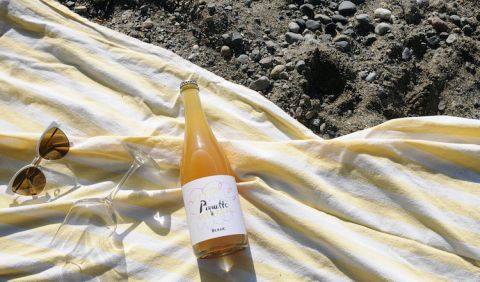
a Sunday in August’s marketing is incredibly endearing, evoking that easy-going summer feeling. In mid May, brand master Michael posted on Instagram, announcing his first release of a Sunday in August piquettes. The rosé, rouge and blanc bottles were pictured lounging together in a basket on a blanket on the beach in Vancouver. Within an hour, the 500 cases of bottle and cans were all gone, sold to the fans with the fastest fingers. This is the kind of excitement piquette generates.
‘It tastes more like a sour beer, than wine', pronounced my husband appreciatively, drinking directly from the piquette blanc can. ‘Kinda tart, but fruity. Acidic, dry ... I like it. Can we get some more?’
Not until next year, my dear.
Sitting out in the sun evoked a memory of the first time I tried piquette. A couple of years ago I attended a week-long educational tour through Rioja as part of the Certified Rioja Wine Educator programme. To recover from the luxurious week of wining and dining in the gracious homes of the region’s bodegueros, I strapped on my backpack in Logroño and started walking the Camino de Santiago pilgrimage trail. The second morning of my walk westward, I came upon a group of workers harvesting a vineyard. Using my new knowledge and enthusiastic, although limited, Spanish, I asked them if they were harvesting Viura grapes. The crew, just sitting down to lunch, was impressed at my varietal knowledge, and asked me to join them.
We sat on the dusty ground together, in the shade of a picking truck. My host, a smiling older man in his seventies, spread out an amazing selection of meats, cheese and pickles on a blanket. We sat there chatting in gestures about the harvest, and he passed me a unlabelled green bottle, indicated for me to take a swig. It was cool, prickly, watery and acidic, tasting of fresh strawberries and lemonade. I have no idea what colour it was, but it was incredibly refreshing and exactly the right drink for manual work on a hot October day.
Not everyone has the same appreciation for piquette. Today in France, if you comment ‘ce vin, c’est vraiement de la piquette', you are essentially calling the beverage in hand disgusting. In European countries where little wines are still made by farm workers, the high-brow wine trade uses the term piquette as an insult.
Why? Perhaps, after decades of vignerons ameliorating winemaking techniques to focus on quality, not quantity, the last thing they want to promote is a watered-down waste product with simple aromas and a short lifespan. Or perhaps, as seasoned wine journalists Dorothy J Gaiter and John Brecher recently commented, ‘wine has been moving back to the tastevin age of snobbery, one-upmanship, pretentiousness and exclusivity'.
Piquette essentially gets to the heart of the question, who is wine for?
Is wine meant to be an everyday drink for the masses, or a luxury product that only a few people are deemed economically or socially appropriate to appreciate? Let’s face it – wine has a deep, tangled history of class, economic and social issues. Piquette wasn’t originally made to use organic waste or catch the attention of young, hip drinkers. Piquette was made because farm workers could never afford the wine they were so essential in making; only the third wine was accessible to their families.
Today, healthy wines of quality are steadily rising in price across the globe. Only mass-produced, industrially farmed, grossly manipulated wine is available to folks at the lower end of the economic spectrum. Piquette provides a third alternative – an affordable wine that comes from the same healthy, good-quality grapes that we use to make good-quality wine.
It’s sustainable, refreshing, and – darn it – a heck of a lot cheaper than fine wine.