Last month I was invited to host a wine tasting at the Ballymaloe Food Festival in County Cork. The next day there was a second wine tasting, this time of Irish wine presented by six local producers, who bravely battle one of the world’s less-hospitable climates for viticulture. Guess which tasting was the more popular – by quite a mile? The disease-resistant hybrids of southern Ireland proved a much bigger draw than my six ‘offbeat wines’ the night before, which ranged from Peter Jakob Kühn’s Quarzit dry Rheingau Riesling 2022 (the audience favourite) to a fine 2021 red Corbières from Domaine Ste-Marie des Crozes.
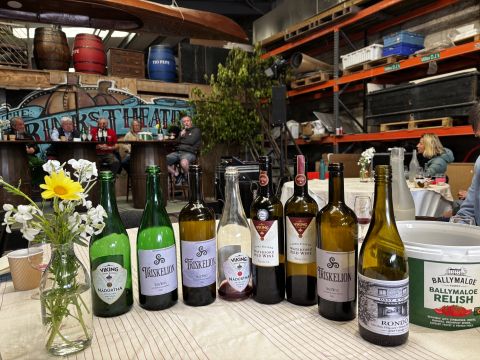
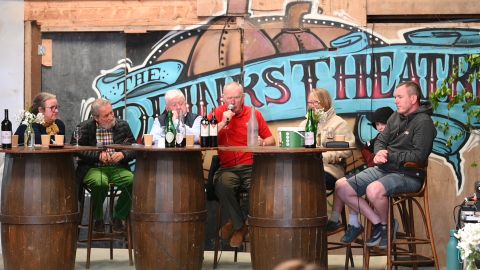
Actually, the joy of the Irish tasting was less the wines than their makers, and the man who had drawn them together, Colm McCan, who was once Ballymaloe’s sommelier. He now has a wine shop there and lives and breathes wine. McCan is a natural promoter of Irish wine and patrolled the stage of the festival’s Drinks Theatre – in a large, rather chilly farm shed overhung by an upturned canoe – asking us, ‘Are you having a good time now?’ and, even more hopefully, ‘Are you converts to Irish wine now?’ The bottles we tasted are shown below, with empty tubs of Ballymaloe’s famous tomato relish as spittoons.
He and his wife Aoife have planted a wide range of different vine varieties whose names she described as ‘lots of letters and numbers’, but they have discovered to their cost that ‘wind is the enemy’ on their relatively exposed site. Nevertheless, they have harvested enough ripe grapes to have been able to trial various ways of crushing them. ‘I can tell you that a potato masher is better than feet’, Aoife assured us, noting that this particular kitchen implement ‘has a suitably Irish vibe’ and is also nicely related to Ballymaloe’s world-famous cookery school. She implored any wannabe winemakers in the audience to keep the lid on their ferments. ‘Otherwise you’ll end up with vinegar’ and recounted a miserable domestic incident involving a too-warm demijohn of red wine and some cream curtains.
Although there have been sporadic outbursts of viticultural experimentation throughout Ireland, the longest-established current practitioner is Thomas Walk of Kinsale, who is one of those chaps whom doubt doth not assail. Brought up in Franken, he still spends much of the year in Germany but is mad on sailing and discovered Kinsale harbour in the early 1980s, ending up with a holiday home overlooking it on a site that looked promising for vine-growing. He went to Germany’s leading wine research institute at Geisenheim (a stone’s throw from Peter Jakob Kühn’s estate) and there met Professor Helmut Becker, who was developing a host of early-ripening German vinifera (all-European) crosses, which he recommended to Walk.
‘None of them worked’, according to Walk. But he then tried three of the new disease-resistant hybrids of vinifera varieties with other vine species, which were being specifically developed to ripen in cooler climates and needed relatively little spraying. Two had pale-skinned grapes, but it was the red-fleshed one, originally known as Gm 6494-5 and now called Rondo, that succeeded in Kinsale, the first planting of the variety outside Germany. Walk’s first vintage was 1989 and today Rondo is planted all over northern Europe. In Germany, these hybrids are called PiWis, short for Pilzwiderstandsfähige Rebsorten. ‘Terrible name’, Walk told us. ‘I suggested a much better one.’ (The Thomas Walk Vineyard, which is not open to the public, has apparently never been sprayed thanks to its PiWi status, and has never experienced frost thanks to its coastal position.)
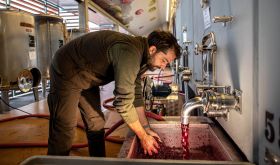
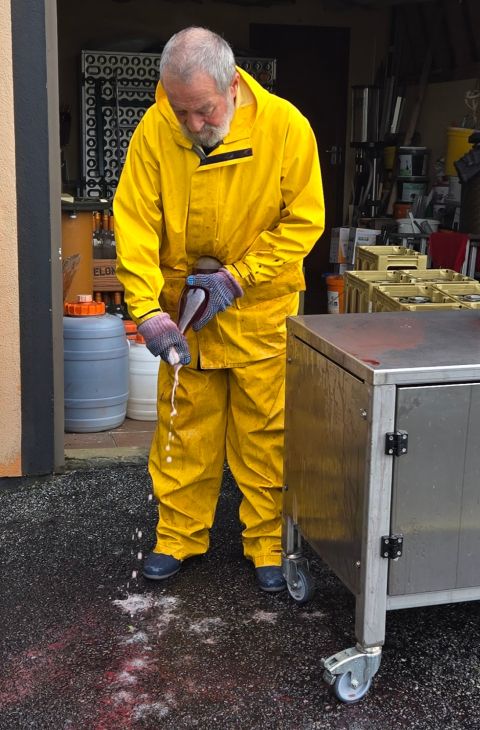
Such Rondos as I have tasted tend to be light, soft and fruity, but Walk claims that his Irish Rondo improves with age and that he has 10-year-old wines that are delicious now. ‘You just have to adjust to a new taste – like getting used to a new girlfriend’, is his advice. We didn’t have a chance to put this to the test as he still sells all his wine in Germany, but he is in the process of organising sales in Ireland. He told us with glee that he has registered the name ‘Exubérance’ for his traditional-method sparkling wine and described how he donned oilskins (see below) to shoot the sediment from the in-bottle second fermentation out of the bottlenecks by hand, at the rate of about 150 bottles a day.
More forthcoming with his output was David Dennison, owner of Viking Irish Drinks based on his farm in County Waterford. We tasted several different versions of his Nádúrtha (Irish for ‘natural’) wines, all based on various disease-resistant hybrids, of which the off-dry, lightly sparkling pale-orange pet-nat Viking No 3 at 10.5% alcohol was my favourite. The 2022 vintage of his Waterford Red Wine was much fresher and fruitier than the 2023, demonstrating the variability of vintages in Ireland. The bone-dry sparkling red Viking No 2 at 9% was a little short of body but had Rondo’s arresting red-berry aroma.
Dennison used to be a sommelier – indeed represented Ireland in international sommelier competitions – went into retail, opened one of Ireland’s first wine bars and visited vineyards all over the world. In 2009, he decided to plant vines and now has over 6,500 of them, but had to wait until 2014 until he had a sufficient crop for winemaking. He warned that in the Irish climate, even with PiWis (he tried and failed with vinifera varieties Bacchus and Pinot Noir), you have to play a long game, but he sees the naturally low alcohol levels as an asset. He supplements with cider production. His farm is an ecology showcase: it has somehow managed to achieve organic certification, despite Ireland’s damp climate, and is in its second year of biodynamic practices. He admitted that the pressure inside sparkling-wine bottles is such that ‘we do get the odd explosion, but it makes a nice smell in the stable where we make it’. He regularly teaches students of winemaking, who are expected to use their feet rather than potato mashers.
Also on stage was Irishman Séan Kerin – in shorts, with an Aussie accent – who studied wine production and made wine in Mornington Peninsula, the northern Rhône and West Sussex, as well as experiencing the harvest in Marlborough, after which: ‘I never want to see another Sauvignon Blanc grape ever again’. Back in Ireland, with partner Phillip Little, he now makes a range of Triskelion wines in County Kilkenny, from a total of 1,400 vines on two sheltered south-west-facing sites. He showed some embryonic 2025 cask samples and a pale amber 2023 pet-nat that seemed a bit tart after Dennison’s. Kerin’s tip was that rootstocks need to be chosen so as to limit the greenery for which Ireland is so famous. He also warned that production volumes of Irish wine are so small that prices were bound not to be. A bottle of David Llewellyn’s Lusca Rondo, Ireland’s best-distributed, from an enterprise north of Dublin, retails at about €50.
Madeline McKeever had come all the way from Skibbereen in West Cork, even though she is still experimenting with viticulture on her dairy farm. She tried protecting her 150 vines in a polytunnel and the resulting wine was apparently ‘absolutely vile’. She explained that her aim was ‘not to sell my wine to the world but to reduce my living costs’.
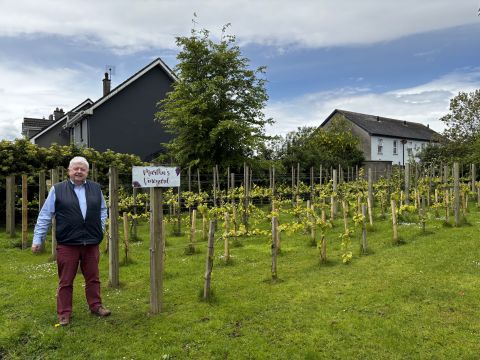
But the star of the show was Ballymaloe’s driver Ger (Gerard Wall, above), well named because of the walled garden in the nearby village of Cloyne in which he and his brother have planted a total of 160 examples of seven PiWis. ‘In October 2024 we picked the grapes, made the wine, bottled it – and spat it out again’, he told us. He has not found vine-growing easy, coming down one morning to see, picking over his grapes, ‘every starling this side of Belfast’.
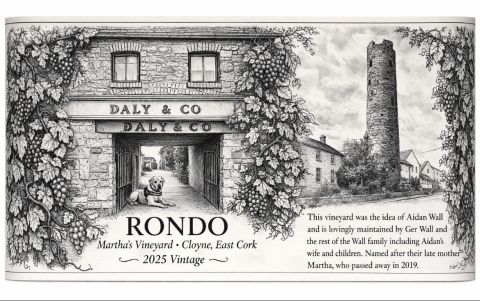
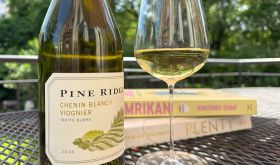
He explained he had had a visit one recent wet February from Dermot Sugrue, the most famous Irishman in English wine. Sugrue explained that his total annual production was about 100,000 bottles. ‘I told him I’d made 13’, Wall told us ruefully. But, for the Ballymaloe tasting, he was kind enough to spare two bottles of the 13 containing Daly & Co Martha’s Vineyard Rondo 2025, named for their late mother. ‘Try just a little leak of it’, he suggested as it was being poured. The label (above) is a lot more intricate than the wine – and the May family who own Napa Valley’s world-famous Martha’s Vineyard can sleep easy for now – but climate change is likely only to favour Ireland’s vignerons, already said to number almost 40.
Irish-owned wine estates
The famous Irish Catholic ‘Wine Geese’, who fled Ireland in the late 17th century, went on to establish such estates in Bordeaux as Châteaux Léoville and Langoa Barton, Lynch-Bages, Phélan Ségur, Kirwan, Clarke, Dillon and Mac Carthy, few of them Irish-owned today, unlike these wine producers outside Ireland.
Sugrue South Downs in Sussex
The Trouble with Dreams 2020 Sussex 12%
£48 Vin Cognito
Ch de Fieuzal, Pessac-Léognan, Bordeaux
Fieuzal Rouge 2016 13.5%
£43.64 iDealwine
Ch Tour des Termes, St-Estèphe, Bordeaux
Ch Tour des Termes Rouge 2020 13%
$39.99 The Wine Rack Hasbrouck Heights, NJ
Ch La Coste, Aix-en-Provence
Dom La Coste, Grand Vin Blanc 2024 13.5%
£45 Cépage
Les Deux Cols, southern Rhône
Ô Font 2024 Côtes du Rhône Rouge 14%
£18.95 Lea & Sandeman
Domaine des Anges, southern Rhône
La Sarabande, Faugères, Languedoc
Roka, Slovenia
Kog Furmint 2022 Štajerska Slovenija 12%
£55 Callmewine
For tasting notes, scores and suggested drinking dates of wines from these producers, see our tasting notes database. For international stockists see Wine-Searcher.com.
The image of Thomas Walk disgorging his sparkling wine by hand is courtesy of Thomas Walk Vineyard.