Summer 1945. Seven years after its annexation by Nazi Germany, Austria was once again a state in its own right, albeit by no means a sovereign one. Until March, more or less regular classes had been held at the Höhere Bundeslehranstalt und Bundesversuchsstation für Wein-, Obst- und Gartenbau in Klosterneuburg near Vienna. Then the oldest wine-growing school in the German-speaking area, founded in 1860, was drawn into the turmoil of the ‘final battle’. But apart from a few artillery hits on the Volkssturm barracks, the school buildings were spared. Then, after the passage of the Red Army in May, they were plundered. Research facilities and experimental areas were not spared.
If there had been an hour zero in Klosterneuburg, then it seemed to last no more than a minute. Classes were resumed almost immediately. But with whom? ‘The academics, ie professors, all of whom were Pg [Nazi party members], had all disappeared', said Professor Emil Planckh, who had been appointed provisional director.
For him it was a reunion with his old place of work. Together with the other Christian Socialist and clerical professors and employees of the school, the professor of growing and processing fruit had been removed from Klosterneuburg after the annexation of Austria in the summer of 1938. Ardent National Socialists, who were as numerous in Austrian viticulture as they were in ministerial bureaucracy, worked hard. Above all Friedrich Zweigelt, the long-standing director of the Federal Vine Breeding Station located in Klosterneuburg.
Zweigelt, born in 1888 near Graz, was a child of Sudeten German parents and a Styrian and thus a ‘borderland resident’ in two senses. He had been strictly national and anticlerical since his childhood. In 1933 he joined the Austrian Nazi party under the impression that power had been transferred to Hitler in Germany. The party's ban in June left him in no doubt. In 1938 he could boast of having been an ‘illegal fighter’ during the ‘prohibition period’.
When he was appointed the Austrian Nazis’ provisional director of the Klosterneuburger Anstalt in March 1938 (he was not allowed to call himself director until 1942), he came close to his goal. In the Berlin Reich Ministry for Food and Agriculture and among the officials of Reichsnährstand, the Austrian activist raised many suspicions. The ambition of making Klosterneuburg scientifically equal to the sister institution in Geisenheim in Germany was not at all appealing to the long-established Nazis.
In Klosterneuburg, Zweigelt had had no adversaries since the 1938 annexation. At his side were the Klosterneuburg graduate and Federal Cellar Inspector Heinrich Konlechner, who in 1936 had also become a member of the Nazi party, then banned in Austria, and Otto Kramer, since 1932 ‘Pg’ and activist in the Württemberg SS. Kramer had given up his position as chairman of the Weinbauversuchsanstalt in Weinsberg on 1 January 1939 in favour of a teaching and research position in Klosterneuburg. Yes, Klosterneuburg had become a National Socialist stronghold within a few years, as everyone could read in March 1942 in the magazine Das Weinland edited by Zweigelt.
Three years later, Hitler’s empire had collapsed. Zweigelt was arrested and taken to a detention camp in Klosterneuburg. During a search of his director's apartment, the state police found all sorts of incriminating material, including the manuscripts of three speeches Zweigelt had delivered to the assembled student body as director on 13 March each year on the occasion of the ‘liberation’ of Austria in 1938: the prose of a die-hard National Socialist, mixed with agitation for war. And, just as Zweigelt had disseminated every conceivable incriminating rumour about his colleagues in 1938, all of those he had treated badly lost no time informing on him to the state police in 1945.
Heinrich Konlechner was also booted out of Klosterneuburg in 1945 – for a while. As a civil servant, compromised by his membership of the Nazi party, he had to seek his livelihood in the private sector. In 1954 he was reactivated – and in 1961 even became director of Klosterneuburg. Kramer, on the other hand, returned to Württemberg and was hit hardest. His internment in an American camp in Ludwigsburg did not end until 1947. Handicapped by his long-standing Nazi career and the consequences of a gas attack in the First World War, he could no longer find employment. Zweigelt, on the other hand, was free again by Christmas 1945.
In Klosterneuburg, meanwhile, those who had already set the tone in the 1930s were again in charge. It was necessary not only to resume teaching, but also to continue scientific research, especially in vine breeding, which was so important for Austria. Even in the inter-war period the Austrians had hardly been able to profit from the selection and breeding efforts in Germany. There, Riesling and Silvaner were prominent for the white wine vines and Spätburgunder and Portugieser for the red wine varieties. The Austrians meanwhile were banking on Grüner Veltliner and Blaufränkisch. And they hoped for new crossings from their native grape varieties which were adapted to Austria’s climate, soils and other conditions. With these aims in mind, in 1921 Zweigelt had taken up the cause as head of a newly erected Federal Vine Breeding Station in Klosterneuburg.
But in 1945 vine breeding efforts had to start virtually from scratch. In 1950 Paul Steingruber, Zweigelt’s assistant, stated: ‘Unfortunately, there is little to be reported in the field of new varieties, since in 1945 it seems that cuttings that resulted from efforts begun in 1929, had disappeared from the two experimental facilities in Langenlois and Krems-Gneixendorf. According to information provided by the staff there, the facilities were simply cleared.’ In other words, a considerable part of what had been created since 1921 ‘with an enormous amount of work by the then Federal Vine Breeding Station, which had been created with modest means but considerable diligence’, seemed to have been irretrievably destroyed.
But Steingruber, who had been dismissed as head of the agricultural school in Retz by the Nazis in 1938 as a Christian Socialist partisan and had been recommended by Zweigelt for practical work (‘we National Socialists do not want to deprive such people of their bread either’), did not give up after his return to Klosterneuburg. A good 2,800 vines had survived the war, most of them in Klosterneuburg itself, a few in Krems. It was possible to work with this material. Of all the plants available in sufficient numbers, a total of 1,949 musts were fermented in 5- or 10-litre containers and tasted by experts and practitioners in Klosterneuburg in February 1950.
As expected, most wines did not stand up to comparison with the traditional noble varieties. Only a few crossings passed muster. This meant that, if possible, these vines would be multiplied so that in a fairly short space of time 'at least one to two hectolitres could be fermented normally in cask’. Among the promising new varieties were 27 for white wines and only eight for red. And even some of these turned out to be unsatisfactory. Blauer Portugieser x Blaufränkisch, for example, had a ‘very beautiful, dark colour’, and ‘smell and taste were very pronounced’, but ultimately the wine tasted ‘somewhat strange, bitter’.
Quite different was one of Zweigelt´s earliest new crossings made back in 1922: St Laurent x Blaufränkisch with the breed number 71-2, which was particularly well represented in the institution’s school vineyard as well as in the vineyard of the monastery of Klosterneuburg. The verdict was: ‘splendid colour, taste and smell – excellent, very nice type of red wine’.
Understandably, this promising grape variety did not then have a name. But that was about to change. By the beginning of the 1950s at the latest, wood from vines with the breeding number 71 had been grafted and planted at Lenz Moser's nursery in Rohrendorf near Krems. Then, in February 1956, there was devastating frost throughout Europe, which caused ‘the most severe damage’ to most red wine varieties, as Moser reported soon afterwards. Above all, the foreign varieties and the new varieties were frozen to death – ‘with the exception of Dr Zweigelt’s Blaufränkisch x St Laurent crossing’. (Moser transposed mother and father in his description.) ‘This new crossing already attracted attention in the earlier years due to its particularly early wood ripeness, great fertility, resistance to rot, early grape ripening and low acidity’, according to Moser. And now it demonstrated frost-hardiness, too. ‘This fact makes the variety very important for high training’, observed Moser, referring to the popular Lenz Moser vine training system.
Lenz Moser also thought about business, especially with red wine vines. ‘It will take about five years until this new variety can be sold as grafted vines’, was the message in December 1956. But Moser wouldn't be Moser if he hadn't also thought of the next step: ‘But since this variety has far too long a name, I asked the breeder if he would allow me to call his new variety simply Zweigelt-Traube’. Moser provided the reasoning at the same time: ‘Dr Zweigelt, the former head of the vine breeding station and later director of the viticulture school in Klosterneuburg, has rendered outstanding services to vine breeding. Unfortunately, we no longer have a Vine Breeding Committee and also no Selective Breeding Register; in my opinion, it would otherwise be the task of a state institution to coin such new variety names and officially recognise them.’
Thus Lenz Moser made a cast-iron proposal which, as far as can be seen, nobody in the Austria of the 1950s and 1960s was offended by. Why should they be? Hadn't the Nazi domination of Klosterneuburg between 1938 and 1945 more or less been forgotten? In 1950, in a publication commemorating the 90th anniversary of the institution, it was merely stated: ‘The year 1938 brought an abrupt departure from their place of work for many loyal employees.’ The names Zweigelt, Konlechner and Kramer were deliberately omitted.
And why not? Zweigelt was charged with treason in 1948 but was pardoned by the then Federal President Kurt Renner. Had the Public Prosecutor's Office in Vienna, which pleaded for the death penalty in Nazi trials against war criminals, not come to the conclusion that Zweigelt’s incitements to war were only ‘oratorical derailment’? Hadn't many well-known personalities argued since 1947 that Zweigelt had always defended Austrian viticulture against the Gleichschaltung (Nazification) tendencies of the Berlin National Socialists? And hadn't a ‘non-Aryan’ member of the Klosterneuburg College, the teacher of German Heinrich Weil, already defended Zweigelt in 1945 with credible statements; Zweigelt had supported him long after he had been removed from the school by the Nazis. Furthermore: Hadn't other National Socialists tried to prevent Zweigelt’s rise in 1938 by claiming that he had published his magazine Das Weinland with a Jewish publisher?
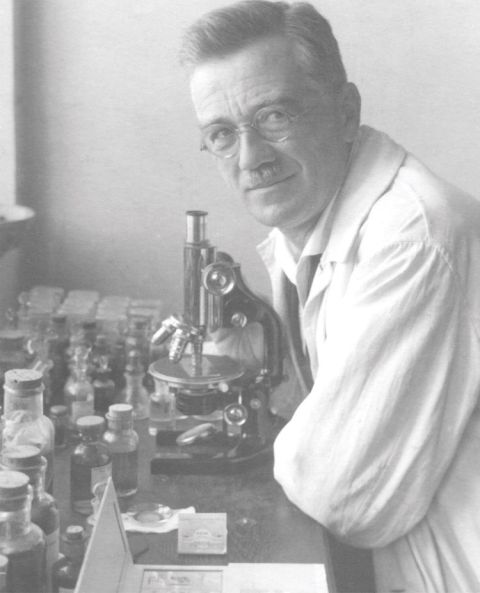
Even before 1938, it had not really been possible to reduce Zweigelt's life and work to his predisposition towards Nazism. In the inter-war period, this biologist with a doctorate, who had begun as an assistant in 1912 at the Botanical Experimental Laboratory and Laboratory for Plant Diseases at Klosterneuburg, was the most productive and influential figure in viticulture in Austria, and indeed throughout Central Europe. Fulfilled by the ‘German’ mission of making Klosterneuburg the ‘cultural hub of viticulture and fruit growing for the entire south-eastern region’, Zweigelt was not only the driving force behind vine breeding, but also fought doggedly against the spread of inferior hybrids of European and American vines that were so popular at that time in France and Central Europe. In Austria he established one expert committee after another, undertook study trips to all European wine-growing countries, and represented his country at numerous national and international wine-growing congresses.
No, the life of this incredibly ambitious and productive man could never have been reduced to simply having been a Nazi. And wasn't it usual anyway to name promising new breeds in honour of their breeder, just like Müller-Thurgau and Scheurebe. Lenz Moser was sure of his cause: ‘From 1960: Zweigelt crossings available', was the title of an article on the occasion of Zweigelt’s 70th ‘and [these] will make the name Dr Zweigelt immortal’.
Almost 100 years after it was bred, the red wine variety that is the result of the crossing made by Zweigelt, the efforts of Steingruber, and the business acumen of Lenz Moser, is the most widespread, and economically by far the most important, red grape variety in Austria, covering an area of about 6,400 hectares. It is hardly known outside Austria (so far). But some people think more of the ‘brown’ (Nazi) Zweigelt than of the ‘blue’ (Blauer) Zweigelt, even though so little has been known about the life and work of this man.
Once and for all Willi Klinger, the long-standing head of Austrian wine marketing, wanted to examine the elephant in the room. Against considerable resistance, he got his way in insisting that the first complete scientific work on wine in Austria, to be published in October 2019, should contain its own article on Fritz Zweigelt. I was commissioned to do the necessary research. Now it has to be decided in Austria whether the grape variety should be ‘de-Nazified’ or whether the fate of the Zweigeltrebe should be left to what Zweigelt noted a few months before his death in September 1964: ‘Thousands of crossings have been carried out for the breeding of new varieties and only a few, in my opinion, have fulfilled expectations. Blauer Zweigelt, a cross of St Laurent and Blaufränkisch, is particularly distinguished by quality, dependable flowering, rot resistance, early ripeness and extensive frost resistance, ie yield security (...) That the Zweigelt grape exists arouses mixed feelings in me. On the one hand the hope that it will probably survive me, and on the other hand the hope that many a person will be enraptured by this wine, as I was enraptured myself at the time with the joy of successful breeding.’
This is the translation of an article to be published in German in FINE magazine, September 2019. Dr Deckers has contributed a chapter on Dr Zweigelt to Willi Klinger and Karl Vocelka (eds), Wine in Austria: the history, published by Brandstätter, 7 October 2019 in German and by the end of 2019 in English.