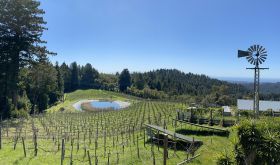
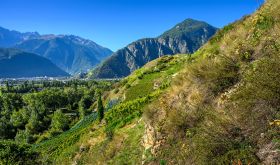
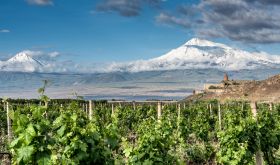
Anyone who has ever flown in to Australia knows how paranoid Australians are about imported insects and germs. Passengers are routinely sprayed before being allowed to disembark on to Australia's fiercely protected soil. Baggage halls are patrolled by dogs trained to sniff out the most minute speck of foodstuff or potentially infested wood or plant. The phylloxera louse ravaged the wine industry in the state of Victoria in the late 19th century and to this day South Australia, now the dominant wine state, is free of this fatal pest, thanks to stringent border controls. (I took this picture in Henschke's Hill of Grace vineyard in March.)
Australia's exceptionally strict quarantine procedures, and the hottest summer on record, are having a considerable impact on the development of the wine industry there. There is nothing more fashionable in Australian wine at the moment than what they call 'alternative varieties', grapes other than the standard likes of Shiraz, Chardonnay and Cabernet Sauvignon. But since it can take up to 11 – yes, 11 – years to get an imported vine cutting through quarantine and into production, it's a wonder that there are quite so many new varieties out there. There is now more Spanish Tempranillo and Tuscan Sangiovese, for example, than there is Cabernet Franc or Chenin Blanc. And other varieties that would have been regarded as impossibly exotic in the last century but of which there are more than 100 hectares planted today include Savagnin of the Jura (imported as Albariño of Spain but initially misidentified); Dolcetto, Nebbiolo and Barbera of Piemonte; Zinfandel of California; and Fiano of southern Italy.
While on holiday on the Greek island of Santorini in 2007, Peter Barry of Jim Barry Wines was struck, as well he might be, by the quality of wine produced by the indigenous Assyrtiko grape and reckoned that its thrilling flavour and ability to retain acidity could be just the job in his native Clare Valley in South Australia. It was only last September, however, that he was allowed to get his hands on his imported Assyrtiko grapevine and it will be another three years before Jim Barry will produce its first vintage of Assyrtiko – if all goes well. Barry is quoted as saying, 'by the time we release this wine, I will have committed 20 per cent of my life to this project, but it is preferable to passing from this world and wondering "what if?"'
He and his family intend for the moment to keep their Assyrtiko to themselves but Yalumba* of South Australia and the Chalmers family are in the business of disseminating the varieties they so laboriously import into Australia. Kim Chalmers was brought up on the New South Wales vine nursery developed by her parents and sold in 2008. She is carrying on their work specialising in Italian varieties downriver at Merbein in Victoria and is thrilled to have been responsible for nursing through the strictures of the Australian quarantine process vines such as the Nero d'Avola of Sicily, Sagrantino of Umbria, most of the Vermentino that is now so popular in Australia, and 'lots that haven't made a splash yet like Refosco, Schioppettino and the fantastic Nosiola'.
These were all originally imported by her family back in 1998 and are only now making wine in any quantity. Clearly blessed with a long-term view and healthy optimism, at the end of last year she set about organising an importation of the Italian white wine grapes Grechetto, Falanghina, Ribolla Gialla, Inzolia and two clones of Pecorino. She had been looking forward to seeing them eventually flourish in different corners of Australia but when I spoke to her last week she had just had a telephone call from the Australian Quarantine and Inspection Service at Knoxfield on the outskirts of Melbourne to say that every single one of the 60 cuttings she had had airfreighted in had died, setting back the existence of an Australian Grechetto by a full growing season, for cuttings can be taken only when vines have gone dormant in the autumn.
For each selection of clone and variety (Chalmers, for example, can offer 14 different Sangioveses and 10 different Nebbiolos) up to 10 dormant cuttings are packed in damp sawdust and couriered out to Melbourne (or Perth, where Australia's other permitted point of entry for grapevines is located). They are checked out by customs and then have to be fumigated before going into the lengthy quarantine. Because all 60 of these latest cuttings perished, and because the summer just past was Australia's hottest ever, Kim suspects that this rather heavy handed fumigation process may have exposed the cuttings to fatally high temperatures.
At the moment, the cuttings are propagated into potted vines and kept in one of the approved greenhouses where they have to be tested and observed for two complete growing cycles just to be sure that they are free of exotic pests and diseases. Eventually, after at least two and half years, a vine importer such as Kim will be presented with one vine a few feet high in a pot and from that single plant will have to develop sufficient quantity of vines to commercialise the variety and produce wine.
It takes two or three years for the propagation and then a further two or three years before the vine is bearing fruit. About a tenth of a hectare of a single selection is generally needed to provide cuttings for commercial sale, while a much bigger area is needed to produce wine in commercial quantity. Using tissue culture and more technologically advanced tests would speed up the process by several years. Mindful of the commercial handicaps, and seeing official vine collections suffer the effects of cutbacks as Australia's total vineyard area shrivels, the department of agriculture (known as DAFF in Australia) is proposing a quicker system.
But, being Australian, the authorities are unlikely to relax their requirement that all imported plant material comes from a fully certified source. Much as Kim, like so many wine enthusiasts today, loves the wonderfully idiosyncratic wines made from the ancient vine stumps on Mount Etna in Sicily, it is unlikely that she will ever be able to import the Nerello responsible for them because there is no nursery in the Etna region. Cuttings are passed informally from one grower to another. Heaven, but no official, knows how riddled with viruses they may be.
SOME FAVOURITE AUSTRALIAN ALTERNATIVES
Crittenden Estate, Los Hermanos Txacoli (Petit Manseng) 2012 King Valley
Crittenden, Los Hermanos Tribute Savagnin 2011 Mornington Peninsula
First Drop, Big Blind Nebbiolo/Barbera 2010 Adelaide Hills
Greenstone Sangiovese 2009 Heathcote
Hahndorf Hill, GRU Grüner Veltliner 2012 Adelaide Hills
Henschke, The Rose Grower Nebbiolo 2010 Eden Valley
Running with Bulls Tempranillo 2011 Barossa
Solita Nebbiolo 2006 Adelaide Hills
See tasting notes search for how these wines taste.
*Yalumba have long specialised in importing French varieties into Australia and have had particular success, for example with Viognier. It was as recently as 2000 that they finally imported some cuttings from its North Rhône homeland, however, and it was only in 2007 that they were able to produce wine from them. Their nursery specialist Nick Dry wrote to me recently, 'In the process of importing grapevine material into Australia, the Australian quarantine system plays a very important role in keeping Australia's status as the world's "cleanest" viticultural region. While the two-year quarantine period does feel lengthy and does slow down entry to market, we understand its importance and are able to plan with the period in mind.
'We formed a relationship with [the French official vine nursery] ENTAV-INRA® in 2003 and since then we have imported 40 new varieties and clones in Australia. We have also imported table grape selections from International Fruit Genetics (IFG) and a few minor selections from independent nurseries (eg Torrontés Riojano). We sell vines across all of Australia and have also exported to India, China, Indonesia and Japan. We sell cuttings to others, except for the ENTAV-INRA® and IFG material, which under the licence agreement may only be propagated by Yalumba Nursery. The work we have undertaken with Viognier has brought great success and satisfaction.'