Eben Sadie (pictured) is widely regarded by South Africa's younger wine producers as a prophet in his own land, if not in Priorat, northern Spain, where he also grows and makes Dits del Terra. According to him, the New World's obsession with varietal wines, those made from and labelled with the name of a single grape variety, is holding back progress outside Europe. For Sadie, blends of different grape varieties such as his own Columella and Palladius from the renascent inland Swartland region of the Cape are the way forward.
He argues that this is particularly true in warmer and maritime climates where the growing season is relatively short, so wines made from a single vine variety, so-called varietal wines, are necessarily less interesting and nuanced than a blend of different varieties. Certainly the archetypal maritime wine region, Bordeaux, has been dependent on varietal blending for centuries. There are at least two good reasons for its recipe of varying proportions of Cabernet Sauvignon, Cabernet Franc, Merlot plus small portions of Petit Verdot, Malbec and, increasingly since Chilean growers drew the world's attention to this old Bordeaux variety, Carmenère. The first is that Cabernet Sauvignon on its own can be pretty austere in a climate as relatively cool as Bordeaux's, so it needs the flesh of Merlot to fill in the gaps – and the others can add interest to the blend. The second is that they flower at different times so that, again in this unpredictable climate, having more than one variety in the ground offers a degree of insurance against the risk of terrible weather at crucial bloom time.
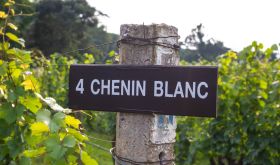
On the other hand, few wine lovers would argue that there is much wrong with a great Montrachet or Chambertin made from nothing but Chardonnay and Pinot Noir respectively. But Sadie maintains that these examples, along with great German Riesling, Piemontese Nebbiolo and Loire Chenin Blanc, for example, prove that in cooler, more continental climates where the grapes stay longer on the vine, there is time to build up interesting, terroir-derived characters in a wine made from a lone variety. 'Grown in an oceanic climate, varietal wine does not declare its origin. When you drink Barolo from Serralunga you have a little bit of Serralunga in your house.
'In the New World we are experimenting. Europe is an advanced model of wine production and our blueprint. Making monovarietals is the easy way to go – typified by California, where they have done one variety after another as fashions change: Cabernet, then Merlot, then Pinot. But the New World varietal drive is keeping the New World behind in terms of wine complexity.'
This may be a bit unfair on California's top producers, many of whom moved away from monovarietals some time ago, and have been blending small portions of other Bordeaux varieties in with their Cabernets for quality-driven reasons. At the other end of the price spectrum, bottlers of more basic varietally labelled wines, all over the world, have a tendency to blend in up to the maximum proportion permitted without having to mention them on the label, usually 15%, of cheaper varieties. This of course is done for purely commercial rather than quality reasons.
But I must admit that when I am tasting through ranges of wines from an individual producer, I often find myself being far more intrigued and beguiled by blends of different grape varieties than by the same old Chardonnay, Cabernet Sauvignon and Shiraz/Syrah.They do often seem to have more interest to them. Perhaps Sadie is right. Or perhaps their novel appeal is much stronger to a wine professional or serious wine lover like me than it would be to a wine beginner who finds comforting familiarity rather than yawn-inducing sameness when confronted by a bank of wines carrying the names of the best-known international grape varieties.
And there are other reasons for favouring blends. For top Turkish architect turned winemaker Resit Soley, varietal blending is treasured as one of the winemaking elements in which he can most freely exercise his creativity. Australian wine writer Max Allen is another vocal proponent of inter-varietal blending. He has already taken a stand by championing those varieties known as 'alternative' in Australia – ie newer than Shiraz, Cabernet, Merlot, Chardonnay, Semillon and Riesling (see Landmark Australia – alternative varieties).They already constitute well over five per cent of all Australian plantings and are rapidly extending their influence. 'The next stage', he said when over in London last year presenting some of his favourite examples to British wine writers, 'is for Australian winemakers to be sufficiently confident in the individual varietal character of these varieties to start to blend them. I'd love to see, for instance, a Wrattonbully Viognier/Marsanne, but the industry is still generally anti blending.'
This reminds me, and reflects my frequent status as an editor, that as far as I can tell, there is no international standard in how more than one grape variety name is written on a label. 'Viognier Marsanne', 'Viognier/Marsanne' or 'Viognier-Marsanne'?
It also reminds me just how particularly happily the Rhône and southern French varieties – Viognier, Marsanne, Roussanne, Vermentino (Rolle), Grenache Blanc, Bourboulenc, Clairette for whites and Syrah, Grenache, Mourvèdre, Cinsault and Carignan for reds – blend together. And their natural habitat is certainly warmer, maritime wine regions.
But there are of course many sorts of blend other than varietal blends. I was reminded of this while listening to the great Austrian winemaker Willi Bründlmayer present some of his wines to a gathering of Masters of Wine, celebrating the fact that our first non-British chairman is Austrian Pepi Schuller. 'I'm very shy, believe it or not', confessed Bründlmayer. 'And because of that I almost prefer producing single-vineyard wines to making blends, because with single-vineyard wines, it's the vineyard that takes responsibility. With blends, they're the creation of the winemaker rather than nature, and the winemaker has to take personal responsibility.' (The polar opposite of Resit Soley's view.)
No producer has championed this sort of geographical blending more than Penfolds of Australia – most particularly but not exclusively with its flagship wines. Penfolds Grange is nowadays made mainly from Shiraz grown in the Barossa Valley but there is usually some fruit from Magill on the outskirts of Adelaide and some too from McLaren Vale, plus sometimes a little bit of Cabernet Sauvignon. At least that means it can be labelled with the 'geographic indication', Australia's answer to appellation controlée, South Australia. Grange's white wine counterpart, Yattarna, which has (so far) been made up exclusively of Chardonnay, may contain grapes from three different states. The current, 2006, vintage has ingredients from the Adelaide Hills, the island of Tasmania and from Henty on the southern Victorian coast. In both cases, the wine is extremely expressive, the result of blending ingredients chosen simply on the basis of blind qualitative tastings. Yet such flexible geographical blending would be unthinkable in Europe.
Well, almost unthinkable.The team at the revered Château Palmer in Margaux has recently started to recreate a blend of wines grown in their Bordeaux vineyards with wine produced in the northern Rhône, a nod to the well-documented historic practice of adding guts to red bordeaux by 'Hermitage-ing' it. And, while it provides Thomas Duroux of Palmer with a good excuse to visit his friends in the Rhône, this is not the only reason for the blend. Perhaps all round the world there is a slow acknowledgement that blending can sometimes be better.
Comments please.