See full tasting notes on Seppeltsfield and Roussillon wines, including six wines more than 100 years old.
There is an upside to unfashionable wines. People don't buy them, so stocks tend to accumulate and, if you know where to look, you can find caches of ancient liquids languishing at unexpectedly attractive prices, waiting patiently for someone to take notice of them.
In our current era this is particularly true of strong, sweet wines, wines that have been the most prized of all wines at various times in history, the Middle Ages and the late 19th century springing most readily to mind.
Several times over the last year I have been made keenly aware of this. The first alert took place in Hong Kong just before an FT wine dinner in aid of the excellent charity Room to Read, when Australian cellist Nathan Waks beckoned me to a corner of the Shangri-La hotel ballroom to give me a taste of two extraordinary century-old nectars. The 1907 and 1908 Seppeltsfield Para fortified wines – burnished fox-red, dried fig-like essences that had recently been taken directly from ancient casks – were just two examples of the treasure that he and some associates, including co-investors in the Clare Valley winery Kilikanoon and Janet Holmes à Court, now own.
Seppeltsfield with its avenues of tall palms (pictured with yesterday's set of tasting notes) is the most recognisable landmark in the entire Barossa Valley. The property includes a historic homestead, atmospheric stables and outbuildings, a cooperage, a distillery, a vinegar factory (not perhaps wine’s greatest friend) and even the Seppelt family’s neo-classical mausoleum. It came as part of the vast Southcorp wine group acquired by brewers Fosters in 2005. But brewers don't always seem to know what to do with vintners and their wares, and Seppeltsfield and the thousands of casks of maturing fortified wines therein were blithely sold off to Waks and friends last year.
I always say that wine is geography in a bottle, but these casks truly contain Australian history, with some of the wine dating back to 1878 (recently taken out of barrel before it evaporates to a droplet), and all of the wood itself is of unusually venerable age. The new owners are busy repackaging the wines – some of the older, rarer wines are being packaged in tiny 10cl bottles – and have signed up the Negociants distribution company owned by Yalumba to spread them around the globe. (Yalumba was South Australia’s other great producer of fortified wines, those strengthened by the addition of alcohol during the production process, the category that dominated Australian wine output until the 1970s, but Yalumba now, like virtually all other Australian wine producers, concentrates on unfortified table wines.)
All Para wines are made in the image of port, but I have tasted nothing from Portugal remotely like 100-year-old Para, the jewel in Seppeltsfield’s crown that has been released since 1978 (when the wine was that 1878), making Seppeltsfield ‘the only winery in the world to release a 100 year old wine every year’. The portfolio also includes copies of sherries matured under flor yeasts, some indigenous and some imported from Jerez; some of the super-sweet Muscats of north-west Victoria matured under Seppeltsfield’s corrugated iron roofs rather than those of Rutherglen; a range of Para tawnies up to the centenary version at Aus$1,000 for 375ml; some wines made in the image of vintage port, historically released at 21 years old; and DP 90 Rare, a most appetising wine not unlike Madeira that, like top Para bottlings, has won many a trophy on the Australian show circuit. James Godfrey has been in charge of winemaking, and the all-important curating, at Seppeltsfield for the last 30 years. A selection of these wines are just hitting British shores and should be of interest to anyone with a passing interest in strong wine.
In an unusually cool April in Andalucia I had the chance to discover how much great sweet wine languishes in various soleras in Montilla and Jerez, and recently wrote here about these treacly-black liquors made from sun-dried Pedro Ximenez grapes.
In the heat of a southern French summer I was made aware of just how much venerable sweet wine there still is in the cellars of Roussillon just north of the Spanish border. Cellars is actually a misnomer, for many of these Banyuls and Rivesaltes wines are deliberately aged under rafters, or even outside in the full glare of the Mediterranean sun. One co-operative has seven million litres of such wine in stock, of which about 400,000 litres is more than 10, and 700 litres more than 20, years old. Even the tiny Domaine Pietri-Géraud in what was once the artists’ port of Collioure (and the home of novelist Patrick O’Brian) seemed to have an almost embarrassing amount of wine to sell, including one particularly vast vat of wine dating from 1950. There were shelves of bulbous glass bonbonnes full of tawny liquid on a balcony overlooking the resort’s terracotta roof tiles, barrel after barrel of all ages in the attic, some wine in old concrete vats and some kept in ancient, blackened barrels in the yard.
How the domaine’s young proprietor Létitia Pietri keeps track of all this wine of such very different styles, I cannot imagine, but she is certainly a forceful personality, determined to resist local officials’ efforts to move winemaking out of the crowded centre of this popular tourist destination. “Collioure used to smell of Banyuls and anchovies”, she told me, “now it’s chips and hamburgers”.
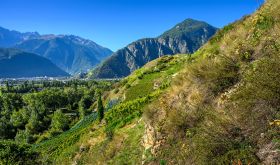
Collioure is overlooked by the steep slopes to which gnarled old Grenache vines cling, on such terraces as are still worked by local vignerons such as those pictured here by Mick Rock of Cephas. But abandoned schistous terraces, which can be seen all the way to the Spanish border and beyond, seem to predominate. At least around Collioure wine producers have long had the choice of making sweet, strong red Banyuls or dry, strong red table wine called Collioure from the produce of these demanding, low-yielding vineyards.
On the flatter, less marine-influenced land to the north towards Perpignan they have had to create a market for table wines to take up the enormous surplus production of Grenache and Muscat grapes now that strong, sweet wines such as Rivesaltes, Muscat de Rivesaltes and Maury are no longer fashionable. These so-called vins doux naturels (VDNs), made sweet and strong by adding neutral grape spirit before fermentation is finished, have known three different heydays: the Middle Ages, the beginning of the 17th century, when Roussillon was finally ceded to France, and the mid 20th century, when such wines were some of the few that were stable enough to provision troops.
More recently, as consultant oenologist Claude Gros, whose career began in Roussillon, put it, “these are artists’ wines, but artists who die poor”. He also points out that in Roussillon in general it can be difficult to work out which terroir is most suitable for VDNs and which for table wines. All of this means that there are some great bargains, not least for those looking for wines to mark a particular anniversary – which is presumably why Farr Vintners are about to ship so many vintages ending with 9.
And then of course there is port, whose quality is better than it has ever been but whose market, most unfairly, seems to be contracting. See Julia’s recent port tasting notes, and my specific recommendations for strong, sweet wines on 13 Dec in the third of my four forthcoming features on what to drink over the festive season.