There is a quiet revolution going on in the world of wine. From the cobbled streets of Barcelona to the glam restaurants in Vancouver, a fortified drink is being sipped from afternoon to evening. Affluent millennials with scarves tossed around their necks are tilting back wine glasses, eschewing the convention of their elders and enjoying craft vermouth straight.
Since Tamlyn Currin wrote last year about the ‘quiet revival’ of vermouth, the herbaceous drink has been carving its own space on wine menus at speed. Although the wine industry is paying scant attention to this ancient fortified wine, it should think again. Vermouth is claiming its rightful place, regardless of the herbs it is laced with, with wine consumers. Driven in part by the craft movement and supported by the preferences of the younger wine generation, vermouth is expected to generate $12.41 billion by 2021.
The original aromatised wines evolved in far-flung corners of the globe, from China to Persia and the Middle East. However, the modern vermouth made from wine, sugar, herbs and alcohol is credited to producers in Turin, Italy, during the 1700s. Place-based craft European beverages, whose ingredients, style and history were local to their point of origin, were eventually replaced by simple, bitter wine infusions for cocktail mixers for the international market. In the last few decades, vermouth was known as the glass-rinsing agent for martini, not a beverage in its own right.
Today’s small craft batches are more similar to the concoctions of hippocras from centuries ago than to the simple bitter mixer recent generations fancied. Leading the vermouth movement are both traditional producers and young upstarts, reviving recipes of old.

In the tidy back alley above in Asti, a small city outside Turin, I found Mauro Vergano. The impeccably neat Mauro is considered godfather to the next generation of vermouth producers, with some of the most respected and coveted bottles in the world under the Chinati Vergano label. To learn more about this exciting wine, I put my vermouth education in the hands of a master.
As a young man, Mauro studied chemistry and oenology, then worked for 15 years developing synthetic fragrances and flavours in labs. His family, like many others in the region, had a history of making vermouth, and he would buy wine from the nearby countryside and make small batches at home. In 2003, Mauro quit his job as a chemist and released his first commercial vermouth, made with Piemontese wine and top-quality herbs from the hills of Asti and around the world.
His honeyed, grapey, traditional vermouth is made from biodynamic Cascina degli Ulivi’s Cortese and Vittorio Bera e Figli's Moscato wine. As I sipped the surprisingly complex liquid, tasting of daisy fields, celery and cinnamon, Mauro explained how he based the fortified wine on a 1786 recipe from Turin. Flavour preferences change over time, and for his modern vermouths he prefers to source unadulterated, varietally pure wines from minimal-intervention producers. In the gleaming-white laboratory, Mauro and his nephews Tomasso and Pietro add carefully measured extracts from roots, leaves and flowers soaked in neutral beetroot alcohol, flavouring and fortifying the wine. The wine is then sweetened with white cane sugar.
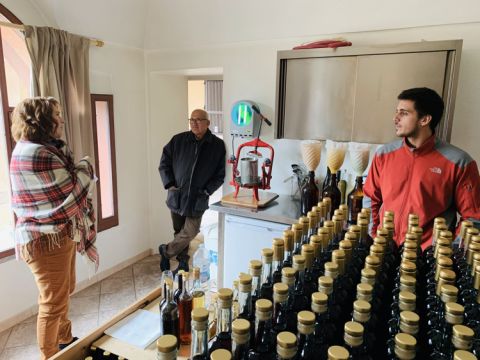
Mauro’s chinati are modern interpretations of ancient Piemontese recipes, suited for the palate of today’s connoisseur. Instead of using traditional, aged Barolo in the red chinato, he sources two-year-old Barbaresco from Guiseppe Cortese, creating a bright cherry-red, medium-tannin wine, with aromas of cinnamon, rhubarb, liquorice root and vanilla, and a fantastically bitter finish. The gentler white chinato is created from Bera's Moscato, with layers of quinine, orange peel and cardamom under the typical Moscato honeysuckle.
After a week tasting wine in Piemonte, I had thought I would be able to recognise the grape varieties and relate the base wines to the vermouths. However, standing on Mauro’s white-tiled floor, I was flabbergasted by the complexity, harmony and length of the wines. My fortified-wine education hadn’t prepared me to gauge bitterness, nor to recognise medicinal aromas. I imagine many in the wine trade would have felt as underprepared and amazed as I was by the quality and novelty of these infused, fortified wines.
My own experience with vermouth began in much less clinical circumstances, on the streets of Barcelona a year earlier. I was on my way from Canada to Rioja, and had stopped in Barcelona to see friends. After I hauled my monstrous suitcase up several flights of stairs to Jesus and Davide’s flat, Jesus suggested in Catalan ‘anem a fer un vermut’ – let’s do a vermouth – so I could recover from my voyage. Tired and hungry, I conceded, and followed him down the stairs, flopping down in a metal chair outside the vermuteria across the street.
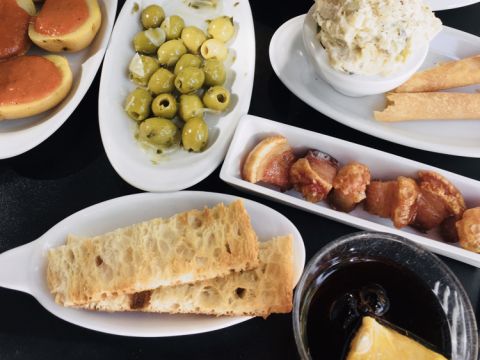
Jesus ordered two vermuts, deep amber fortified wine in narrow glasses with a slice of orange and a few cubes of ice. Then the food started arriving: little plates of anchovies, potato salad, olives, patatas bravas, pork rinds. I relaxed, we started to catch up, and I then understood that doing a vermouth was not just sipping a sweet fortified wine in the afternoon – it’s a long-standing social tradition of early-afternoon visiting. People of all ages do a vermouth, often with their families after church on Sundays. And in recent years, doing a vermouth has become a raging trend with 30- and 40-year-olds, superseding the Sunday tradition and becoming a popular excuse for colleagues and friends to meet up in the middle of any day of the week.
I’m not the only Canadian enamoured by the vermut tradition. Former wine importer Shawn Dalton’s hours wiled away on the streets of Barcelona inspired him to start concocting recipes in his kitchen back in Winnipeg. After five years of researching North American botanicals and trialling techniques, he relocated across the Rocky Mountains and opened Marrow Vermouth in Penticton, the epicentre of British Columbia’s Okanagan wine region.
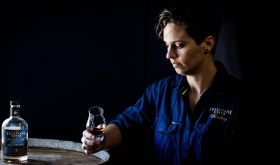
Shawn, pictured at the top of this article, is taking the concept of terroir to the extreme. His fortified wines are a collaborative experiment involving not only local wineries but also local orchards for apple distillate, and nearby apiaries for honey to sweeten the wine. His winemaker friends sell him products that they don’t know what to do with, like hard pressings and oxidative wine. With the addition of indigenous herbs such as yarrow, clover and sweet cicely, as well as some internationally sourced ingredients such as wormwood and bergamot, Shawn creates swans out of ducklings.
Still experimenting, Shawn’s latest batch of vermouth includes Syrah, Pinot Noir and Pinot Gris. In contrast to the layered complexity of Mauro Vergano’s vermouth, this drink is about purity, with clean flavours of juicy, tart red berries, caramel, fresh dill, dried rose petals and the gaminess of the natural wines in the mix. With high acid and definable aromas, it’s clearly a Canadian wine.
When I visited him at his friend’s straw-bale winery this winter, Shawn had only barrel samples to pour for me. Much like the cult Atsby New York vermouth, and Berlin-based Belsazar, Shawn’s fortified wines were not difficult to sell to regional bars and restaurants. In the nearest large city, Vancouver, vermouth is appearing in its own section on wine lists, and Shawn’s complete bottled stock is snapped up as soon as a batch is released.
To quote Tamlyn, ‘there are some visionary little companies, pioneering, adventurous, and romantic, who believe that if you peel away the plastic coating of commercialisation, and take things back to the same basic principles of every quality revolution – high-quality raw ingredients, not mucked about with – then vermouth is something to be taken very seriously indeed.’
The rise of craft vermouth has, indeed, been astronomical. According to Atsby’s Adam Ford, who just published a book on vermouth, there were no modern vermouth producers in the United States in 2009. Then in 2012 there were three, and now dozens of vermouth brands are available across the country. In 2017, a geographical indication was designated for Piemonte vermouth, creating appellation of origin regulations defining style, technique and origin of the base wines and botanicals. The beloved German Belsazar was fully acquired by drinks giant Diageo in 2018, to round out their premium portfolio.
According to Christy Canterbury, vermouth lover and Master of Wine, there is also a ‘super-cool renaissance of vermouth coming from wineries themselves’, whose craft aromatised wines she sees as ‘uniquely different from their monotone brethren’, the mass-produced drinks of yesteryear. Vermouth has become another tool for a winery to deal with less-than-ideal batches and vintages, creating an additional revenue source and appealing to a new set of consumers.
Yet despite craft aromatised wines claiming space on wine lists, and individual epiphany experiences such as Brian Freedman’s night of the cocktail, and Nick Lander's going for a vermut in Spain, the wine industry has failed to embrace vermouth as one of its own. Master of Wine Jennifer Simonetti-Bryan recounted ‘when I tasted Atsby New York vermouth it blew my mind that vermouth could be that intense, flavourful and complex’. Yet, Jennifer doesn’t think that vermouth has been given a fair shake by the wine industry.
Vermouth doesn’t yet appear in the Wine & Spirit Education Trust’s fortified wines curriculum. Of the 10,400 wines intended (before its cancellation due to COVID-19) to be showcased in April at the largest wine exhibition in the world, VinItaly, in Verona, so very close to the cradle of vermouth production, only four are vermouths.
Surely, vermouth’s exclusion from the mainstream wine world isn’t because of the ingredients of sugar and spirit, as chaptalisation has long been common and many fortified wines include additions of alcohol. Is this disdain because of the flowers, roots, leaves and barks steeped into the wine? Yet oak barrels, even oak chips, are rarely questioned as extraneous components of wine.
Christy thinks that’s the case. Most wine professionals are purists, and aromatised wines are too exotic for the wine industry to lay claim to the category. The industry ‘spends so much time thinking about wine, that they don’t know much about vermouth’, or, even how it’s made.
Or perhaps, as Shawn hypothesised, leaned up against a qvevri (which he plans to bury underground, as they do in Georgia) and sipping a glass of vermouth, perhaps it is young people’s wine. It’s cool. Chinati Vergano’s Instagram feed is like an alternative art exhibit. Marrow Vermouth’s labels are covered in cartoons.
Millennials brought up in the craft generation don’t want to drink the same global brands as their parents. Let the wine world keep producing pink drinks in an effort to distract them. They are more than happy to keep vermouth to themselves.