For the background to this harvest report by Tanya Garnham, see Part 1 – introducing DJP and Part 2 – waiting and sampling.
After about a week of berry sampling, we were given the go ahead to harvest on Friday 14 September. This might also have been because a Spanish TV crew was in town and wanted to do some picking themselves for a reality TV show involving Ecuadorian Indians, as we were then given the weekend off. I had been given the impression that, once the harvest started, there would be no rest until it was over.
Friday 14 September also happened to be the most religiously significant day in the annual programme of Villafranca (quite a religious town), as it is when a fifteen-foot wooden statue of Christ is carried throughout the streets of the town by some seriously strong people. Madelena, who works in the vineyards, was really sad to miss it as he has been an active part of the Fiestas del Cristo de la Esperanza for about 25 years. Happily, the festival lasts for a few days so he still got to be part of the remaining celebrations.
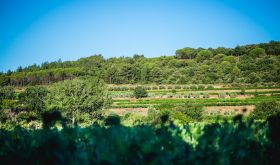
 But back to harvesting… We went to two vineyards, both of which had slopes of more than 50º (or at least it felt like it at the time). In retrospect, after having picked grapes at several other DJP vineyards, 50º is practically flat! But seriously, if you ever decide to do a harvest here, bring shoes with first-rate treads and perhaps even some climbing ropes.
 The vineyards are between 50 and 60 years old and are all bushvines. They are planted a bit haphazardly with all the grape varieties permitted by the Bierzo DO (and a few others besides), namely the red Mencia and Alicante Bouschet, and the white Godello, Malvasia, Doña Blanca and Palomino, so you find pretty much everything along any given row.
We picked red grapes first and then a few crates of white grapes; varying percentages of white grapes also go into some DJP wines. It was only ever a few crates of white grapes in comparison with red, though, and it was a bit shocking at first to see the rest being left on the vines for the animals, but that's what happened.
We sorted the grapes directly in the vineyard, as opposed to at the winery, so anything damaged or not quite up to standard was left for the (very well fed) animals. Full crates were given to Morena to carry up the slopes and, thank goodness for her, as I was having a hard time getting myself to the top of the vineyard even without the crate. Morena, by the way, is a 25-year-old mule (pictured above with Augustin, who looks after her), hails from Catalunya, and must be the most docile creature on earth. It was amazing to see her in the vineyard with us as she brought a real sense of tradition to the whole experience. Julio, who also works in the vineyards, explained that the animals (DJP also has two horses and a baby mule that just eats at the moment as she's too young to work) have to be between 300 and 400 kg or they'll tumble down the slopes with their loads if they are any lighter. I imagine that they can't be any bigger or they'll trample the vines.
Harvest started in earnest on Monday 17 September and Friday's vineyard team of nine was joined by six extra local people. The following day six more people joined, after which numbers steadied out. To give an idea of harvest speed – or more appropriately harvest crawl – it took about 100 working hours to cover half a hectare. But I suppose that isn't actually surprising because it was hard work and also time consuming bending over each vine to cut off the bunches, snipping off any bad grapes, hauling one's increasingly heavy crate over to the next vine, placing it in such a way that it didn't go careening down the slope, while simultaneously attempting to maintain one's footing.
The other pickers hardly seemed to struggle, which was a bit embarrassing, but I suppose it is because they are all from around here and therefore used to the slopes. A lot of them have done the harvest with DJP before as well, whereas this was my first ever. Any excuse!
A lot of the pickers were young people out of work who were just trying to earn the few euros that this job pays. Some of the others had jobs and had taken holidays in order to do the harvest. People work incredibly hard over here and, from what I understood of the conversations (in Galician not Castilian, which I do speak), they do this extra work in order to get by and/or have a little disposable income to go out at the weekend.
One word I did hear a lot was jabalí ('wild boar'), usually said with disgust. They are a massive problem in this area as they come out at night and literally feast, leaving the fruit as shown here.
 The vineyard team puts up temporary fencing around the time of véraison to protect the grapes, and two employees go nocturnal for a couple of months doing the rounds with air guns, but I don't think this has much effect. Rabbits are also a problem but at least they have the decency to finish off one vine completely before moving on to the next. Hunting season officially started in October in Villafranca but by that time it was already a bit late; perhaps someone should suggest bringing it forward by a month?
 All in all, the harvest period was unusual in that it was very much on and off throughout the season because of the weather. The first round of picking lasted only six days before it was called off because of rain.
The weather turned nice again for a few days at the end of September so it was back to picking, although I am not sure exactly where, as DJP have about 200 small parcels of vines scattered around the town of Corullón. We'd basically all pile into the various DJP vehicles and go wherever the density, pH, TA and tasting-test results (and Ricardo, of course!) told us to go.
Harvesting stopped again for a chilly spell which slowed down ripening. According to Ricardo, Mencia also has a critical picking moment as it goes from being green to being slightly overripe from one day to the next.
I do know that we were out harvesting again at the start of October because I managed to tear my iliopsoas muscles going down the vineyard slopes. If you haven't done this before, don't attempt it because it is painful to say the least – I couldn't walk properly for about a week. I also remember 5 October quite well because there seemed to be nothing but grey rot on the vines; so the rain did affect some of the vineyards. Camilo, one of the guys in charge of the pickers, got really mad at one point and started yelling at us because rotten grapes were making it into the crates. I suppose that goes with going quickly as the vineyard team had definitely picked up the pace by this time. I was told that people here associate speed with good work and therefore with keeping their jobs; on that particular day, it probably would have been better to slow down.
 La Faraona (right), DJP's top vineyard (and wine), was harvested on 16 October. Because of the weather, by now quite cold, wet and miserable, not even the vineyard manager really knew when we were to pick there. Such is the admiration for the site, however, that the vineyard team refrained from taking their customary post-lunch chupito(s) (shots of homemade spirit) the day before in case it was to be that afternoon. They declared that the utmost concentration was required as each grape berry was to be inspected in person by Ricardo or Álvaro as it went into a crate, and that Morena was banned from putting a hoof anywhere near the vineyard. One of the guys even suggested that a booth be set up in order to collect entrance fees from the pickers! I wasn't there on the day but I don't think any of the above actually happened. It was funny to listen to the stories though.
 Part 4 tomorrow describes the initial fate of the fruit.



Guest contributor