California wine producers are a bit like Japanese businessmen. The minute they meet you they present you with cardboard, except that with the Californians it’s not a business card but a big fat folder full of data. The mission statement of the winery, a feast of abstract nouns, typically features prominently. Then there are details of its history and personnel. And, particularly, a full-sized sheet for each vintage of each wine telling you exactly how it was made and what it tastes like, with up to 16 flavours you should find in it. All of this makes a considerable impact not just on the world’s forests but on the baggage of any wine journalist returning from California. I suspect I am not the only one who regularly leaves a significant proportion of all this flannel in the waste bin of my last hotel room.
The female-run Spottswoode winery in the Napa Valley provides a refreshing exception to this rule. Every year the team do a vertical tasting of every vintage of their famous Cabernet Sauvignon and this year invited me to join them. After our tasting and an hour or so’s discussion of these exceptionally elegant wines, I realised I didn’t have a single bit of printed material about Spottswoode. It took Beth Novak Milliken, daughter of the founder, a good 15 minutes to find anything to give me.
In the Napa Valley Cabernet arena, where muscle and potency seem to have become the most admired, or certainly the most notable, attributes, it is unusual to read a producer claiming “we strive for refinement, elegance and balance”. In many Napa Valley vineyards, high alcohols and super-ripeness are almost unavoidable, so generous is the reliable summer sunshine. But Spottswoode’s estate Caberney vineyard is in a special position at the bottom of the Mayacamas Range where it meets Spring Mountain, thus creating a gap in the hills which regularly allows in cooling Pacific influence. This, along with the Novaks’ near quarter-century knowledge of this particular vineyard and their determination to bottle its peculiar essence, is probably why the alcohol levels of Spottswoode Cabernets hover equably around 13 per cent, while so many other producers have to devise ways of reducing alcohols that naturally reach 16 per cent or more.
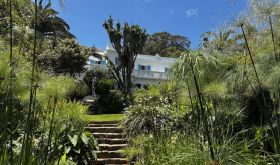
This alluvial gravelly loam vineyard on Madrone Avenue on the far western edge of the town of St Helena was first planted with vines in the 1880s, and comes with one of the Napa Valley’s relatively few pre-Prohibition winery buildings, a modest stone construction still used for barrel ageing. Jack and Mary Novak bought the property in 1972, principally for its enviably mature gardens and the rambling Victorian homestead that must have seemed perfect for their five children. By 1982 Mary Novak had produced her first Spottswoode Cabernet, with the help of consultant winemaker Tony Soter who made the next nine vintages and oversaw Pam Starr’s work on vintages 1992 to 1996. In 1997 he introduced them to Rosemary Cakebread, married to Bruce of Cakebread Cellars and keen to make wines at one of the blue chip properties of the valley. Thoughtful and softly-spoken, Cakebread seems to fit perfectly into the matriarchal team at Spottswoode and is now approaching her tenth harvest there.
She was particularly attracted by the fact that Spottswoode was one of the Napa Valley’s earliest converts to organic farming (in their olive grove as well as their vineyards) with official certification since 1990. I am not at all sure that I can tell by tasting a wine whether it was made from organically farmed vines or not, but the Spottswoode Cabernets certainly sing a particularly gentle, harmonious song. Those grapes were happy all right.
In our blind tasting the wines were mixed up and served blind in two big flights, the first 1982 to 1991 and the second from 1992 to 2003, the current release. I had only tasted Spottswoode once or twice before and when I took a sniff of the wine in the first glass my heart sank. Would this double session crammed into a tiny room with virtual strangers prove hugely embarrassing? This first bottle was definitely a bit past it, its obviously once-lovely fruit dogged by the telltale, stale aromas of oxidation. “Decidedly senior with some spice and dustiness”, I wrote tactfully, hoping that the other wines would prove more lively.
I need not have worried. This turned out to be a disappointing bottle of the 1990, but of all these 22 vintages of a wine style not known for exceptional longevity, only our bottles of the 1990, 1983 and, curiously, 1997, generally regarded as a fine Napa Valley vintage, showed signs of age. The oldest wine of all, the 1982, was in great shape and the 1984 did not seem to have even approached its peak.
Most such vertical tastings, especially in California where, as the Novaks put it ruefully, “our pendulums swing too much”, reflect the dramatic changes in winemaking fashion which have invaded the Napa Valley, from the lighter ‘food wines’ of the early 1980s to the ‘bigger is better’ blockbuster mode of the 1990s. But there was an admirable consistency in these Spottswoode Cabenets – 100 per cent Cabernet Sauvignon for the first two vintages but with a small and varying percentage of aromatic Cabernet Franc from 1984, since which time they have never added acid.
I am delighted that the Spottswoode label, relatively unusually, carries an appellation more specific than just Napa Valley, St Helena of course in this case, an AVA the Novaks helped to define and see granted in 1995. The more we can start to understand the particular characteristics of individual parts of this very privileged vine-growing environment the better. Like any top quality Napa Valley Cabernet, Spottswoode at $100 a bottle is not cheap, but it is far from the most ridiculously priced. The wines are fairly widely available in the US and imported into the UK by Domaine Direct. The vintages that most impressed me in this blind tasting were 2002, 2001, 1994, 1989, 1988, 1986 and 1985.
See full tasting notes with scores and suggested drinking dates.