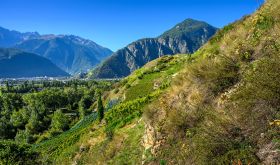
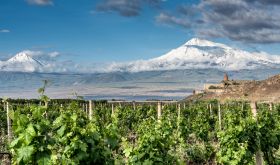
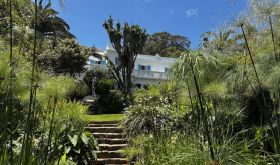
Near the hamlet of Randazzo, in the northern slopes of Mount Etna, Sicily, there is a vineyard of 0,8 hectare that dates back to 1880, named “La Vigna di Don Peppino” (The Vineyard of Don Peppino). The parcel is located amidst a larger Contrada (local name for cru) named Calderara Sottana belonging to the Tenuta delle Terre Nere owned by Marco De Grazia. I wonder why the vineyard is still there after all these years and why they call it “La Vigna di Don Peppino”. I need to visit the vineyard to find out.
The trip to Mount Etna
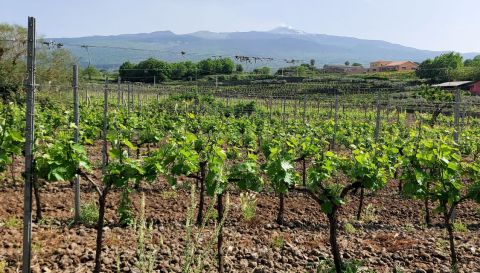
My trip begins in Catania, a dynamic modern town of 313,000 inhabitants. As soon as I leave the town, I feel daze by the typical scents of Sicily. I smell both the sea breeze and the orange blossom, the scent of the sea and the mountain combined in a unique mix. I head immediately toward the majestic Mount Etna, the highest active volcano in Europe (second in the world after Fujiyama) with its 3,330 meters above the sea level. And my mind flies, thinking of the mythological creatures that populated the volcano, at least in the imagination of the people who lived here, from the Greeks to the Romans, fed by their poets. I can almost see Aeolus taming the winds inside the mountain, Hephaestus working the fire in his underground forge, I close my eyes to see the giants Typhon and Enceladus, the Cyclops and Ulysses. From a fissure in the ground, through a jet of sulphureous smoke I can almost waive to Tartarus, the Greek god of the dead! I drive through the eastern slopes of the Etna through the hamlets of Zafferana, Milo and then I turn to Linguaglossa enjoying the most charming landscape of the mountain along with the sea view at every bend of the road. In these slopes of the mountain, where the indigenous white grapes Carricante and Catarratto thrive, the vines are planted in sandy soils enriched by the pumice of the volcanic ash and sustained by dry lava-stone walls. Here the viticulture had developed earlier, due to the vicinity to the port of Riposto from where since the end of the 1700s the grapes were shipped to Malta and to the major ports of the Mediterranean. I arrive near Randazzo, my final destination: the northern slopes of Etna, maybe not as appealing to tourists as the eastern side (you cannot enjoy the sea-view from here) but certainly wilder and more celebrated from the viticulture point of view. The northern slopes of the Etna develop along 40 km between the hamlets of Piedimonte Etneo and Bronte. The vines here are planted at an altitude of 600/900 meters a.s.l. in volcanic sandy soils rich of volcanic pebbles, the area enjoys a continental climate with high diurnal variations and it is a dry due to the rain shadow provided by the Nebrodi mountains. I cannot help but admiring the beauty of this wild nature, never quite tamed by the stubborn action of men through the centuries trying to subjugate the soil to the human needs, including wine.
Calderara Sottana and the pre-phylloxera vineyard
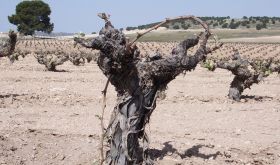
I arrive finally to the Tenuta Delle Terre Nere where Christian Liistro, the director of the winery welcomes me warmly. Christian leads me to the Contrada Calderara Sottana and then he shows me the pre-phylloxera vineyard where in less than a hectare of volcanic sandy and rocky soil at 650 meters a.s.l. several rows of very old but vigorous Nerello Mascalese vines stand still, proudly exhibiting their charming wrinkles like aged princesses in a royal garden. Nerello Mascalese, the indigenous grape of the Etna, is wild and sour just like the volcanic soils that feed it. The grape is so strikingly acidic that often it needs to be mellowed by Nerello Cappuccio in a mix so perfect that can be compared to the most famous marriage between Cabernet Sauvignon and Merlot in Bordeaux. The vines of the vineyard are more than 140 years old. They are planted in the oldest point where you can plant the vine in the Etna that is in soils 70,000 years old, dating back to the Ellittico Period. Ellittico is the name of the elliptic-shaped original volcano that exploded about 15,000 years ago giving birth to a second volcano: the Mongibello which is now the highest part of Mount Etna. One detail makes me feel emotional: these vines, exactly these vines have been living and making grapes through three centuries and two millennia in the very same place where an unknown contadino (farmer) planted them at the end of the 1800s! Garibaldi and Mussolini, two World Wars, the end of monarchy in Italy, the post-war reconstruction of the Country, dramatic social and technological changes have been going by during the last 140 years and these vines are still here.
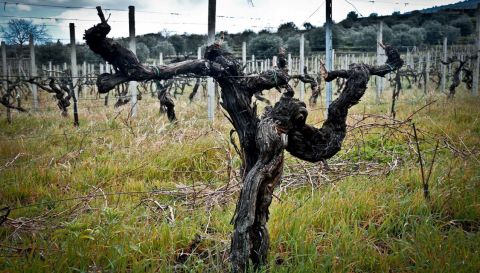
When the vines of the vineyard were planted at the end of the 1800s, the vines in Etna were typically shaped in alberello, an upward training system widely adopted to maximize the density of the vineyards. The system of planting the vines in the vineyard, the quinconce, was based on a scheme of different squares with five vines inside every square, four at the corners and one in the middle. The vines were bush-trained in a three-dimensional way, pruned with three short spurs each with two buds. The yields were very low, about 1 kg per plant. The grapes produced were collected by hand and transported by the workers in wooden baskets from the vineyard to the palmento, a lava-stone building where the grapes were pressed, fermented and aged. The palmento in Etna was not shared among different producers, as in other parts of Sicily, but it was part of the estate because every wine producer of Etna wanted to process its own grapes. In the palmento the unstemmed grapes were pressed in a lava-stone vat (pista) from where the must flew by gravity to a second vat placed below (tina) in which the tumultuous force of the fermentative process could be unleashed, propelled by myriads of wild indigenous yeasts.

Phylloxera vastatrix struck Sicily in the late 1880s and by the beginning of the new century the viticulture of the island was devastated. Strangely the aphid did not affect that much the Etna vineyards and the simple explanation was because…phylloxera did not like the volcanic ash!
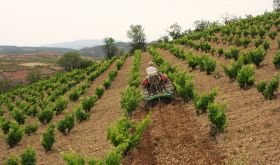
In the 1960s Italy experienced the social process of a massive internal emigration of the laborers from the fields of the south to the factories of the industrialized north of the Country. This process had dramatic consequences for the wine producers of the Etna that lost most of the precious workforce they needed in the vineyards. To face the new situation more labor-saving techniques had to be introduced in the vineyards. The era of mechanization and the presence of the tractors in the vineyards led to a tremendous change in the training system in Calderara, including the pre-phylloxera parcel. In the vineyard the alberelli were not left anymore free to grow in their original three-dimensional shape and they had to be trained in a two-cane dimension and trellised up wires. The quinconce scheme was abandoned and the vines planted outside the rows were explanted to make room for tractors. The yields dropped consequently from 10,000 to 7,000 vines per hectare. It is not wrong to say that the tractors were more lethal for the vines of Calderara than phylloxera and the bombings during WWII!
Tenuta delle Terre Nere
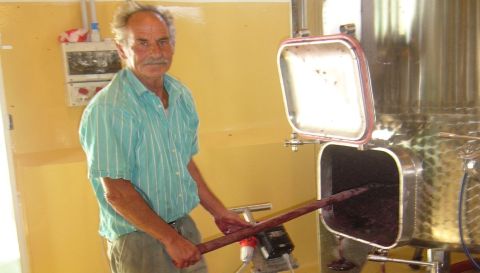
At the beginning of the new millennium, in 2002, Marco De Grazia, Italo American with a past of importer of premium wine and a revolutionary experience with the “Barolo Boys” in the Langhe arrived in Sicily with a precise target in his mind: enhance the uniqueness of the terroir of Etna he considered “The Burgundy of Mediterranean”. He insisted that the peculiarities of the different Contrade of Etna had to be recognized and certified, just like the crus in Burgundy and the MGAs in Piemonte. Now there are 133 approved Contrade within Etna DOC, 81 of which in the northern slopes. The style of his Tenuta delle Terre Nere, both in the vineyard and in the winery, is adapted to the new times but with an eye open to the tradition to strive for excellency. In the vineyard the vines are organically grown: to pursue this vision a permanent staff of over 40 people is maintained in the field, with the ratio of almost one worker per hectare! The consistent presence of these passionate workers ensures unmatched standards of efficiency: when the grapes arrive in the winery, they have been so accurately selected in the vineyard to make the work at the sorting table almost useless! In the winery the focus is to enhance the character of the different Contrade, whose grapes are processed separately, with temperature-controlled fermentation, spontaneous malolactic, a wise use of steel and oak (barrique, tonneau and barrel), to produce wines with unique stylistic footprints.
The vineyard of Don Peppino
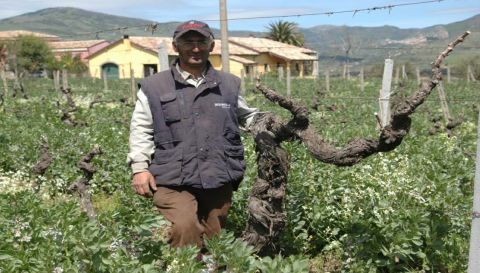
When Marco De Grazia bought the estate, at Calderara Sottana lived an old farmer, Peppino, who had been working for his entire life in the pre-phylloxera parcel. Peppino himself lived in a typical lava-stone house built by his ancestors in the middle of the same vineyard. Peppino asked the new owner to continue to take care of the old vineyard as he had been doing since he was 12 and De Grazia enthusiastically agreed, welcoming Peppino among his staff. Following De Grazia’s vision of enhancing the Contrade individual character, the first bottle of Etna DOC Contrada Calderara was commercialized with the vintage 2003. A couple of years went by and one day Peppino asked to talk with De Grazia. We need to specify that De Grazia, Italo American coming from Piemonte, was considered a “stranger” by the rustic and somewhat shy local farmers therefore “a couple of years” was the timespan Peppino needed to trust Marco and to consider him “one of us, the Etna people”. Peppino told Marco the entire story of the pre-phylloxera vineyard explaining him the peculiarity of the parcels and telling him that the vines of all the other vineyards in the very same Contrada and in the surroundings had been replanted over the years. Peppino, however, was not able to explain why just the vines of that specific parcel had been lasting for so long while consistently producing grapes of such a high quality. Marco then commissioned in depth analysis of the soil composition of the vineyard to solve the mystery but, despite all the best efforts of the people involved, no scientific evidence came up to explain the longevity of those vines. Somebody argued that maybe the particular aspect and the microclimate of the vineyard combined with the perfect drainage of its soil had created the ideal mix for the vines to survive but that was a mere hypothesis. For sure, without the love, the competence and the complete dedication of Peppino to the vineyard the old vines would not be so lively and healthy today. De Grazia decided then to pay a tribute to whom he considered the master, the greatest of his teachers: Peppino. The pre-phylloxera vineyard was named after the old contadino “Vigna di Don Peppino”. Furthermore, following the advice of Peppino, Marco De Grazia decided to focus on the unique expression of the parcel and to vinify separately the grapes produced by the old vines of the vineyard: the first bottle of the acclaimed “Tenuta delle Terre Nere Etna Rosso DOC Prephylloxera Calderara Sottana” was commercialized with the vintage 2006.
Acknowledgements: The present article is based on the inspiring visit to the Tenuta delle Terre Nere on last May and on the invaluable conversations I had with Christian Liistro in June.
References:
www.tenutaterrenere.com;
Salvo Foti, “The Wines of the Volcano”, Maimone, 2020.
Benjamin North Spencer, “The New Wines of Mount Etna”, Gemelli Press, 2020;
The photos are provided by Giovanni Di Guardo.