Could the Skurfberg old Chenin vines be the saving grace of Loire Valley wine identity?
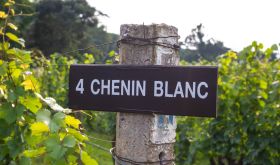
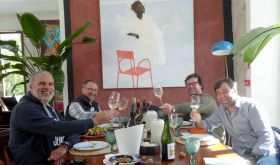
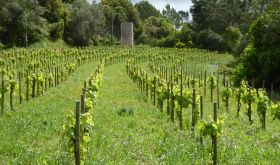
As Henk Laing (pictured above) is drying his Rooibos tea leaves on his family farm Krommevalley, he is overlooking the ungrafted old Chenin vines, starting to show signs of autumn. Born in 1959, he mentions that as long he can remember this vineyard has been here, planted by his father in 1960. One can say that they have aged together, both establishing their roots in a mountainous area about 3hrs north of Cape Town. Formerly only known by viticulturists of nearby cooperatives1, Krommevalley and neighbouring farms Oudam and Arbeidsend rose to fame among fine wine enthusiasts in the late 2000s.
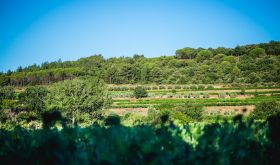
Today, this area is referred to as Skurfberg2, with Sadie Family, Anthonij Rupert, Botanica Wines, Klawer Cellars and Alheit Vineyards sourcing Chenin here. If there was ever any doubt if terroir3 does exist in South Africa, and if it matters, Skurfberg allows to uncork such a complex concept. Part of the Citrusdal Mountain Wine of Origin district, Skurfberg seems geographically too warm in an already arid climate to grow sustainably dryland vineyards, let alone produce quality and authentic wine. Yet, the old Chenin vines from Skurfberg tell another story.
|
Chenin vineyard characteristics by farm in the Skurfberg area4 |
|||||||
|
Skurfberg |
Block |
Rootstock |
Vineyard |
Planting |
Row |
Vine |
Farming |
|
Krommevalley |
5 |
Ungrafted |
3.0ha |
1960 |
3.0m |
3.0m |
Dryland |
|
Oudam |
7 |
Jacquez |
1.0 ha |
1975 |
3.0m |
3.0m |
Dryland |
|
9 |
Jacquez |
1.6ha |
1975 |
3.0m |
3.0m |
Dryland |
|
|
10 |
Richter 99 |
1.8ha |
1983 |
3.0m |
3.0m |
Dryland |
|
|
12 |
Richter 99 |
1.5ha |
1986 |
3.0m |
3.0m |
Dryland |
|
|
13 |
Richter 99 |
1.0ha |
1989 |
3.0m |
3.0m |
Dryland |
|
|
22 |
Richter 99 |
1.0ha |
2016 |
3.0m |
2.0m |
Irrigation |
|
|
Arbeidsend |
4 |
Ungrafted |
2.2ha |
1982 |
3.0m |
1.4m |
Dryland |
|
9 |
Richter 99 |
1.7ha |
1990 |
3.0m |
3.0m |
Dryland |
|
|
10 |
Ungrafted |
1.1ha |
1984 |
3.0m |
1.4m |
Dryland |
|
|
13 |
Ungrafted |
1.0ha |
1981 |
3.0m |
1.4m |
Dryland |
|
|
15 |
Richter 99 |
0.5ha |
2019 |
3.0m |
3.0m |
Dryland |
|
Geographical location and farming practices
Located at about 500m above sea level and 35km away from the Atlantic, terrain elevation and ocean proximity are key mitigating factors of the regional climate. The vineyards benefit from cool maritime afternoon breezes, with low night temperatures and a strong diurnal range. Krommevalley is part of the Trekpoort setting, referring in Afrikaans to the open landscape towards the ocean, like a gateway for sea breezes or mountain winds. Viticulturist Rosa Kruger mentions that the fresh and clean air contributes to vine health and limits disease pressures5.
Soils are texturally sandy, medium to coarse grained, low in pH, with a loamy subsoil overlaying the decomposed sandstone bedrock. The higher subsoil clay content has more water holding capacity, vital in this arid land as average rainfall is 442mm/year and 137mm/season (Sep.-Mar.). In 2017, annual and seasonal rainfall was as low as 185mm and 43mm respectively6. Henk Laing states that this is the driest place in South Africa to farm vines dryland, an account supported by Eben Sadie of Sadie Family Wines, saying “Skurfberg is the northern limit for viticulture without irrigation”. The most qualitative soils also display a reddish colour7, resulting from oxidized iron deposits.
These natural features provide an exceptional vine growing milieu, reflected by the Rooibos bushes grown here, famous for their high-quality tea. It was this unique setting that gave Ginny Povall of Botanica Wines an overwhelming, yet assuring feeling that Skurfberg is special upon her first visit to Krommevalley, when block 5 became her first vintage in 2009. Since then, her winemaking philosophy has been to minimize cellar intervention8 to express the identity of Skurfberg.

These old Chenin vines have equally benefited from three devoted farmers9, relying on nature and fatherly advice10 to guide their decision making. Christiaan van Lill of Arbeidsend says “there are many textbooks applying to viticulture in Stellenbosch, but here in Skurfberg, everything is unorthodox”. Three principals seem to apply when comparing the best management practices among the farmers to sustain vine productivity and longevity.
Firstly, in this arid climate, shoot thinning and topping along with cluster thinning (as early as possible) are central to correctly partitioning vine resources. Average yields are two to three tons per hectare11, but considerably lower in dry years, explain Jozua Visser of Oudam. The farmers make sure “vine water and nutrients go to the right places” to ensure healthy vine development for both this and the following year. On these bush vines, care is taken to have two to four shoots on supported arms, rather than one long shoot. The shorter and leaner shoots withstand afternoon see breezes, or mountain winds, performing better during droughts or heat events, with more cluster shading.
Secondly, soil moisture and nutrient management is essential, starting at planting with wide row and vine spacings. According to autumn rainfall, cover cropping may be practiced, only to be removed mechanically in spring or rolled down as a mulch, avoiding resource competition with vines. Cover cropping (e.g. lupins) is important as mineralization rates are high, due to warm temperatures and increased soil aeration with tillage practices. To control nutrient levels, farmers apply soil organic amendments (e.g. chicken manure), or in dry seasons with limited vine water uptake, foliar treatments. Henk Laing specifies that spring tillage is helpful to loosen the soil surface, making it more receptive to summer rainfall than a hard-sunbaked layer.
Thirdly, the old Chenin vines were historically only grown for nearby cooperatives, hand harvested at 21 Balling. Sourced today by wineries, they continue to avoid extended hang time as it can limit the natural expression of Skurfberg. The old vines benefit therefore from post-harvest care to store carbohydrate reserves in permanent parts, assuming that leaves are photosynthetically active with adequate resources. This recovering period has been vital for lengthening vine lifespan, reducing stress after the high demands of ripening grapes in these environmental conditions.
There is always the risk of seeking high productivity and brief profitability, but a balanced vine rewards the farmer with longevity and sustainability. The endless hard work of these farmers is a testimony that “for whatsoever a man soweth, that shall he also reap”, as in 2018, when Basie van Lill of Arbeidsend was awarded grower of the year12.

Ecological value of old vines
As is the nature of terroir products13, the old Chenin vines of Skurfberg have created economic, social and ecological values within their territorial setting. Chenin from Krommevalley produces the Botanica Wines Mary Delany Collection; from Oudam, the Alheit Vineyards Huilkrans; and from Arbeidsend, the Sadie Family Skurfberg, Anthonij Rupert Cape of Good Hope, Klawer Cellars Villa Esposto and Alheit Vineyards Magnetic North.
Their acclaimed wine quality and distinct sensory attributes14 have meant that wineries are paying farmers at least three to four times more for grapes15, compared to past cooperative dealings. The cultural value is seen through the dynamic long-term relationship between farmers and winemakers16, exchanging on practices and trusting each other in times of disagreement. Not excluding the inputs from viticulturists Jeff Joubert and Rosa Kruger.
It is however their ecological value that should not go unnoticed. An old vine with well-developed roots is able to self-regulate its performance with a greater sense of the local environment. Epigenetic mechanisms seem to be involved in this learning process, increasing the vine’s plasticity to cope and adapt to environmental changes. In 2018, this ecological value was of interest to French agronomists seeking to increase the genetic diversity of Chenin, by exploring South Africa who accepted it as their own, renamed Steen. Knowing that Chenin left the French shores in the 17th century, returning in the 21st century can only be seen as unprecedented, yet that is the nature of contemporary climate change. Chenin has completed a life circle, coming back to its native region.

The Loire Valley as many other European wine regions is challenged by origin and variety being at risk with a changing climate. Chenin is the signature variety of many prestigious Loire appellations (e.g. Vouvray and Savennières), expressing the geographical diversity of this wine region. A more heat and drought resilient Chenin from South Africa could allow the Loire Valley a substantial solution to preserve its wine identity, constructed over many centuries.
Skurfberg is at the heart of this project, as nine of the ten virus free Chenin cuttings send to France are from Krommevalley, Oudam and Arbeidsend. Currently completing additional tests, which will allow them be multiplied, grafted and planted in the Loire, there is much anticipation to study their behaviour in relation to the already large collection of 441 different Chenin clones. From a Mediterranean climate much warmer and drier than the Oceanic Loire region, Skurfberg’s old vines definitely present an exciting climate change adaptation strategy. Hopefully, this story will draw more interest and collaboration with other European regions, seeking to manage the challenges of a global changing climate.
Footnotes
1 Until the late 2000s, Krommevalley farm sold all their Chenin to Goue Vallei cooperative (renamed Citrusdal Cellars before closing permanently), while Oudam and Arbeidsend to Klawer Cellars. Arbeidsend still continues to sell Chenin from one vineyard to Klawer Cellars.
2 Rosa Kruger named this area Skurfberg (because of the Skurfkop road sign nearby) following her visits in the 2000s as she was exploring the winelands for old vines (https://oldvineproject.co.za/). Today, Sadie Family Wines is the only winery commercially using Skurfberg. The other wineries make mention of the Citrusdal Mountain district, according to the Wine of Origin scheme in South Africa.
3 Terroir can be defined as a well-defined bounded area where natural and constructed local (social, historical and cultural) resources give place to a product with an embedded identity (adapted from the OIV definition).
4 Provided by Henk Laing of Krommevalley, Jozua Visser of Oudam and Christiaan van Lill of Arbeidsend.
5 On average, the number of seasonal treatments is 3 to 4, where powdery mildew is the main disease.
6 Rainfall totals have been recorded since 1982 on Arbeidsend by Basie van Lill. Krommevalley has also rainfall recordings since 2005, showing it is even drier than Arbeidsend.
7 Drawing comparisons with the red sandstone soils of Coteaux de Salagou in South of France or even the famous Terra Rossa limestone soils of Coonawarra in South Australia.
8 After destemming and pressing, 50% is fermented and aged in 400L barrels and rest in stainless steel, remaining on gross lees for 8 months. Last year, a concrete egg was also used for a part of the wine production.
9 They farm with Rooibos tea bushes, sheep, cattle, etc. Vines are about 10% to 20% of their farming activity.
10 Arbeidsend is farmed by Christiaan, son of Basie van Lill, Jozua Visser of Oudam planted the first vineyards with his father, and Henk Laing’s grandfather planted the first vineyards on the Krommevalley farm.
11 Ungrafted vines are less productive than grafted vines.
12 Atkin T, South Africa Special Report (2018).
13 Charters S, Spielmann N and Babin B, The nature and value of terroir products (2017).
14 The South Africa Special Reports by Tim Atkin MW have scored Sadie Family Skurfberg, Botanica The Mary Delany Collection Chenin, Alheit Vineyards Magnetic North and Huilkrans higher than 95 points. Klawer Cellar Villa Esposto Chenin also received a score higher than 90 points. There seem to be a family resemblance among Chenin wines produced from Skurfberg, displaying distinct acidity and salinity tasting notes.
15 In recent dry growing seasons, with extremely low yields, compensation was sometimes per hectare rather than per tons. Making sure the farming costs of these old vines are covered and the long-term viability of vineyards.
16 Sadie Family planted new vineyards with Arbeidsend in 2019 and Alheit Vineyards with Oudam in 2016.
Neethling included a one-and-a-half-minute video with his entry, worth watching: The Skurfberg Vineyard Landscape, by Jaco Engelbrecht of Visual Viticulture, and provided all the photos.