It may seem unfair to highlight just one family to illustrate the recent history of Argentine wine but there is one blindingly obvious example, the Zuccardis. Their story incorporates mid 20th-century technical innovation, enviable sales success around the turn of the century and, now, a possible blueprint for the future of Argentine wine.
Alberto Zuccardi’s family was one of thousands who in the late 19th century emigrated from Italy (Avellino in his case) to Argentina. They settled in Tucumán in northern Argentina but, in his capacity as an engineer, in 1950 he was drawn to the country’s wine capital Mendoza, eventually demonstrating a new irrigation system he developed in an attempt to alleviate the region’s chronic shortage of water. The overhead vine pergola he designed is still in use today and is called the Parral Zuccardi. He died last year and is survived by his widow Emma, who still organises art exhibitions at the two popular restaurants the Zuccardis have opened on their Santa Julia estate in Maipú at about 700 m elevation on the flatlands south of Mendoza that were the traditional source of so much Argentine wine.
The animus behind all this has been Alberto’s 61-year-old son José, who, with his flashing dark eyes and thick moustache, may look like a comic opera villain but is the very opposite of a buffoon. Under his direction, and in often difficult financial circumstances, Zuccardi has grown to be one of Argentina’s most successful wine exporters.
A few years ago he developed a wine brand that was such a hit with the LCBO, the liquor monopoly in Ontario, which claims to be the world’s biggest buyer of alcoholic drink, that it outsold Smirnoff vodka. Fuzion is, or at least was, a wine-trade phenomenon to rival Yellowtail or Two Buck Chuck in the US. It began as a juicy Malbec tailor-made for the Quebec monopoly but took off so fast that in 2010 sales were worth Ca$31m.
Last month I visited the nerve centre of all this commercial activity, the original Maipú estate, for the third time and enjoyed a dinner for the all-female panel of judges of this year’s Wines of Argentina awards hosted by José. He introduced me with evident pride to his second son Miguel who is, surely presciently, producing some of the Argentina’s most admired olive oils, and to his daughter Julia rocking his first male grandchild to sleep. Although most of us were flying off to very distant parts the next morning, he insisted we each take a giant can of luxury olive oil. The ethos here could not be more Italian.
The elder son who is dramatically sketching out quite a different future for the Zuccardi wine business was stuck in Buenos Aires but got back to Mendoza in time to collect, in jeans, a trophy for his groundbreaking Aluvional Vista Flores Malbec 2012 at the next night’s awards ceremony.
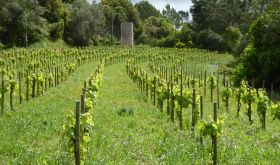
34-year-old Sebastián has worked for the family business since 2004 and has set in train a determined move uphill into the Andes where the climate is cooler and Argentina’s finest wines are now grown. The Zuccardis have a total of 280 ha in the Uco Valley at up to 1,400 m on several sites. The one in Altamira they call Piedra Infinita because the stones they had to clear to make way for the vines filled a thousand truckloads. And still the vineyard is dotted with giant cairns of stones the size of suitcases. As the afternoon breeze rustles the poplars that line the vineyard, the sun beat down on vines that were ripening two weeks earlier than usual. Sebastián’s vineyard scientist, Martin Di Stefano, explained earnestly that they had changed the traditional north-south row orientation to 21 degrees north-west so as to protect the fruit from sunburn at midday.
Chile’s terroir specialist Pedro Parra has been a consultant here since 2009, as was evident from the soil pits dotting the vineyard. Sebastián and his Tuscan oenologist consultant, Alberto Antonini, have instigated high-tech soil mapping of all the vineyards so that they are criss-crossed with coloured tape to denote the polygons of vines of similar character that are all picked and vinified separately.
But the real investment needed to realise Sebastián’s vision for fresher, lighter Argentine wines is being lavished on an ambitious winery on the Piedra Infinita site. Somehow or other the young winemaker Laura Principiano and Sebastián managed to vinify the 2014 crop here, even though the building was far from ready and prepared to receive even the 2015 harvest. This is Argentina’s first winery to ferment all wines in fashionable concrete rather than wood or stainless steel. Presumably in a country ravaged by inflation, this saves considerably on import costs, and the proud boast that all materials are local should be seen in this context. But Sebastián has gone out on a limb to minimise the imprint of oak in his wines, and maximise their provenance. The aim is to make vineyard-specific Malbecs (the word Malbec does not even appear on the label of these Aluvional wines), a relatively new but growing phenomenon in Argentina, to make the most of the variations in the alluvial soils here. They may be less pronounced than in Chile but are still considerable.

On an upended barrel surrounded by workmen, I tasted their range of high-altitude wines and it is light years from what has been the rich, oaky Argentine Malbec norm. I had had a foretaste of the style last September when Sebastián, Antonini and Parra had come to London to show them off.
Because the wines are so different, I asked how they had been received in Argentina. ‘We don't care. We want not to follow the market but to explain them to the market’, said Antonini before correcting himself, perhaps conscious that his client was listening. ‘The response has been much, much better than expected, even though they have all be used to drinking Schwarzenegger wines’, he added. ‘Everyone who started something new seemed crazy at first. Let’s talk again in 25 years.’
Sebastián was more circumspect: ‘the market is smart and if you give them something new, they understand’. He is certainly one of the most admired of the new breed of wine producers who are shaking up the Argentine wine scene – perhaps slightly more gently than their Chilean counterparts but there are definite tremors in the air. Sebastián, for example, is even making, with Francisco Bugallo, a natural wine in San Juan from the once-reviled Criolla Chica, the same grape variety as the humble País that is making such a comeback over the Andes.
As for his father, who is presumably signing the cheques, José beams with pride. ‘It’s the new generation. We must let them take charge.’
SUPERIOR ARGENTINE MALBECS
$7-$13 RRP
Catena Zapata, Alamos 2014 Mendoza
Finca El Origen, Reserva 2014 Tunuyan
$13-$20 RRP
Callia, Magna 2013 Pedernal
Catena Zapata, Alamos Selección 2013 Mendoza
Los Toneles, Tonel 2 2013 Mendoza
Margot, Maula Oak 2013 Mendoza
Domino del Plata, Crios 2013 Mendoza
Quara, Reserva 2012 Cafayate
Vid y Vinos, Vida y Alma 2013 Uco Valley
$20-$30 RRP
Escorihuela Gascón, 1884 Limited Production 2012 Mendoza
Mendoza Vineyards, Gran Reserva 2012 Mendoza
Vicentin, Robusto 2012 Mendoza and Gen 2012 San Carlos
$30+ RRP
Alto Los Hormigas, Reserve 2012 Uco Valley and Appellation 2012 Gualtallary
Cavas del 23, Beviam Reserva 2013 Mendoza
Chakana Estate Selection 2013 Paraje Altamira
Doña Paula, Seleccion de Bodega 2010 Mendoza
Las Moras, Finca Pedernal 2010 Pedernal Valley
Norton, Lote 2010 Lunlunta
Matías Riccitelli, Vineyard Selection 2013 Mendoza
Zuccardi, Aluvional 2012 Vista Flores and Paraje Altamira