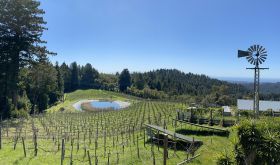
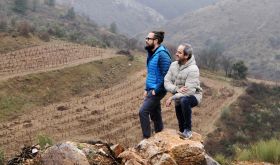
The Catalans take conservation seriously. To the extent of removing an entire Club Med holiday village in order to restore the north-eastern tip of the region to its natural, geologically unique state. Knocking down 430 buildings that, admittedly, looked as integrated with the landscape as a caravan site is surely taking rewilding to an entirely new level.
It was inspired by the declaration in 1998 of Cap de Creus, the rocky outcrop in the hinterland of the seaside town of Cadaqués and the famous elBulli restaurant, as a natural park. By 2010 the Club Med had been excised from the landscape and today the extraordinary rock formations of Tudela, site of the Club Med, and Cap de Creus’s ancient history with its own particular land, sea and air ecosystem are once more as Nature intended.
On the August Saturday morning I visited Cap de Creus, the carefully landscaped trails were dotted with shiny lycra as runners and cyclists made their determined way up them. My host was the energetic Anna Espelt, who runs her family’s Espelt wine operation, the one with the most vineyards, 172 ha (425 acres), in the local appellation, Empordà – although the vast Perelada operation sells more wine.
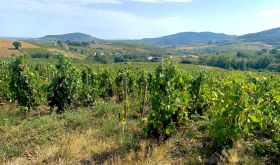
Espelt’s tourist-friendly modern winery in Vilajuïga is based quite a way inland and draws on vineyards in several different locations, but you feel Anna Espelt’s heart is most moved by those she was encouraged to create in Cap de Creus within sight of the sea. ‘I feel very good in this place’, she smiled as she took in the panorama from deep blue Mediterranean to the tourist resort of Roses in the distance, a Bronze Age menhir, unearthed by her father, at the foot of her vineyards.
Before the phylloxera louse, fatal to vine roots, arrived here – the first case in Catalunya was identified in 1879 in Rabós where Espelt have some vines today – this was wine country. By the turn of the century a wine region with about 10,000 hectares (25,000 acres) of vines had been almost wiped out. Today, evidence of the 30,000 km (18,640 miles) of once painstakingly built stone terraces for vines can be seen on many a hillside of this only recently revived denomination that currently has just 1,821 hectares (4,500 acres) of vines in production.
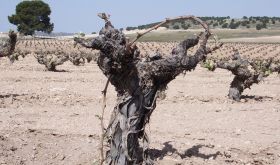
It was partly to honour Cap de Creus’s viticultural legacy that Espelt planted vineyards there. The vine trunks were so spindly I thought they were only a handful of years old but they bear witness to how tough conditions are here for vines. The chilly tramuntana whistles through the mountains from the north, and the vines are buffeted by winds off the sea too. The park’s guardians are keen to encourage biodiversity and see vines as more fire-resilient than many other plants in a landscape that is tinder-dry in a ‘normal’ summer, let alone 2021, which has so far seen just 153 mm (6.02 in) of rain, Espelt told me.
The precision of that number is testament to both the pain imposed by the drought and her scientific training. She was meant to be a biologist but the opportunity to carry on her grandfather’s wine-producing legacy lured her back in 2000 from California, where she had been a mere cellar hand. She was very much thrown in at the deep end. Nineteen years ago they planted 25 hectares (62 acres) of vines on Cap de Creus, partly to encourage others. She describes her decision to trellis the vines on wires, rather than plant them as possibly more resilient and less thirsty standalone bush vines, as her first mistake, but the single-vineyard varietal wines they have yielded since 2017 are pretty impressive nevertheless.

She organised a tasting of them, with her winemaker Xavi Martínez, Nick and our very own Ferran Centelles, in one of the most atmospheric locations for a tasting I have ever encountered, at the end of an avenue of trees at the base of her vineyard, next to the ruined farmhouse below, where she says she wants to end her days ‘making soup’.
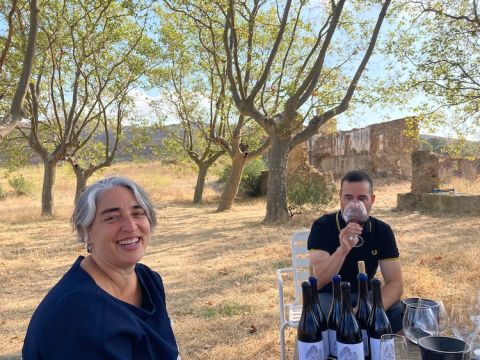
She has named these newish single-vineyard wines after places on Cap de Creus that have a special meaning for her. The white, made from Picapolla, as they call tangy Clairette grapes here, is called Pla de Tudela, after the beach where she particularly likes to swim, post Club Med. ‘I always have a towel in my car’, she told me, though admitted she rarely gets to use it. The red is made from Garnacha, a grape called Lledoner (sometimes spelt Lladoner) Negre here, and seems to be being slimmed down and freshened up with each successive vintage. It’s called Cala Rostella after a pine-covered outcrop overlooking elBulli.
These special bottlings are offered at the same price and I wondered whether the Spanish market was ready to pay a relatively high price for a white wine and was assured that the white sells out faster than the red, although it is admittedly made in smaller quantities. According to Espelt, ‘for many years we thought Empordà was a red-wine area but now we learn we should focus on whites too – especially from the local varieties Lledoner Blanc (Grenache Blanc), Lledoner Roig (Grenache Gris) and Carinyena Blanca (Carignan Blanc)’.
Anna Espelt covertly converted the family’s vineyards to organic viticulture and says she waited to break the news to her father, an agrochemical merchant, until after a bibulous Sunday lunch.
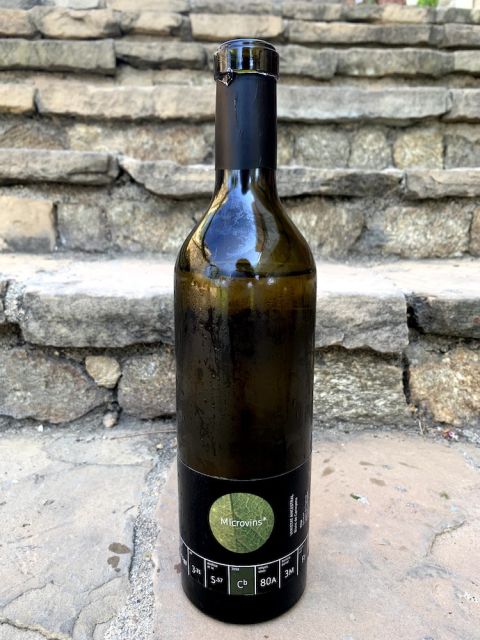
Espelt pioneered the local renaissance of Grenache Gris, which can make arguably more interesting, more perfumed wines than the more common pale-skinned Grenache Blanc. I had previously been rather unimpressed by such Carignan Blancs as I had tasted over the Pyrenees in France, and one or two of the Empordà versions confirmed this. But La Vinyeta’s Microvins 2019, aged for 14 months in old French oak barrels and tasted at their stylish winery, won me over. It was dense, vibrant and had rather impressive grip, but both Josep Serra, co-founder of La Vinyeta, below in Rumble in the Jungle T-shirt with his cheeses, and Anna Espelt admitted that the grape doesn’t have that much actual flavour. Perhaps it will end up as a useful blending ingredient rather than as a varietal wine.

La Vinyeta, set up by Josep and Marta Serra only in 2002, is another particularly interesting operation, very much informed by the fact that Josep’s brother is a designer in Barcelona. Microvins labels (below) are lessons in providing useful, geeky information in a clever, attractive way – and the La Vinyeta team have really shown the locals how to attract visitors, with their outdoor cafe, their sheep and their own cheeses and olive oil. La Vinyeta looks as though it belongs in California.
Empordà is very definitely on the move. It is well past its flirtation with international vine varieties and is now concentrating on the two most-planted varieties, both local, Lledoner Negre and Carinyena Negre, or Grenache and Carignan, the same varieties as dominate the wine region that achieves Catalunya’s highest prices, Priorat. Empordà is perhaps too small to be similarly appreciated, even though the average age of these Empordà vines, and their pale-skinned mutations, is impressively high. In a tasting of 73 Empordà wines recently I was also delighted to see that some of the best wines included single-vineyard bottlings by one of the handful of co-ops – a welcome change from throwing everything into the same vat.
Some of the best wines of all – for in terms of geology and climate Empordà is really just a mirror image of Roussillon, home of Banyuls, on the other side of the Pyrenees – are the strong, sweet ones, made in a wide range of ways and some of them completely stunning. But I won’t waste space saying any more about them since I know how frustratingly little attention is given to such wonders at the moment. I do hope their day will come. Together with their dry counterparts.
Exciting Empordà wines
I gave all these wines at least 17 points out of 20 and am very sad to see how few of them make it to the UK and hardly any to the US, though European Cellars import Espelt wines.
White
Clos d’Agon, Clos d’Agon 2018 13.5%
Espelt, Pla de Tudela 2018 12.5%
€36.90 RRP in Spain, $75 RRP imported by European Cellars
Red
Perelada, Aires de Garbet 2017 14.5%
€40 RRP in Spain
Perelada, Finca La Garriga Samsó 2016 13.5%
Espelt, Cala Rostella 2018 and 2017 14.8%
€36.90 RRP in Spain
Masia Serra, Aroa 2018 13.5%
€26 RRP in Spain
Roig Parals, Camí de Cormes Vinyes Centenàries Carinyena 2018 14.5%
€26 RRP in Spain; £60 (2007) Seckford per case of 6 in bond, £70 (2007) Fine + Rare per case of 6 duty paid
La Vinyeta, Microvins Carinyena Negra Bota 2018 15%
Sweet
Vinyes dels Aspres, Bac de les Ginesteres NV 15%
£36.50 Albion Wine Shippers
Tasting notes on all these Empordà wines and many more on Purple Pages of JancisRobinson.com and such international stockists as there are on Wine-Searcher.com