
Alberto Paltrinieri (below) was one of the few winemakers who crossed the Channel for the ‘Lambrusco goes large in London’ tasting late last year. As a consequence, he had to face my barrage of questions about Lambrusco – the wine and the grape varieties (explained fully in the article based on that tasting). The least I could do in return was to highlight just one of his very good Lambrusco wines. But that’s not why I am writing about his Solco bottling. (Solco, incidentally, means ‘furrow’, a reference to the deep connection between the land and the wine.)

I’ve chosen this wine because it epitomises the pure pleasure principle. It’s neither complicated nor too serious, it’s not expensive, it’s not bone dry, it’s not tricky to match with food and it’s nothing like the sweet, sometimes sickly, grapey Lambruscos of yore.
It’s sparking in every way: bright violet-crimson in colour, carefully made, replete with scrumptious red and dark fruit, ever-so-slightly floral, refreshing, full of life, relaxed at the table or on its own and utterly life-affirming. And it has only 11% alcohol. A perfect way to start the new year.
Paltrinieri told me, ‘Solco is a wine we designed to be approachable and joyful – a modern interpretation of Lambrusco that stays true to its roots while appealing to a global audience. It’s a crowd-pleaser that pairs beautifully with a variety of dishes, from charcuterie to more contemporary fare.’ Job done.
Winemaker Alberto and his wife Barbara are at the heart of this hands-on family business, founded by his grandfather in 1926. According to his daughter Cecilia, who is in charge of hospitality, the front office and social media, her father oversees the vineyards and production, and her mother is in charge of all things administrative. And, she added, ‘We also have a fantastic team supporting us, making it all possible.’
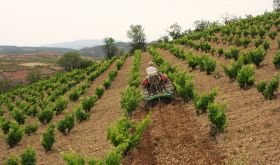
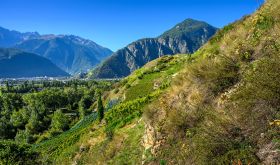
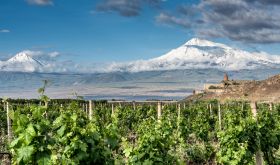
Their winery and 17 ha (42 acres) of vineyards – relatively small scale for Emilia-Romagna – are in Cristo di Sorbara, in the heart of the Sorbara area, after which the local variety Lambrusco di Sorbara is named. Unlike all the other wines in their portfolio, which are 100% Sorbara, this wine is made from Lambrusco di Salamino, a variety often planted alongside the Lambrusco di Sorbara vines for the purposes of pollination because the latter has female-only flowers. On the spectrum of Lambrusco Somethings, Salamino falls between the light-bodied and elegant Sorbara and the more tannic and fuller-bodied Grasparossa.
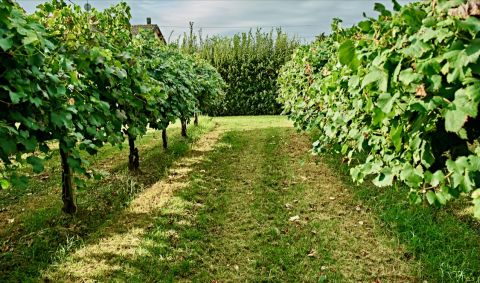
The soils in this area are, says Paltrinieri, ‘predominantly sandy, with some alluvial deposits, which contribute to the wine's freshness and elegance. They allow good drainage, keeping the vines healthy and promoting vibrant acidity in the grapes.’
The first fermentation, which lasts around 20–30 days, takes place at a cool 16–18 °C (61–64 °F) in stainless-steel tanks using cultured neutral yeast in order to highlight the vibrant fruit flavours and freshness.
The second fermentation is done in a pressurised tank known as an autoclave (partly shown below). This is the method most common in the region and is said by many to allow the most vibrant expression of the fruit and aromas. Generally referred to as the Charmat method (in contrast to the so-called traditional method, in which the second fermentation takes place in the bottle), our Italian editor Walter Speller would not be happy if I did not use the Italian name: the Martinotti method. As Walter explained when we were updating The Oxford Companion to Wine, the method ‘was invented by the Italian Federico Martinotti a decade before it was improved and patented by Frenchman Eugène Charmat in the early years of the 20th century, even though Charmat gets most of the credit.’

This second fermentation lasts 2–3 months and they stop the fermentation when the fizziness and sweetness are at the level they are aiming for. In this case, the wine is frizzante (less fizzy than spumante) and secco (17 g/l residual sugar). The fermentation is stopped by chilling the wine and adding a little bit of SO2 (‘as a safeguard’), as well as filtering it before bottling under pressure.
If the thought of an off-dry wine worries you, don’t let it. The acidity is high enough (6.5 g/l, pH 3.5) to balance that little bit of sweetness, which in itself highlights the fruit – both its aroma and its flavour – and accentuates the pleasure.
Solco is imported into the US, where it seems particularly good value, by Polaner Selections and into the UK by Passione Vino. It is also widely available in Europe.
For more on Lambrusco – appellations, grape varieties, winemaking and wine styles, see Lambrusco goes large in London and Tam's earlier article Lambrusco – not fizzling out.